The Connoisseur's Circuit: Xi'an for Culture Lovers
Three days for travelers who came for the art and the history, not the checklist. This route skips the Terracotta Army entirely — not because it isn't extraordinary, but because you've either seen it or you're saving it — and goes deep on everything else. Day 1 is the Tang layer: the Shaanxi History Museum at opening (reserve your free slot the moment it releases, about five days out), the oldest Buddhist temple in the city, and the Big Wild Goose Pagoda flowing into the Ever-Bright City after dark. Day 2 is ink and stone: three unhurried hours in the Forest of Steles, the scholars' lane outside its gate, the Small Wild Goose Pagoda, and a sunset ride on the city wall. Day 3 goes deeper in time — a 6,000-year-old village at Banpo — then ends where Xi'an's history is still alive: the Great Mosque and a slow evening under the wall.
Two logistics to lock in early: the Shaanxi History Museum reservation (free, real-name, competitive) and your weekdays — Shaanxi History and the Steles close Mondays, the Small Wild Goose Pagoda closes Tuesdays, so if a day lands wrong, swap days 1 and 2.
Budget: roughly ¥600–1,000 per person (about US$85–140 / €78–130) excluding hotels — admissions (¥250 or so unless you spring for the ¥270 murals hall), food and local transport. Seasons: spring and autumn suit the wall ride and the long outdoor stretches; summer just means earlier starts, and most of Day 2 is indoors anyway.
Day 1
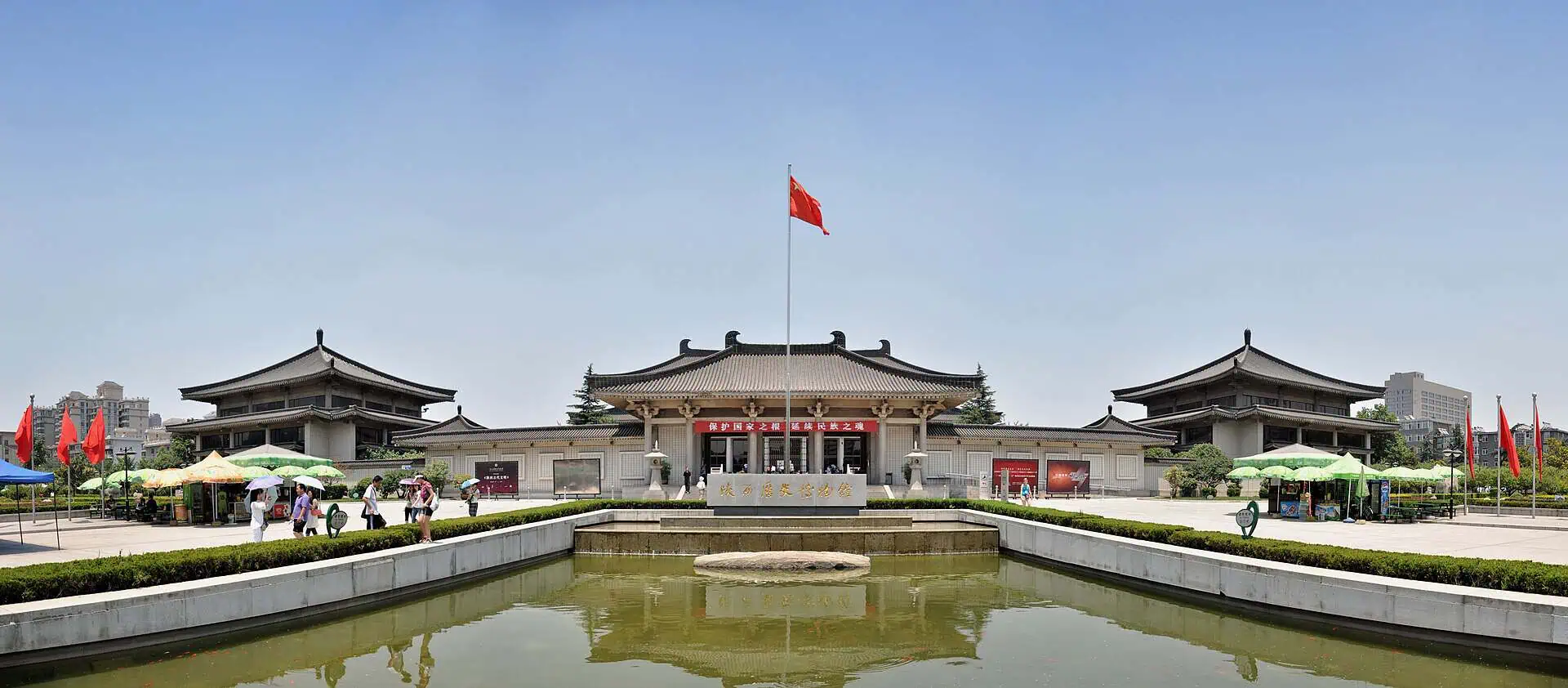
Be at the door when it opens. Shaanxi History Museum (陕西历史博物馆, Shǎnxī Lìshǐ Bówùguǎn) is the single best museum in northwest China, and the basic exhibition is free — but only with a real-name timed reservation, and slots release about five days ahead and vanish. Book the earliest slot of the day and you get the Zhou bronzes and Tang gold before the halls thicken. Connoisseurs should budget for the Tang murals hall (¥270, bought inside): expensive, uncrowded, and the finest painting in the building. Closed Mondays — swap with Day 2 if needed.
Walk 10 minutes south to Daxingshan Temple, via lunch on the way.
- 11:45–12:45Lunch around Xiaozhai
The Xiaozhai (小寨, Xiǎozhài) crossroads is student territory, which means cheap, fast and good. Any busy counter works — a bowl of biangbiang noodles (biángbiáng面) or a roujiamo (肉夹馍) with liangpi lands around ¥25–35. Don't linger; the temple waits.
Daxingshan Temple is a 10-minute walk from the Xiaozhai crossroads.
Daxingshan Temple (大兴善寺, Dàxīngshàn Sì) is free, one of the oldest Buddhist temples in Xi'an, and where the monk Amoghavajra translated Tantric sutras in the 8th century — Japanese Shingon Buddhism traces its lineage to this courtyard. It stays a working temple: incense, chanting, pigeons fat on offerings. An hour covers it, and after the museum's crowds the calm is the point.
One metro stop (Line 2/3 at Xiaozhai to Dayanta) or a 25-minute walk east to the Big Wild Goose Pagoda.
The Big Wild Goose Pagoda (大雁塔, Dàyàntǎ) stands in the Da Ci'en Temple (大慈恩寺, Dà Cí'ēn Sì), built for the monk Xuanzang (玄奘, Xuánzàng) to house the sutras he carried back from India in 652 — the real journey behind Journey to the West. Temple entry is ¥10, the pagoda climb ¥25 extra and worth it for the view down the axis. Buy tickets at the south-side entrance by the Xuanzang statue, not at the fountain square. Read the temple slowly; tonight ends late.
Stay put — early dinner nearby, then walk south into the Ever-Bright City as the lights come on.
Grand Tang Dynasty Ever-Bright City (大唐不夜城, Dàtáng Bùyèchéng) is a free, roughly 2 km pedestrian boulevard of Tang-style facades, light shows and street performers that runs south from the pagoda. It's kitsch in daylight and genuinely spectacular after dark — shows run about 19:00–22:30, so time it accordingly. Weeknights beat weekends by a wide margin. Dayanta station (Lines 3 and 4) takes you home.
Day 2
Give the Forest of Steles (西安碑林博物馆, Xī'ān Bēilín Bówùguǎn) the full three hours — it earns them. A thousand years of stone-engraved calligraphy, including the Kaicheng Stone Classics and rubbings of every master whose handwriting Chinese schoolchildren still copy. Even if you can't read a character, the stone library rooms and the carved Han animals in the sculpture gallery carry the weight. ¥65, closed Mondays, last entry 17:00; the ¥120 combo ticket with the City Wall saves money on today's plan.
Shuyuanmen lane begins at the museum's front gate — walk straight in.
- 12:00–13:00Lunch near the South Gate
Eat around the lane or just inside the South Gate: a simple noodle or paomo lunch runs ¥25–40. The point is to stay close — the afternoon never strays more than a few minutes from here.
Back into Shuyuanmen on foot.
Shuyuanmen (书院门, Shūyuànmén) is the scholars' lane: brush shops, seal carvers, inkstone sellers and calligraphy paper stacked to the ceiling, running west from the Steles toward the South Gate. Some of it is tourist stock, but the back rooms hold the real trade — watch a seal being carved to order (from ¥30 or so) even if you don't buy. Shops shutter by early evening, so browse now, not later.
A 10-minute taxi or 25-minute walk west along the wall to the Small Wild Goose Pagoda.
The Small Wild Goose Pagoda (小雁塔, Xiǎoyàntǎ) is the big pagoda's quieter, more elegant sibling — a 8th-century brick tower that survived the 1556 earthquake (the crack and re-knitting are part of the legend) in the grounds of Jianfu Temple. The park and the excellent Xi'an Museum (西安博物院) are free with a timed reservation; closed Tuesdays. The museum is compact and beautifully lit — a palate cleanser after the morning's intensity.
Taxi 10 minutes to the South Gate (永宁门) — you're aiming for the wall at golden hour.
Finish the day on the City Wall (西安城墙, Xī'ān Chéngqiáng) at sunset. Enter at the South Gate, rent a bike on top (¥45 single, ~¥90 tandem) and ride west as the light drops — even half an hour each way gets you the roofline views and the evening haze over the old town. South Gate stays open to 22:00, but rental desks stop hiring around 20:00, so don't push the start too late. If you bought the Steles combo this morning, this entry is already paid.
Yongningmen station (Line 2) is directly below the gate.
Day 3
Metro Line 1 to Banpo (半坡), exit A — the Banpo Museum (西安半坡博物馆, Xī'ān Bànpō Bówùguǎn) is a 6,000-year-old Neolithic village preserved under one roof: house foundations, the defensive moat, pottery kilns, and the famous fish-face painted basins. ¥55 (¥45 in winter). One honest caveat: this is a 1950s institution, the exhibition halls are old-school and English labeling is thin — read up beforehand or bring a translation app, and the site hall will still get you.
Walk 10 minutes north to the Banpo art zone.
The Banpo International Art Zone (半坡国际艺术区, Bànpō Guójì Yìshùqū) occupies a converted textile mill up the road — studios, small galleries and cafés in brick factory sheds, free to wander. Set expectations honestly: many studios shut on weekdays, so think of it as an atmospheric industrial walk with the occasional open gallery rather than a guaranteed art fix. Weekends are livelier.
Metro Line 1 back west to Beidajie, change to Line 2 to Zhonglou, then walk 10 minutes into the quarter — about 50 minutes all told.
- 13:00–14:00Late lunch in the Muslim Quarter lanes
You're coming into the quarter hungry — use the side lanes (Dapiyuan and friends), not the main strip, and let the crowds point you to a counter. ¥30–45 for a proper feed. The street-by-street eats guide has the hit list.
The Great Mosque is a few minutes' walk through the lanes.
The Great Mosque (化觉巷清真大寺, Huàjuéxiàng Qīngzhēndàsì) is the connoisseur's pick of the quarter: a 14th-century mosque laid out as a series of Chinese garden courtyards, with phoenix-tailed roofs over the prayer hall and Arabic steles beside stone tortoises. ¥25 (¥15 in winter). It remains an active mosque — the prayer hall is closed to non-worshippers, dress modestly, and avoid Friday midday when access tightens around prayers. The blend of Ming garden and Islamic function is unlike anything else in China.
Wander back out through the lanes and drift south toward the wall.
Close the trip the way the city does: along Shuncheng Lane (顺城巷, Shùnchéng Xiàng) at the wall's foot. By early evening the teahouses and small bars under the ramparts are filling up — pick one, order tea or a beer, and watch the wall light up above you. If you'd rather shop, Shuyuanmen's lane is a short walk east, though most stores close by dusk. Either way, dinner is wherever you stopped walking.