The Shaanxi Dialect of Xi'an
The speech you hear around Xi'an is the Guanzhong dialect — a branch of Central Plains Mandarin, not a dialect of standard Mandarin, and not fully mutually intelligible with it. Locals take genuine pride in its Tang-dynasty capital pedigree, though linguistically it's a cousin of Tang court speech rather than a fossil of it. For travelers it's flavor, not a tool: everyone you'll deal with speaks standard Mandarin.
6 min read · 5 sections
The short version
- Xi'an's local speech is Guanzhong dialect — a branch of Central Plains Mandarin, not standard Mandarin with an accent.
- The Tang-heritage pride is real (old words, the right geography), but "Tang poetry rhymes here" is stronger for southern dialects like Cantonese and Min.
- Learn one word: 嫽咋咧 (liáo zǎ lie) — "excellent" — and you'll delight any snack-stall owner.
- You'll hear it from older residents, at markets, and in Qinqiang opera — not from your waiter.
- Standard Mandarin (Putonghua) is what tourists actually use; the dialect is texture, not a communication tool.
What the Shaanxi dialect actually is
Shaanxi province splits into three broad speech zones: Guanzhong (the central Wei-river plain around Xi'an), Shaanbei (the loess north, influenced by Jin dialects), and Shaannan (the south, closer to Southwestern Mandarin). When someone in Xi'an says „the Shaanxi dialect,” they almost always mean Guanzhong dialect (关中话) — the speech of the capital and its plain.
Linguistically, Guanzhong is classed as Central Plains Mandarin (中原官话, Zhōngyuán Guānhuà). That makes it a sibling branch to the Beijing-based Mandarin that standard Mandarin (Putonghua) is built on — not a daughter of standard Mandarin, and not fully mutually intelligible with it. A fluent Mandarin speaker from Beijing can catch the gist of slow dialect, but two locals talking fast will be largely opaque to a Putonghua-only ear. Think of it as related to Mandarin the way Catalan is related to Spanish: same wider family, its own system.
The Tang connection (with an honest caveat)
Xi'an was Chang'an, the Tang dynasty capital (618–907), and local pride holds that Guanzhong speech carries the echo of the court and marketplace where Li Bai and Du Fu once walked. There is real substance to this. The dialect preserves older vocabulary — for example 嫽 (liáo, „good/fine”) traces back to the Shijing (Book of Songs), predating the Tang by a thousand years — and the cadence of regional opera is built on this speech.
But treat the line that „Tang poetry rhymes perfectly in the Shaanxi dialect” as local pride, not settled linguistics. Tang court speech was Late Middle Chinese, reconstructed by scholars from rhyme dictionaries like the Qieyun and Guangyun — and no modern dialect reproduces it. The stronger reputation for preserving Tang rhymes actually belongs to southern dialects (Cantonese, Min, Hakka), because they kept the entering tone (入声) — the short, stop-ended syllables of Middle Chinese — that northwestern Mandarin, including Guanzhong, has largely lost. The honest version: a genuine Tang pedigree, real old words, geographic rightness — but a cousin of Tang speech, not a living fossil of it.
Words and phrases you might overhear
A short phrasebook for recognition, not conversation. You will hear these far more often than you will need to say them.
- 嫽咋咧 / 嫽扎咧 (liáo zǎ lie) — „Excellent / really great.” The signature Xi'an thumbs-up. You will hear it at a food stall when someone's roujiamo hits the spot. The single most useful — and charming — word to learn.
- 克里马擦 (kè lǐ mǎ cā) — „Hurry up! / Quick!” Often shortened to 克马 (kè mǎ). Linguists trace it to a Turkic or Persian loanword that traveled the Silk Road into Tang Chang'an — a living echo of the city's cosmopolitan heyday. Read more on that exchange in our Silk Road history.
- 么嘛达 (me ma dà) — „No problem / all good.”
- 咋 (zà) — „What's up? / What happened?” A standalone exclamation, often drawn out.
- 毕咧 (bi lie) — „It's over / done for.” Comic, slightly fatalistic — the sound of a plan gone sideways.
- 碎碎的事 (suì suì de shì) — „A small matter / no big deal.”
None of these appear in a standard Mandarin phrasebook. That is the point.
Where you will actually hear it
The dialect is strongest in everyday, unselfconscious settings:
- Older residents chatting in the lane neighborhoods (胡同) inside the City Wall and in city parks — chess games, morning exercise, market banter.
- Wet markets and morning markets, where vendors and regulars trade in the local tongue.
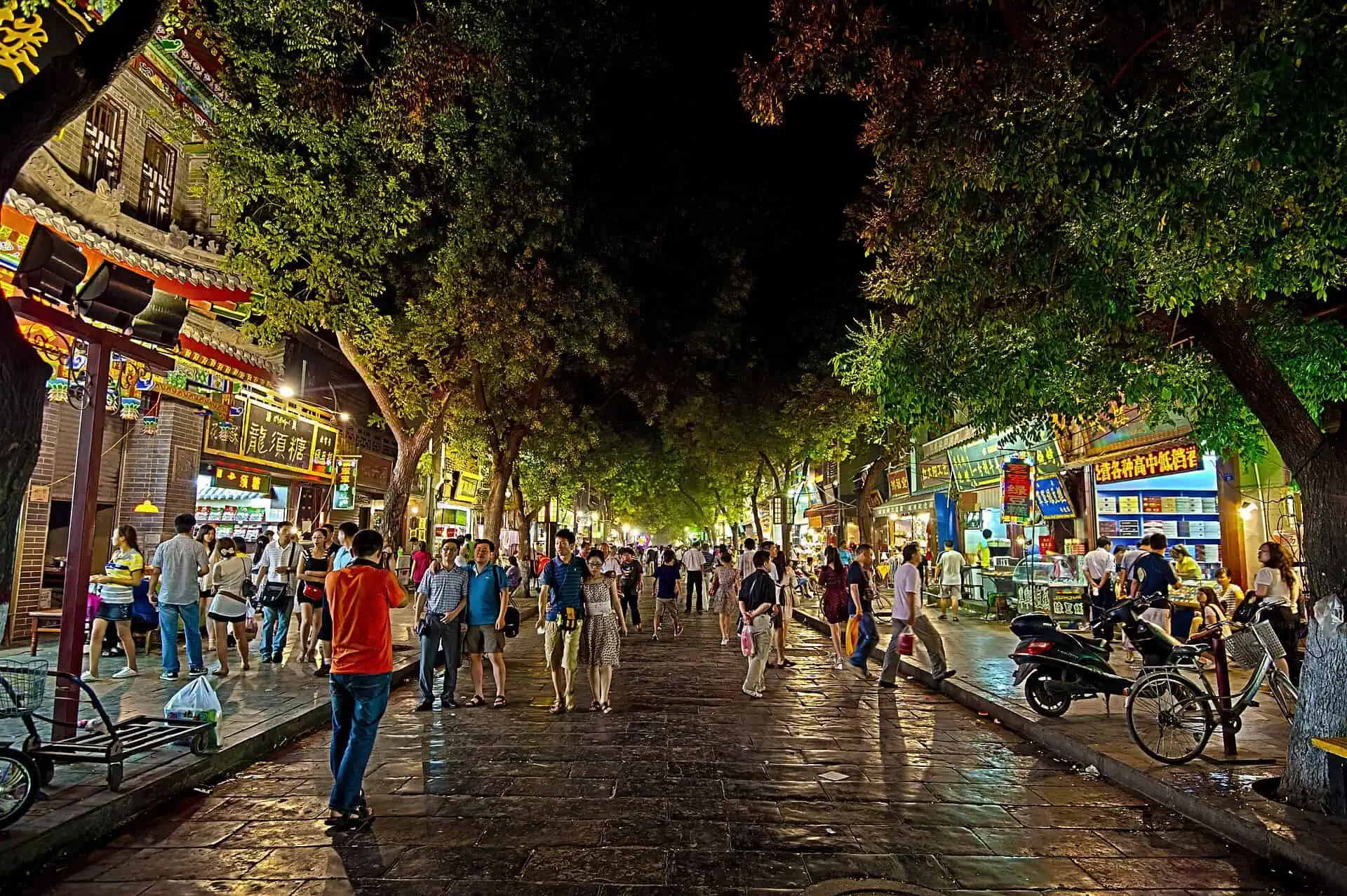
- Snack stalls — a back-lane roujiamo shop or a busy counter in the Muslim Quarter. The moment the vendor clocks you as a foreigner, the transaction flips to Putonghua (or gestures).
- Qinqiang (秦腔) — the raucous, throaty regional opera of Shaanxi, sung in Guanzhong dialect and one of China's oldest living opera forms. Catching a performance, often free or cheap at a local theater or an informal park gathering, is the purest hit of the language you can get.
Among residents under roughly 35, standard Mandarin is now the default; many understand the dialect passively but answer in Putonghua.
The honest note for travelers
You do not need a word of Shaanxi dialect. Everyone in tourism, hospitality, transport, and retail speaks standard Mandarin, and the younger the person, the more reliably so. English coverage at major sights is thinner but workable.
The dialect is not a communication tool for you — it is texture. Learn 嫽咋咧 if you want a grin from a noodle-stall owner; otherwise your Mandarin phrasebook and a translation app (Pleco, or Google Translate with the offline Chinese pack downloaded, since mainland China's network blocks live Google) are what you will actually reach for.
Treat the speech around you as ambient culture: a sound that tells you you are in a specific place with a long memory, not a barrier between you and your next bowl of biangbiang noodles.
Questions, answered
Do I need to speak the Shaanxi dialect to visit Xi'an?
No. Standard Mandarin (Putonghua) is universal in hotels, taxis, restaurants, shops, and at every major sight, and younger locals default to it. The dialect is ambient culture, not a travel necessity.
Is the Shaanxi dialect just accented Mandarin?
No. It is classified as Central Plains Mandarin (Zhongyuan Guanhua), a sibling branch to the Beijing-based Mandarin that standard Mandarin is built on. A Mandarin speaker can catch fragments, but natural rapid dialect between two locals is largely opaque to a Putonghua-only ear.
Did people in Xi'an really speak like this in the Tang dynasty?
Partly, with a caveat. Tang-era Chang'an was the capital, so the local pride is real, and the dialect does preserve some old vocabulary. But Tang court speech was Late Middle Chinese, which no modern dialect reproduces. The strongest rhyme-preservation reputation actually belongs to southern dialects like Cantonese and Min, which kept phonetic features (notably the entering tone) that northwestern Mandarin lost.
What is one fun word to learn?
嫽咋咧 (liáo zǎ lie) — „excellent / really great.” Drop it after a good bowl of roujiamo or biangbiang noodles and the cook will light up. For „hurry up,” 克里马擦 (kè lǐ mǎ cā) is the iconic one.
Will young people understand the dialect?
Most understand it passively but speak standard Mandarin. The dialect is strongest among older residents and in markets, Qinqiang opera, and casual family settings; people under roughly 35 increasingly run on Putonghua.
Is the Shaanxi dialect written down?
It is spoken, not standardized in writing. When it appears in print, it is spelled ad hoc with roughly-chosen Chinese characters — which is why a phrase like „hurry up” has several spellings (克里马擦 / 可立马遪). Menus and signs that include dialect are usually phonetic approximations.