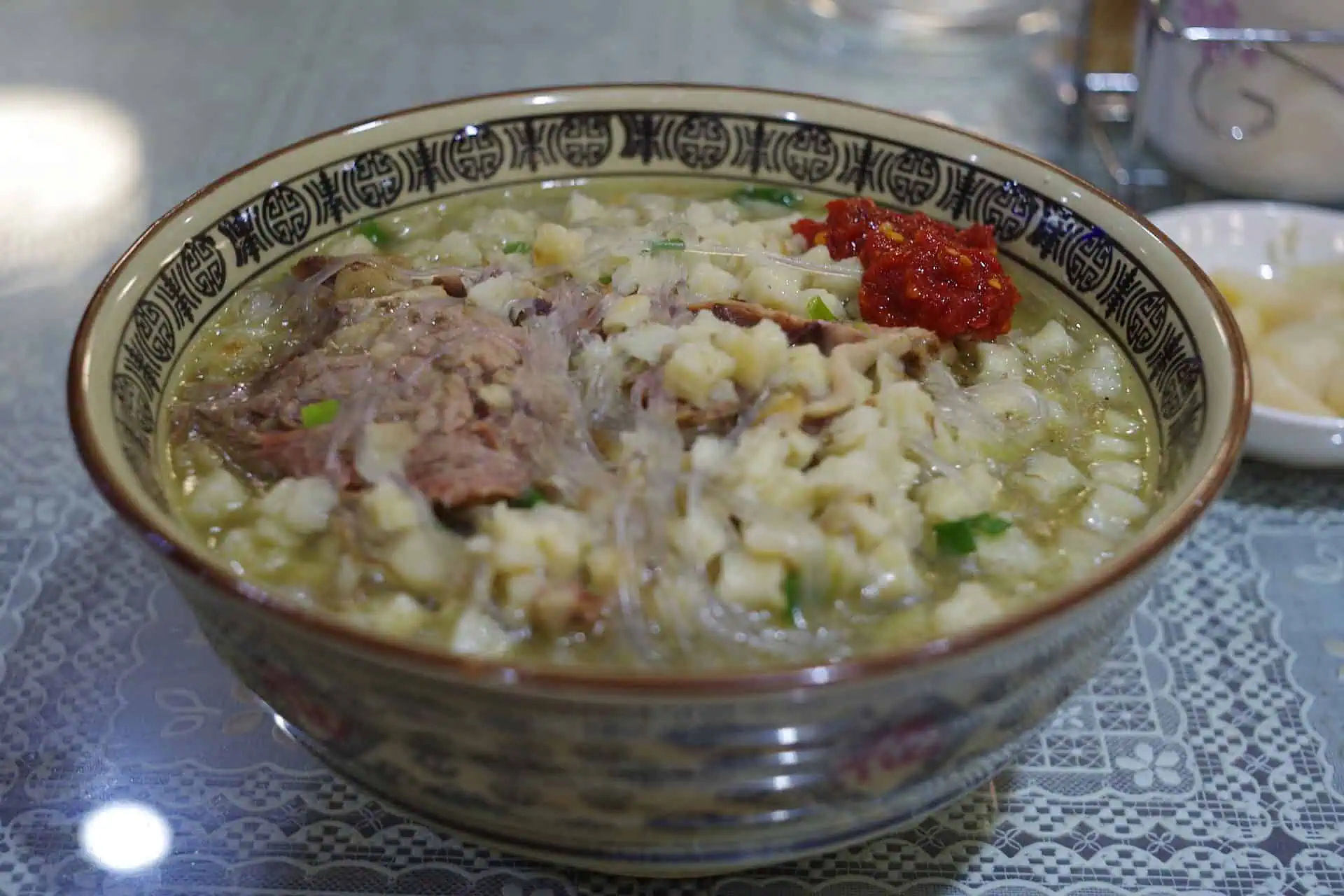
Yangrou Paomo
Yángròu Pàomó · say it: “yahng-roh pow-moh”
- Spice
- Mild
- Typical price
- ¥15–40
- Dietary
- HalalContains gluten
Xi'an's signature dish is a thousand years of Silk Road in a bowl — a lamb-broth ritual the Hui community has performed since merchants ate this way after desert crossings. Yangrou paomo (羊肉泡馍, yángròu pàomó) — "mutton-soaked bread" — begins when the server hands you a bowl and one or two rounds of tuotuo mo (坨坨馍, tuótuó mó), a dense, half-baked wheat flatbread. Your job is to tear it into small pieces. The bowl then goes back to the kitchen, where the cook floods it with a broth that has been simmering since before dawn — mutton bones, mutton and a spice bag — and finishes it with slices of meat, a tangle of glass noodles (粉丝, fěnsī), garlic shoots and chili. It returns with sweet pickled garlic (糖蒜, tángsuàn) and chili paste on the side, and you are expected to eat the garlic: it cuts the richness between bites. Expect to pay about ¥25–40 a bowl at the famous houses, less at neighborhood shops.
This is Hui cooking — the Muslim community that has fed Xi'an for centuries — so the canonical versions are mutton and beef, and the dish is halal by default. (Pork-eaters after the same idea should look for hulutou, the pork-and-intestine cousin.) What makes paomo special isn't any single ingredient; it's the texture conversation between hand-torn bread and broth. Machine-crumbled mo turns to paste; hand-torn pieces keep ragged edges that soak up soup while staying chewy at the core. That is why the tearing is the point, and why old Xi'an men will spend twenty minutes over a bowl before a cook ever sees it.
How to eat it
Tear small — this is the whole game. Aim for thumbnail-sized pieces or smaller; the kitchen can tell a tourist's bowl from a local's at a glance, and old-school shops will quietly judge coarse tearing. Every shop also has a machine that crumbles the mo for you, and nobody will stop you using it — but do it properly by hand at least once. Then tell the kitchen how soupy you want it. The three classic styles:
- Ganpao (干泡, gānpào) — "dry": the bread drinks nearly all the broth. For people who like it dense.
- Koutang (口汤, kǒutāng) — "mouth soup": exactly one sip of broth left when the bread is gone. The connoisseur's default, and a good first order.
- Shuiweicheng (水围城, shuǐwéichéng) — "water surrounds the city": a generous moat of broth. Order this in winter or if you want it soupy.
Say nothing and you get a middle path. Eat from the rim inward instead of stirring the bowl to death — it keeps the heat and the texture — and chase bites with the pickled garlic. A regular bowl (普通, pǔtōng) gets a standard ladle of meat; premium (优质, yōuzhì) roughly doubles it for about ¥10 more. Beef paomo (牛肉泡馍, niúròu pàomó) is milder and usually a few yuan cheaper; mutton is the one Xi'an people argue about.
Plan around it: a bowl is a full meal and a 30–45 minute sit-down, not grab-and-go street food. It works best as lunch before a Bell Tower and Muslim Quarter afternoon — see our Muslim Quarter eats guide for how it fits a crawl, and the halal eating guide for more of the Hui canon. More dishes on our Xi'an food hub.
Where to try it
Lao Sun Jia (老孙家饭庄)
The century-old flagship on Dongguan Zhengjie, just outside the East Gate — a polished dining room whose paomo technique is listed as Shaanxi intangible cultural heritage. The famous, reliable first bowl; several branches around town trade under the same name.
Tong Sheng Xiang (同盛祥)
A Bell Tower-side landmark founded in 1920 and a national intangible-heritage bearer for paomo — the most convenient famous bowl, minutes from the Muslim Quarter. Staff will still walk you through the traditional soup styles if you ask.
Huang Jia Paomo (黄家泡馍馆)
A west-side neighborhood institution on Kunming Road, known locally as a late-night canteen at roughly ¥34 a head. Only makes the list if you're out that way — which is exactly the point: paomo is everyday food, not a tourist set piece.
Muslim Quarter paomo houses
The Quarter's side lanes (Xiyangshi, Dapiyuan) are lined with Hui-run paomo shops. Pick one full of locals tearing mo, and match their piece size.
Read the guide