Hulutou
Húlútóu · say it: “hoo-loh-toh”
- Spice
- Mild
- Typical price
- ¥18–38
- Dietary
- Contains gluten
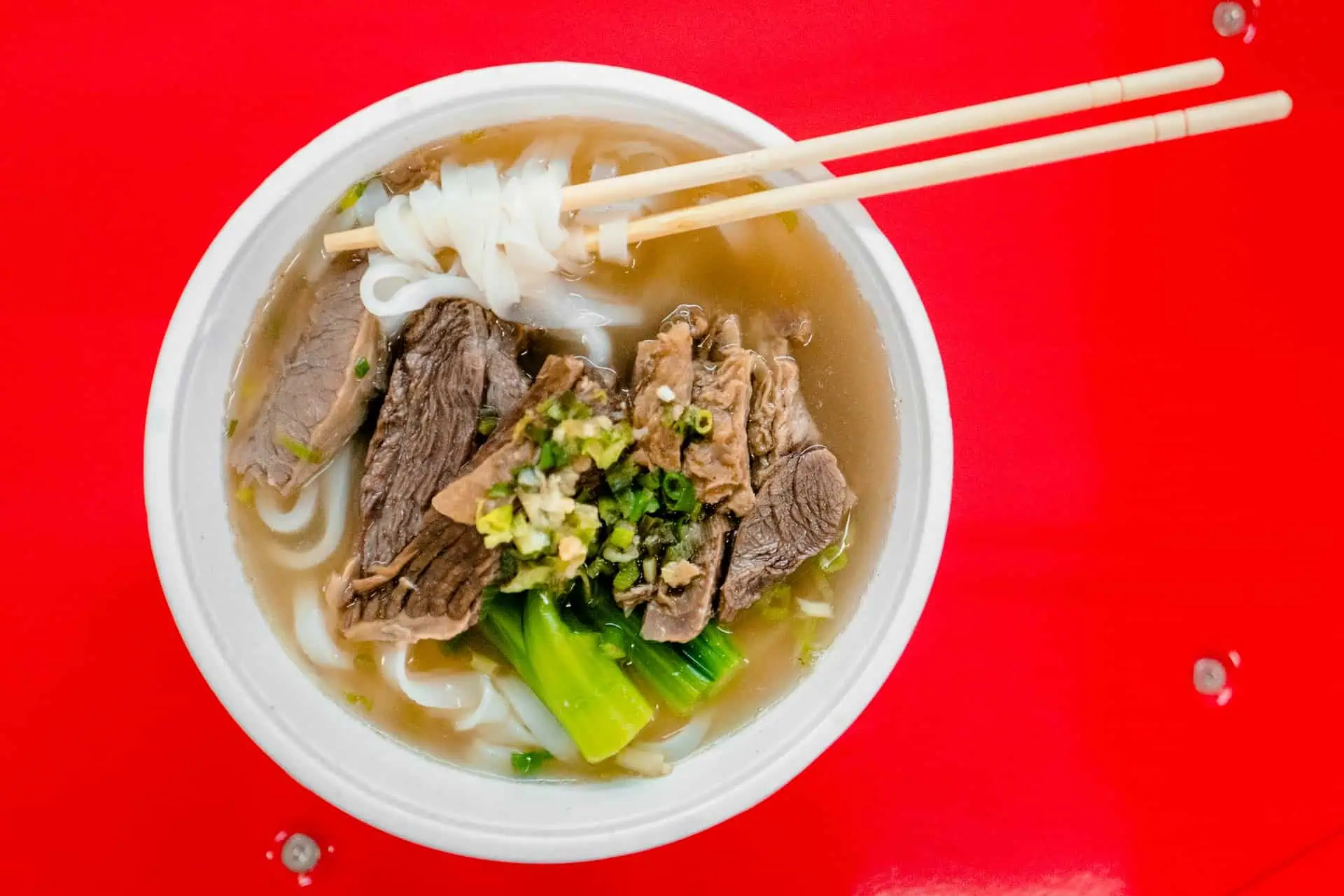
This bowl's origin story starts in the Tang dynasty, with the seventh-century medicine king Sun Simiao and a gourd hung at a street stall. Everyone who visits Xi'an for three days eats yangrou paomo. The people who actually live here quietly queue for its porky sibling. Hulutou (葫芦头, húlútóu) — the name means "gourd head" — is Xi'an's other paomo: the same ritual of hand-torn flatbread drowned in broth, but built on pork large intestine in a soup boiled to milky white. The "gourd" is the shape a length of cleaned intestine curls into as it simmers, though locals prefer the legend: the Tang-dynasty "king of medicine" Sun Simiao (孙思邈, Sūn Sīmiǎo) supposedly taught a Chang'an street vendor how to tame the funk of stewed intestine with spices and left his medicine gourd hanging at the door as a signboard. Whatever the true origin, the bowl has been the Han-Chinese answer to the Muslim Quarter's paomo for well over a century — where yangrou paomo is halal, hulutou is cheerfully, defiantly not. The broth is the point: pork bones and intestine at a rolling boil for hours until the soup turns opaque and sweet, seasoned with white pepper rather than chili, so it eats rich rather than hot. Each serving gets slices of large intestine — clean, springy and faintly sweet at a good house, with no funk at all — and the canonical side order is bangbang rou (梆梆肉, bāngbāng ròu), a cold plate of smoked pork and intestine sliced by the liang. This is the locals'-locals dish of Xi'an: tourists cluster on Beiyuanmen for lamb; taxi drivers, retirees and off-duty chefs come here.
How to eat it
If you've done the paomo ritual, you know the drill: you're handed a bowl and a baked mo (馍, mó), and you tear it yourself into thumbnail-sized pieces — small matters, because every piece needs to drink the broth. The bowl goes back over the counter, the cook blanches your bread in the boiling soup (a step old-timers call mao, 泖, mào), then tops it with sliced intestine, the white broth, garlic sprouts and coriander. Menus offer 普通 (pǔtōng, standard) and 优质 (yōuzhì, premium) — premium just means more intestine and meat, so order it.
Two rules from the regulars. First, add a small plate of bangbang rou — a bowl of hulutou, a plate of the smoked cold cuts and a beer is the canonical Xi'an workingman's dinner. Second, season at the table: the broth arrives deliberately mild, and the pickled sweet garlic (糖蒜, tángsuàn) and chili paste sitting on every table are part of the design, not decoration. The classic houses cluster on the south side of the old city, inside and just outside the City Wall — an easy walk south from the Bell Tower, and a fixture on any honest local-eats list.
Where to try it
Chun Fa Sheng (春发生)
The famous house, founded in 1920 on Nanyuanmen (南院门, Nányuànmén), the lane running south from the [Bell Tower](/en/attractions/bell-tower) toward Fenxiang. A 1920s gourmand named it after Du Fu's line „good rain knows its season — it comes when spring begins.” Prices sit at the top of the ¥18–38 range; the bowl is the benchmark.
Tianfaya He Ji (天发芽何记葫芦头)
The Small South Gate (小南门, Xiǎonánmén) area is hulutou's unofficial district, and this long-running house on nearby Baensi Street is a local favorite — a lighter, clearer broth than the competition.
Chengxinhe (诚信和葫芦头泡馍馆)
The other Small South Gate standby, practically next door: a heavier, stronger broth and the bangbang rou regulars swear by. Go with an appetite and order both.
Laoheijia (老黑家葫芦头)
A late-night canteen on Qingsong Road, south of the wall, that taxi drivers treat as a clubhouse — this is the 1 a.m. bowl.