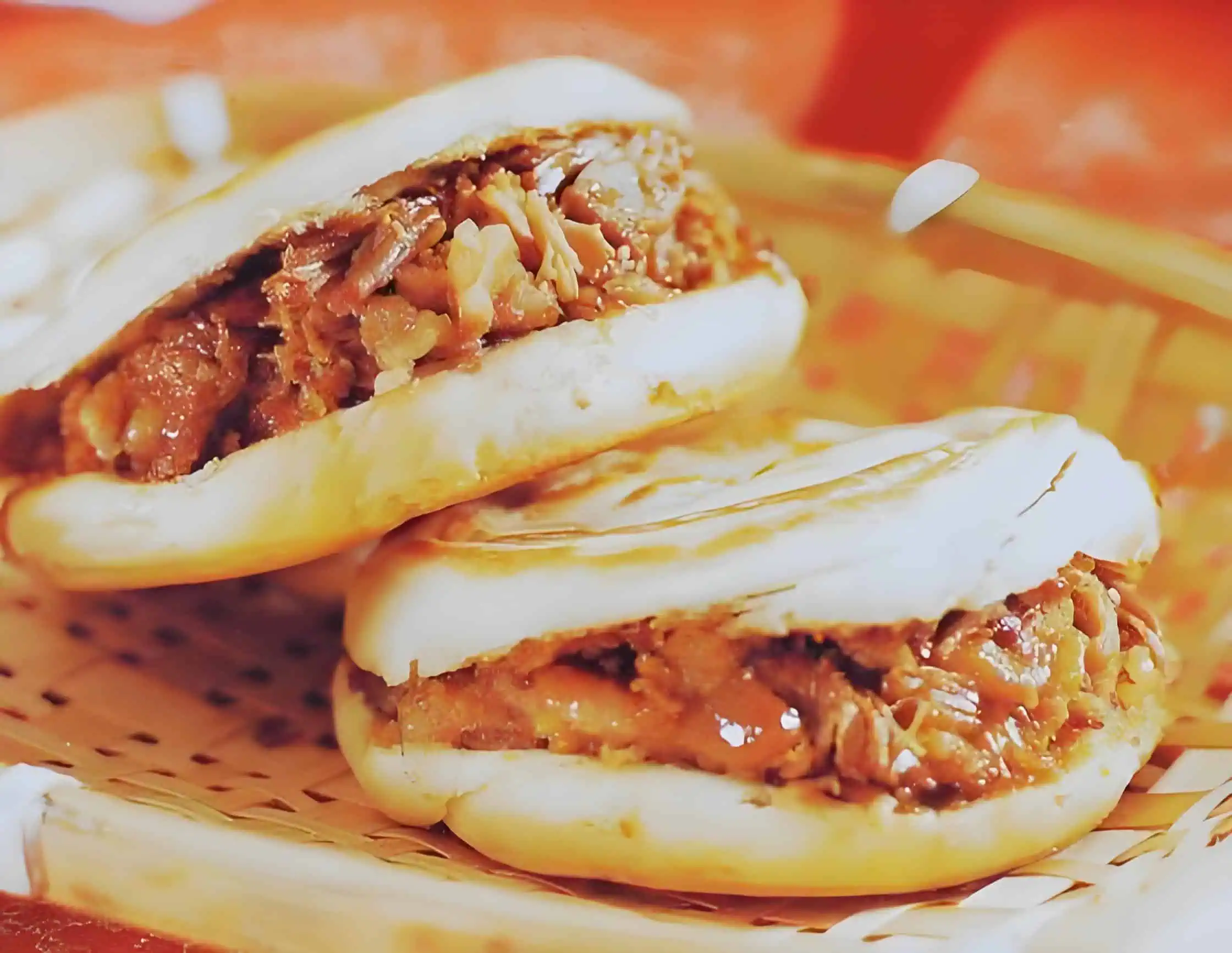
Roujiamo
Ròujiāmó · say it: “roh-jyah-moh”
- Spice
- Mild
- Typical price
- ¥10–20
- Dietary
- Contains gluten
Xi'an's answer to the burger predates the burger by roughly two thousand years: the slow-braised pork was already a recorded recipe when Han-era Chang'an was one of the largest cities on earth. Roujiamo (肉夹馍, ròujiāmó) — the name means, bluntly, "meat stuffed in bread" — is a palm-sized baked bun split open and filled with lazhi rou (腊汁肉, làzhī ròu), pork belly and shoulder braised for hours in a master stock of soy, rock sugar and spices that some old shops claim to have kept simmering, topped up daily, for decades. The bun is the underrated half of the dish: baijimo (白吉馍, báijímó) is wheat dough baked on a griddle until the outside crisps and freckles with char while the inside stays soft enough to soak up the braising juices. The pork is chopped to order — lean, fatty, or the mix you actually want — and a spoonful of the braising liquor goes in with it. The result is crisp, rich, gone in six bites, and costs less than a coffee back home. It's breakfast, lunch and late-night food in Xi'an, and the standard local order adds liangpi and an orange soda called Bingfeng (冰峰, Bīngfēng) — a combination locals call the "Three Qin set" (三秦套餐, Sānqín tàocān). Note that this canonical version is pork: in the Muslim Quarter, Hui cooks make a halal counterpart called 腊牛肉夹馍 (là niúròu jiámó) — cured beef (腊牛肉) braised until tender, chopped and packed into the same bun. It is a different dish from the pork original, not just the pork with the meat swapped, and well worth ordering on its own terms.
How to eat it
Eat it immediately, over the paper wrapper it comes in — a good roujiamo leaks, and the wrapper is your plate. No chopsticks, no knife and fork: this is two-handed street food, best eaten standing near the shop or walking. Most counters offer a choice of lean (瘦肉, shòuròu), fatty or mixed (肥瘦, féishòu) — order mixed; the fat carries the braising flavor and an all-lean one eats dry. Many shops also list a "premium" version (优质, yōuzhì) with extra meat for a few yuan more. And note what isn't there: a proper Xi'an roujiamo is just meat and bun — no green peppers, no chili, no lettuce. Some shops elsewhere add stir-fried green pepper (青椒, qīngjiāo) to the filling, but that's a cross-regional modern tweak, not the Xi'an original; locals eat the plain braised-pork version.
Locals rarely eat it alone. The classic companion is a bowl of liangpi (凉皮, liángpí) — cold, chewy wheat noodles dressed with chili oil and black vinegar — plus a Bingfeng orange soda, a combination so standard it has its own name, the "Three Qin set." If you're more in a noodle-soup mood, a bowl of biangbiang noodles alongside is carb-on-carb and completely normal here. In the Muslim Quarter, follow a beef roujiamo with grilled skewers or a persimmon cake — see our street-by-street eating guide for how to string it together. Browse more of the canon on our Xi'an food hub.
Where to try it
Fanji Lazhi Rou (樊记腊汁肉)
A local standby on Zhubashi Street just south of the Bell Tower, braising lazhi pork since the early 20th century. Order at the counter and take the paper-wrapped bun to go.
Qinyu Roujiamo (秦豫肉夹馍)
A Dongmutoushi institution east of the Bell Tower that locals consistently rate among the city's best. Famously sells out by early afternoon — go before lunch.
Ziwulu Zhangji (子午路张记)
A well-loved local chain; the Cuihua Road branch in Yanta District is a convenient stop if you're out at the Big Wild Goose Pagoda. Also does a solid liangpi for the full Three Qin set.
Muslim Quarter beef roujiamo stalls
The halal version — 腊牛肉夹馍: cured beef (腊牛肉) braised tender and chopped into the same bun. It's also the natural sidekick to a bowl of meatball hulatang. Stalls line Beiyuanmen and the side lanes — pick one with a queue and a cook chopping to order.
Read the guide
On video
Xi'an on video
What this place looks like on video.