VISITXIAN
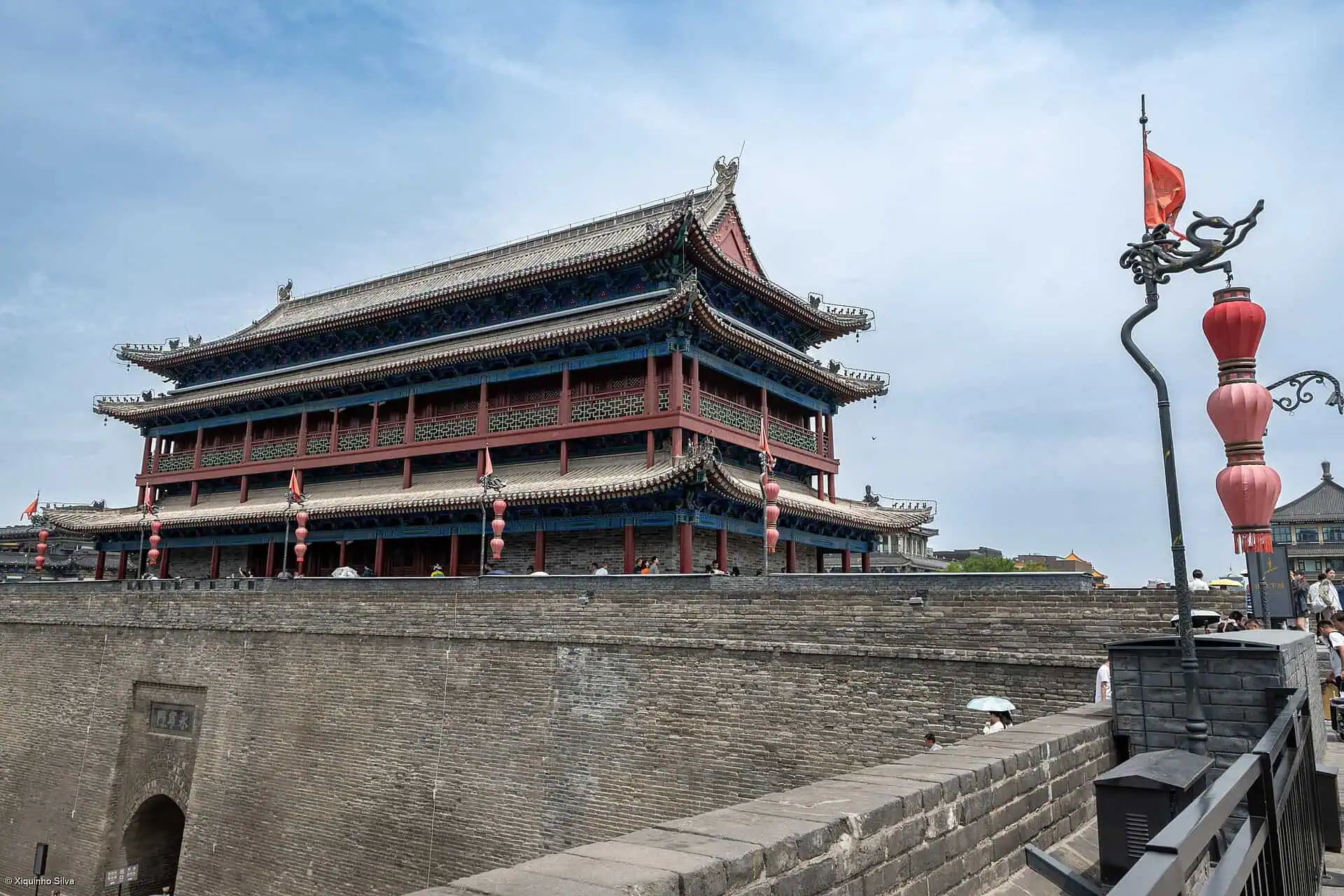
Yongningmen, the south gate of Xi'an's city wall
Districts & where to stay

Get oriented.

Which time do you want to wake up in? Nine districts, from the 6,000-year-old east to the hermit mountains of the south — each with its own layer of the city's stack, its own food, and its own answer to where to stay.

Photo by Bob Wehn, via Wikimedia Commons · CC BY-SA 4.0
01

The district map

Tap a marker for the district guide. The wall sits at the center; time radiates outward.

Loading map…
02

The districts

Each with its own layer of time, its own food, its own answer to where to stay.

01Wall Time · the Ming grid, 1370s

Inside the City Wall: Bell Tower & South Gate

The easiest orientation in China: if you're within the Ming wall — a grid laid out in the 1370s and still the frame the city hangs on — you're in the old city. The rectangle of streets inside the City Wall (西安城墙, Xī'ān Chéngqiáng) is what locals mean by 城墙内 (Chéngqiáng Nèi) — "inside the wall" — and it's where Xi'an still keeps its center of gravity. The Bell Tower (钟楼, Zhōnglóu) stands at the exact crossroads of the grid, where the four great avenues meet; the Drum Tower (鼓楼, Gǔlóu) sits a few minutes west, guarding the entrance to the Muslim Quarter. The character is busy, commercial and walkable — department stores and phone shops on the main arteries, quieter lanes of courtyard guesthouses and calligraphy shops behind them, especially around Shuyuanmen (书院门, Shūyuànmén) near the South Gate. It's also the most forgiving place in China to be a lost tourist: the grid is rigid, the wall is always somewhere on the horizon, and every wrong turn ends at a gate you can name. That gate, Yongningmen (永宁门, Yǒngníngmén), is the handsome face of the district: the wall's grandest restored entrance, the place to start a rampart walk or bike ride, and the backdrop for the evening light-up that makes the wall glow. Eating is the district's quiet superpower. The Muslim Quarter's lanes cover the northwest corner — roujiamo, paomo and persimmon cakes within a 15-minute walk of most hotels — and the streets south of the Bell Tower fill up with noodle shops and barbecue after dark. The deeper cuts reward the curious: Sajinqiao (洒金桥, Sǎjīnqiáo) is the food street locals actually eat on, Xuexi Xiang is the Quarter's barbecue alley, and on Thursday and Sunday mornings the Xicang market fills the old granary lanes with birdcages and bargain hunters. Dawn people should aim for the Xiaonanmen morning market along the wall's base — breakfast with the whole neighborhood. Between meals there's the City God Temple on West Avenue, the all-Shaanxi food stalls of Yongxingfang by the northeast gate, the Ming-dynasty Guangren Temple in the northwest corner, and the 300-year-old Catholic church on Wuxing Street (五星街, Wǔxīng Jiē) hiding in the southwest lanes. Transit is as simple as the map: metro Line 2 runs north–south straight through the district, with stations at Zhonglou (Bell Tower) and Yongningmen (South Gate), while Line 6 crosses it east–west at Zhonglou. Line 2 also runs directly to Xi'an North station for high-speed trains. Most of what you'll do on a first visit — the wall, the towers, the Quarter — sits within a 20-minute walk. Our 3-day itinerary spends its entire first day inside this rectangle, and Getting around Xi'an covers the metro basics.

17 places inside →

02Wall Time · steles & scholars

South Gate & Beilin: the scholars' quarter

Step out of the wall through Yongningmen (永宁门, Yǒngníngmén) — the South Gate, grandest of the Ming entrances — and you land in the quarter that has handled the city's culture business for a thousand years. This is Beilin (碑林, Bēilín), named for the "forest of steles": the Forest of Steles Museum (碑林博物馆, Bēilín Bówùguǎn), where the canon of Chinese calligraphy sits carved in stone, from Confucian classics to the Nestorian tablet that recorded Christianity's first arrival in China in 781 AD. The approach alone is worth the trip. Shuyuanmen (书院门, Shūyuànmén), the old scholars' street, runs from the South Gate to the museum under Ming eaves, lined with brush sellers, seal carvers and paper shops — the one street in Xi'an where the souvenir is a craft, not a fridge magnet. Around it spreads a lattice of old lanes the guidebooks mostly skip: Defu Lane's (德福巷, Défú Xiàng) cafés and bars in grey-brick courtyards, the teahouses of Xiangzi Temple Street (湘子庙街, Xiāngzǐmiào Jiē), and Shuncheng Lane (顺城巷, Shùnchéng Xiàng) tracing the base of the wall itself — the city's favorite after-work stroll, strung with small bars and barbecue. The district's second act is two free, underrated sites on its western edge. The Small Wild Goose Pagoda (小雁塔, Xiǎoyàntǎ) stands in the quieter of Xi'an's two great Tang temple grounds, with the Xi'an Museum at its foot — the Shaanxi History Museum without the queues or the ticket scramble. A ten-minute walk north, a 300-year-old Catholic church hides in the lanes of Wuxing Street (五星街, Wǔxīng Jiē), all Chinese roof-lines on a Roman basilica plan — one of the strangest and most photogenic buildings in the city. Just beyond the wall's southeast corner, Xingqing Palace Park (兴庆宫, Xīngqìng Gōng) turns the Tang emperor Xuanzong's private palace into the neighborhood's morning-exercise ground. Transit couldn't be simpler: Line 2 runs down the district's spine, with Yongningmen station at the gate and Nanshaomen (南稍门) one stop south for the Small Pagoda — and Line 2 also takes you straight to Xi'an North for high-speed trains. Line 6 skirts the southeast corner for Xingqing. Everything described above sits inside a 25-minute walk, which is why our where to stay guide calls this the connoisseur's base.

5 places inside →

03Current Time · the young city

Xiaozhai & the Museum Mile: the young city

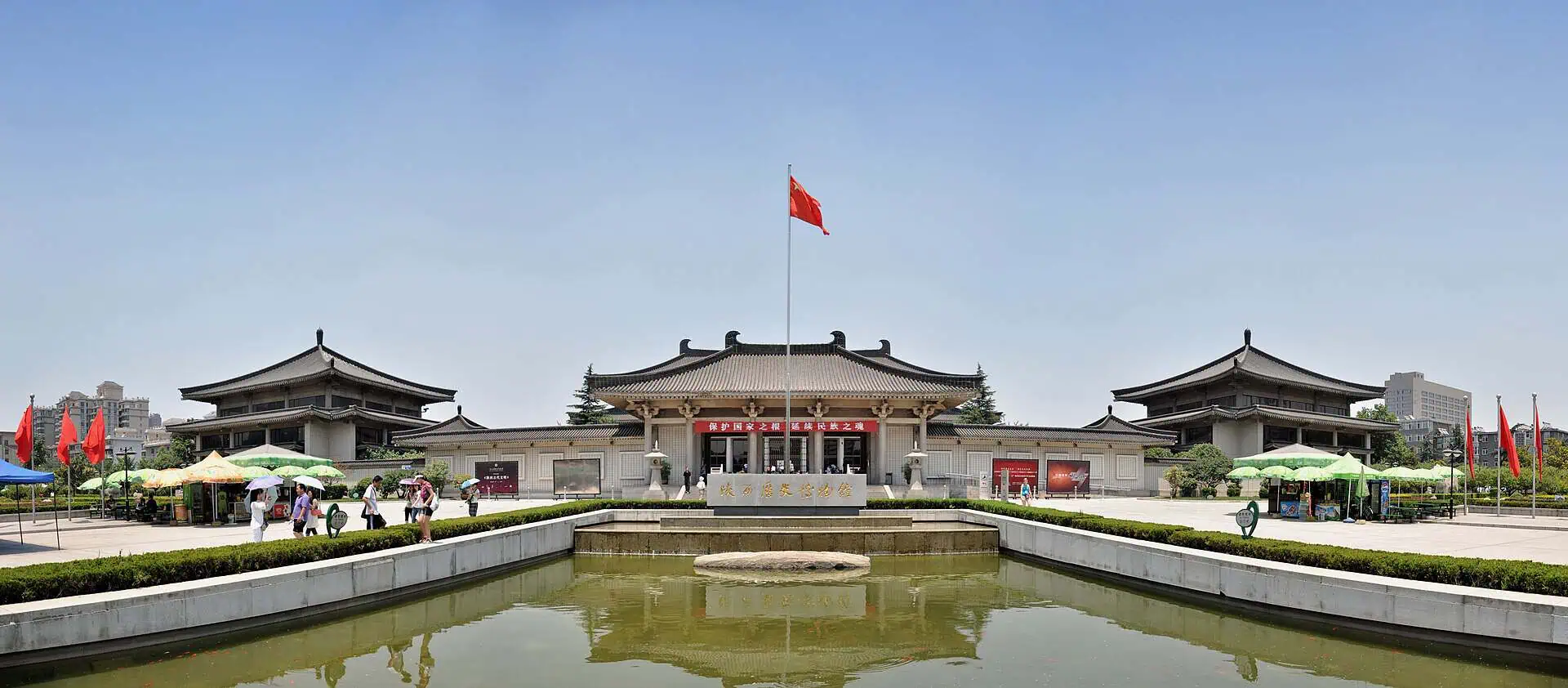
Every Chinese city has a crossing where the youth congregate, and in Xi'an it's Xiaozhai (小寨, Xiǎozhài) — the Line 2/Line 3 interchange that handles more passengers than any other station in the system, ringed by malls, milk-tea shops and the campuses of a half-dozen universities. If inside the wall is where Xi'an keeps its history and Qujiang its stage set, Xiaozhai is where the city actually lives its weeknights. Come here to see the average age drop by twenty years. The surprise is that the city's single greatest sight hides in the middle of it. The Shaanxi History Museum (陕西历史博物馆, Shǎnxī Lìshǐ Bówùguǎn) stands a ten-minute walk east of the crossing — free, reservation-only, and the one museum in China that can genuinely claim 3,000 years of national treasure under one roof. Book it the moment your dates are fixed; slots go days ahead in season. From the museum, the Big Wild Goose Pagoda is a 15-minute walk further east, which is why this district works as the hinge between Xiaozhai and Dayanta & Qujiang. Across the road from the crossing sits the district's second treasure, and it costs nothing: Daxingshan Temple (大兴善寺, Dàxīngshàn Sì), a 1,700-year-old monastery that was once the headquarters of Esoteric Buddhism — the place where the Tang capital's Indian monks translated the sutras that still anchor Shingon practice in Japan. On any given afternoon you'll have its cypress courts nearly to yourself while the city's busiest mall seethes two blocks away. That mall, Saige International (赛格国际, Sàigé Guójì), is itself a spectacle: an eight-storey atrium with an indoor waterfall and an escalator that climbs six floors in one run, plus the best rooftop food court view in the south city. Transit is the district's superpower. Line 2 runs north to the Bell Tower (10 minutes) and south toward Chang'an; Line 3 runs east to Dayanta and the Qujiang strip. You can be anywhere a first-time visitor wants to go within 25 minutes — Getting around Xi'an covers the metro basics.

3 places inside →

04Golden Time · Tang echoes

Dayanta & Qujiang: the Tang district

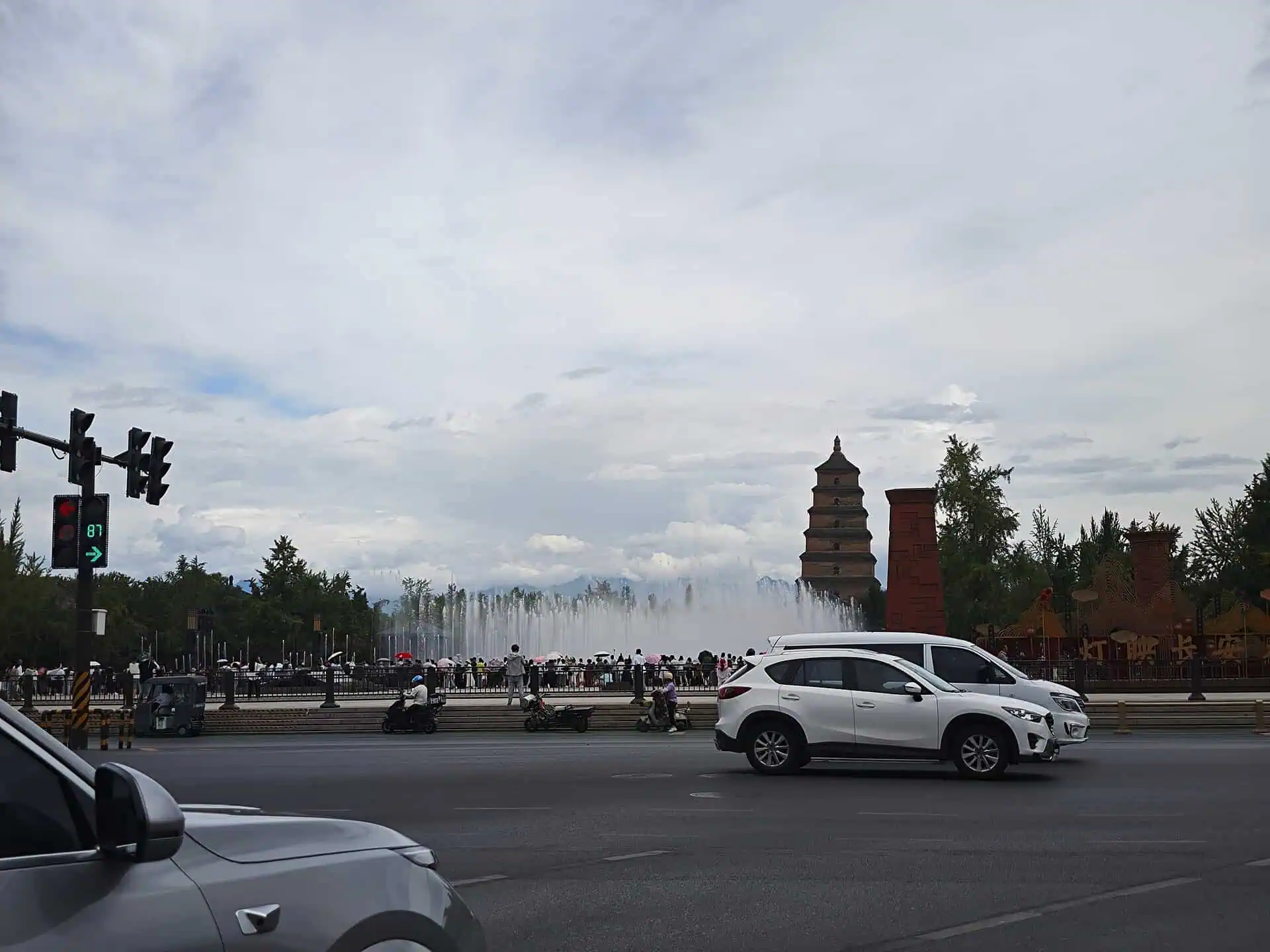
Qujiang (曲江, Qǔjiāng) is Xi'an's landscaped southeast — a district rebuilt over the past two decades in the image of its Tang-dynasty self, thirteen centuries after the Qujiang pool and gardens were the capital's pleasure ground and newly minted exam graduates came here to celebrate passing the imperial exams. Where the old city inside the wall is dense and commercial, Qujiang is wide boulevards, parkland and Tang-styled streetscapes. It feels planned, because it is. And after dark it becomes the city's evening heart: this is where Xi'an goes out. The anchor is the Big Wild Goose Pagoda (大雁塔, Dàyàntǎ), standing at the district's northern end since the 7th century. Due south of it runs Grand Tang Ever-Bright City (大唐不夜城, Dàtáng Bùyèchéng), the pedestrian strip that turns into the city's biggest open-air evening scene. To the east, Tang Paradise (大唐芙蓉园, Dàtáng Fúróngyuán) spreads Tang-style halls around a lake; further south, Qujiang Pool Park (曲江池, Qǔjiāng Chí) rebuilds the original pleasure lake as a free public park. On the district's northwest edge, near the Xiaozhai (小寨, Xiǎozhài) crossing, sits the Shaanxi History Museum (陕西历史博物馆, Shǎnxī Lìshǐ Bówùguǎn) — free with a reservation, and the strongest argument in Xi'an for booking attractions ahead. The newest addition is Chang'an Twelve Hours (长安十二时辰, Cháng'ān Shí'èr Shíchén), an indoor block that recreates a Tang street day, actors included. Transit is straightforward. Metro Lines 3 and 4 both stop at Dayanta (大雁塔) station, right by the pagoda's north square, and Line 4 continues a stop further for Tang Paradise. From the Bell Tower it's about 20 minutes: Line 2 to Xiaozhai, then Line 3 one stop east — Getting around Xi'an covers the metro basics. Taxis and DiDis between here and the wall are short hops, though the post-show rush around Ever-Bright City means a wait at closing time. One honest caveat: Qujiang's Tang is a stage set, lovingly maintained — fresh paint, perfect eaves, performers on a schedule. You won't find old-town texture here; you come for the evening spectacle. The free fountain shows on the pagoda's north square, the pagoda lit gold, and the crowds in rented hanfu make this the city's best night walk — our Xi'an at night guide routes it, and a hanfu photoshoot here is about as close to Tang cosplay as travel gets. Our 3-day itinerary strings the museum, pagoda and Ever-Bright City into its final day.

6 places inside →
05Golden Time · the palace grounds

Daming Palace & the North: the empire's front yard

North of the wall, Xi'an exhales. The dense old grid gives way to broad avenues, housing blocks and sky — and then to one of the great urban parks of Asia. Daming Palace (大明宫, Dàmíng Gōng) was the Tang dynasty's working palace for 240 years, the seat from which the dynasty at its zenith governed an empire stretching to Persia. Today its foundations sit inside a 3.5 km² national heritage park — four and a half times the Forbidden City, mostly open lawn and reconstructed gates — and the surrounding district has settled into an easy, un-touristed rhythm around it. The experience here is scale rather than polish. You don't tour Daming Palace so much as range across it: rent a bike at the gate, ride the axis from the vast Danfeng Gate reconstruction to the Hanyuan Hall foundations, and watch the neighborhood claim the empire's front yard as its own — kite flyers on the parade grounds, grandparents ballroom-dancing under the locust trees, schoolkids sprinting the plaza where ambassadors once waited for dawn audience. On a smog-free evening, the sunset over the ruins is the best free show in the north city. Two more layers of time sit nearby for the committed. Just east of the palace park, Dahua 1935 (大华·1935, Dàhuá 1935) has turned a 1935 cotton mill — one of the northwest's first modern factories — into a mill museum, creative shops and the city's main mid-size livehouse. West of the palace, the fenced grasslands of Han Chang'an (汉长安城, Hàn Cháng'ān) preserve the rammed-earth wall lines of the Han dynasty capital — 600 years older than the Tang palace and almost completely unvisited, a pilgrimage for history readers rather than a sight. North along the metro, Weiyang (未央, Wèiyáng) is the new municipal heart: city sports parks, the library and exhibition centers, and Xi'an North station, where the high-speed trains leave for Beijing, Chengdu and Shanghai — see Getting to Xi'an and the high-speed rail guide for how the station works. Transit runs on two lines: Line 4 serves the palace park directly (Daminggong and Hanyuandian stations), and Line 2 bisects the north on its way to Xi'an North station — about 15 minutes from the Bell Tower to the palace gates. Getting around Xi'an covers the metro basics.

3 places inside →

06Deep Time · 6,000 years, then factories

Banpo & the East: from 6,000 BC to factory lofts

Xi'an's east side tells the city's two least-touristed stories, and they sit ten minutes apart. The first is the oldest one there is. The Banpo Museum (半坡博物馆, Bànpō Bówùguǎn) preserves a 6,000-year-old Neolithic village on its original site — house foundations, pottery kilns and burial urns under a single great hall — the remains of a matriarchal farming community that was already two millennia old when Egypt raised its first pyramid. It's the place that resets every visitor's sense of how deep "old" goes in this city. The second story is industrial. In the 1950s the east suburbs became Fangzhicheng (纺织城, Fǎngzhīchéng) — "Textile City" — a Soviet-planned mill district that wove cloth for half of northwest China. When the mills fell silent in the 1990s, the looms' halls found a second life: the Banpo International Art Zone (半坡国际艺术区, Bànpō Guójì Yìshùqū) turned a spinning mill's sawtooth workshops into studios, galleries and cafés, Xi'an's answer to Beijing's 798 on a human scale. Brick chimneys, graffiti walls, studio cats — and, on weekends, the city's art students shooting lookbooks against the old machine shops. Combined with the museum next door, it's the best half-day in Xi'an that most visitors never take. The east also carries the city's literary memory. At Baqiao (灞桥, Bàqiáo), where the Ba River leaves the plain, Tang poets saw friends off beneath the willows — "breaking a willow branch at Ba Bridge" became the stock image of farewell in Chinese poetry, and the riverbanks are now a long, willow-lined eco-corridor. Further north, the Chanba (浐灞, Chǎnbà) district has rebuilt the river confluence as wetlands, parkland and the venues of the 2021 National Games — the swooping Olympic Sports Center stadiums included — plus the wide, quiet riverfront cycling that locals drive across town for. Getting here is a straight shot: metro Line 1 runs the east axis from the city center, with Banpo station for the museum and art zone and Fangzhicheng at the terminus for the old mill quarter — about 15 minutes from the Bell Tower. Line 3 covers Chanba and the Expo Park to the north. Getting around Xi'an covers the basics.

3 places inside →

07Deep Time · the hermit mountains

Zhongnan Mountains & Chang'an: the hermit range

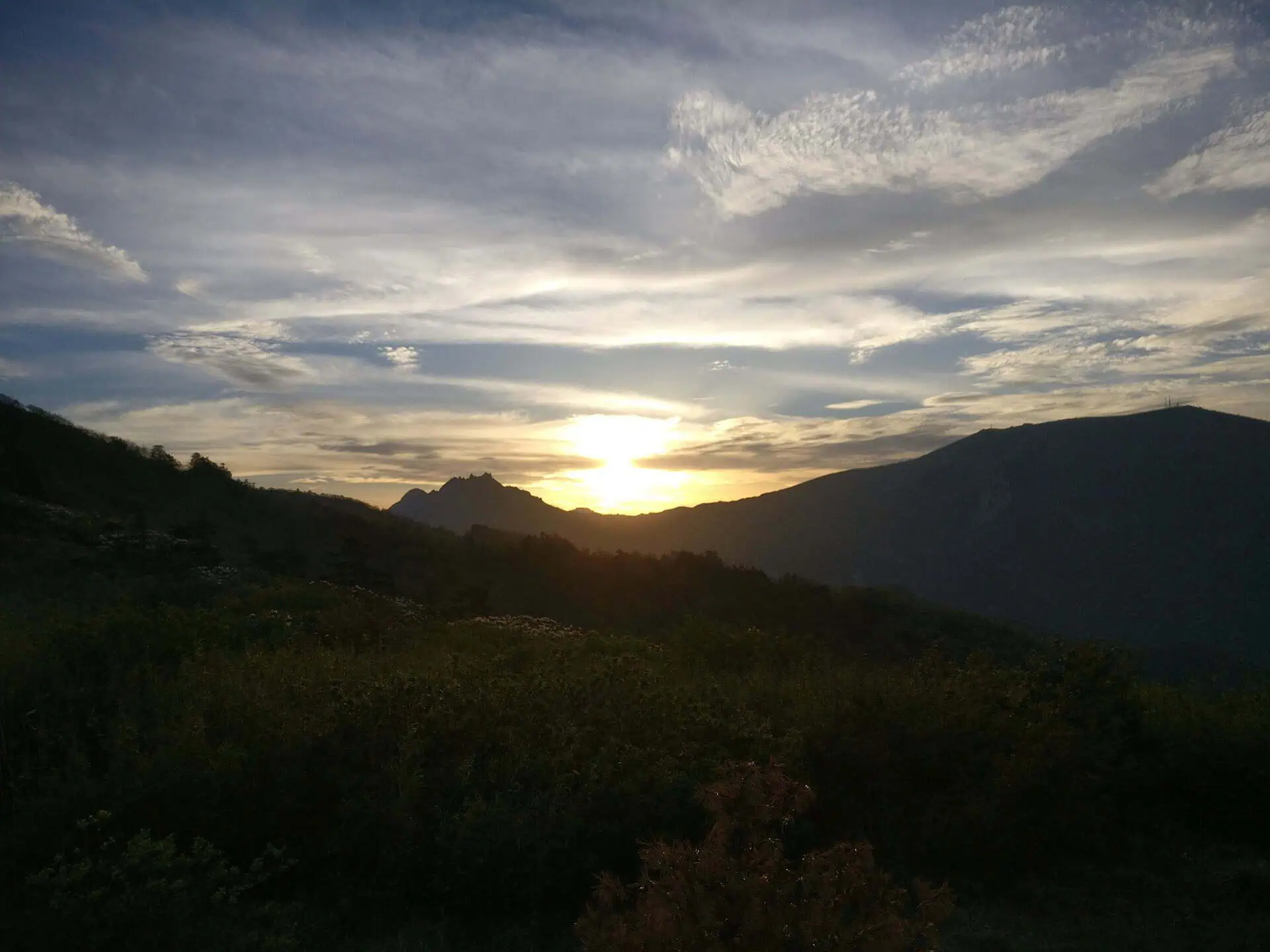
Every visitor photographs Xi'an's wall; almost none look south from it. On a clear day the horizon answers with a blue wall of its own — the Qinling (秦岭, Qínlǐng) range, the mountain spine that splits China into north and south, and the reason a capital existed here at all: thirteen dynasties put their throne where the plain meets these slopes, watered by the rivers running off them. The nearest and holiest ridges are the Zhongnan Mountains (终南山, Zhōngnán Shān), 30 km from the Bell Tower — and missing them is missing half of what Xi'an is. These are China's hermit mountains. For over two thousand years, recluses, monks and poets have walked up these valleys to live alone in huts and caves — a tradition that runs from the Taoist patriarchs through the Tang poet Wang Wei, who farmed his Wangchuan villa here, to a living community of modern hermits documented in Bill Porter's cult classic *Road to Heaven* (《空谷幽兰》). At Louguantai (楼观台, Lóuguāntái), tradition says Laozi stopped at the pass keeper's cottage and wrote the Tao Te Ching before vanishing west — the birthplace of Taoism is a wooded temple hill an easy day out from the city. The accessible highlights stack up well for a day trip. Cuihua Shan (翠华山, Cuìhuá Shān) climbs to a jade landslide-dammed lake beneath granite crags — the easiest real Qinling summit day. Nanwutai (南五台, Nánwǔtái) strings Buddhist temples along a five-terrace ridge with views back over the whole Guanzhong plain to the city. On the plain between the city and the peaks, Xiangji Temple (香积寺, Xiāngjī Sì) honors Shandao, the 7th-century patriarch of Pure Land Buddhism — free, serene, and almost always empty. In autumn the valleys add ginkgo and red maple; in summer they're the city's escape hatch from 38°C heat. Getting there is simpler than it sounds: metro Line 2 runs south to its Weiqunan (韦曲南) terminus in Chang'an district, where local buses and DiDis continue 30–45 minutes to the trailheads. Trailhead entry fees are modest; winter fire-season closures are common, so check conditions before you go — and treat the higher Qinling trails as real mountain hiking, with weather to match. Getting around Xi'an covers DiDi and metro basics.

1 places inside →

09Empire Time · the First Emperor's county

Lintong: Terracotta Army country

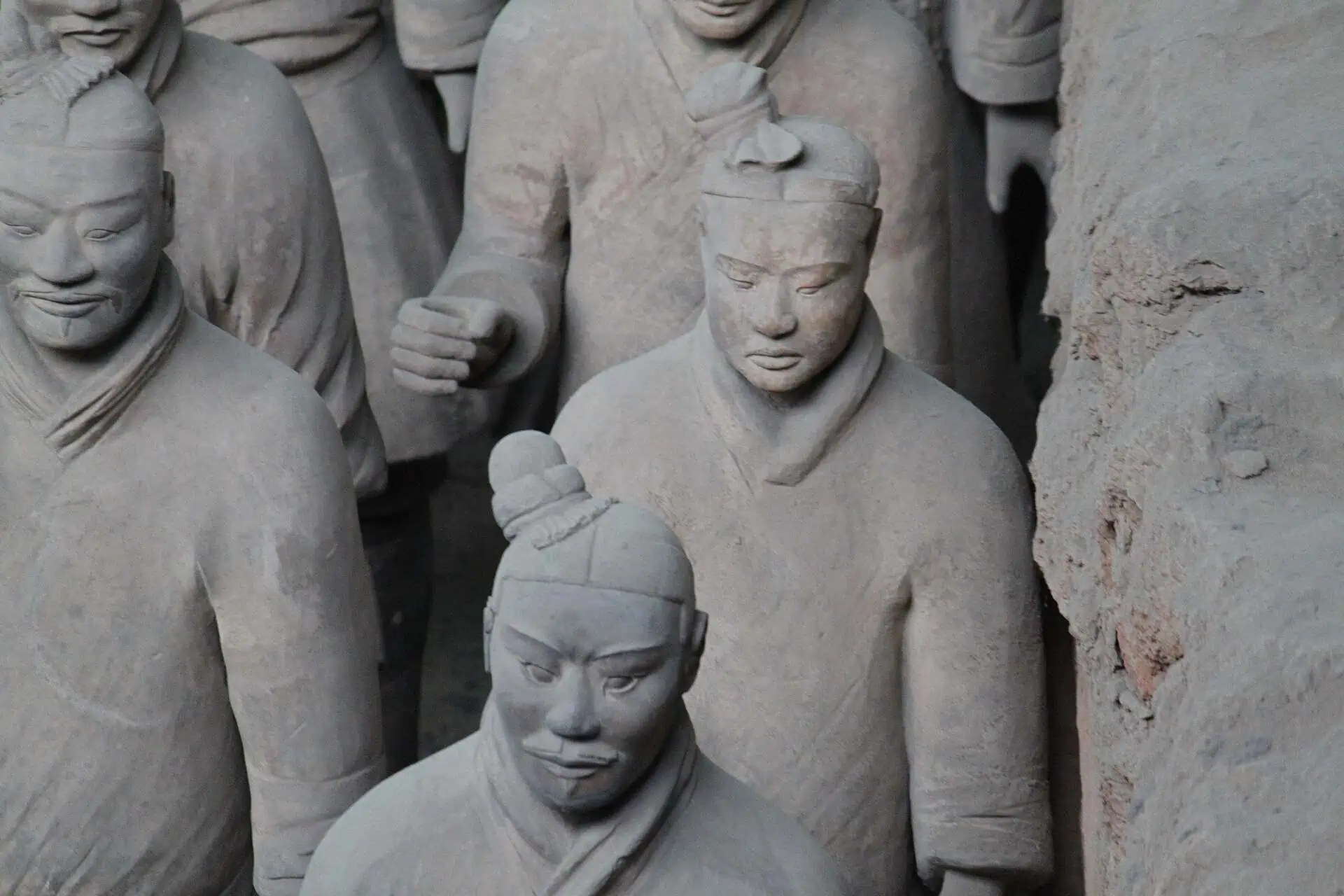
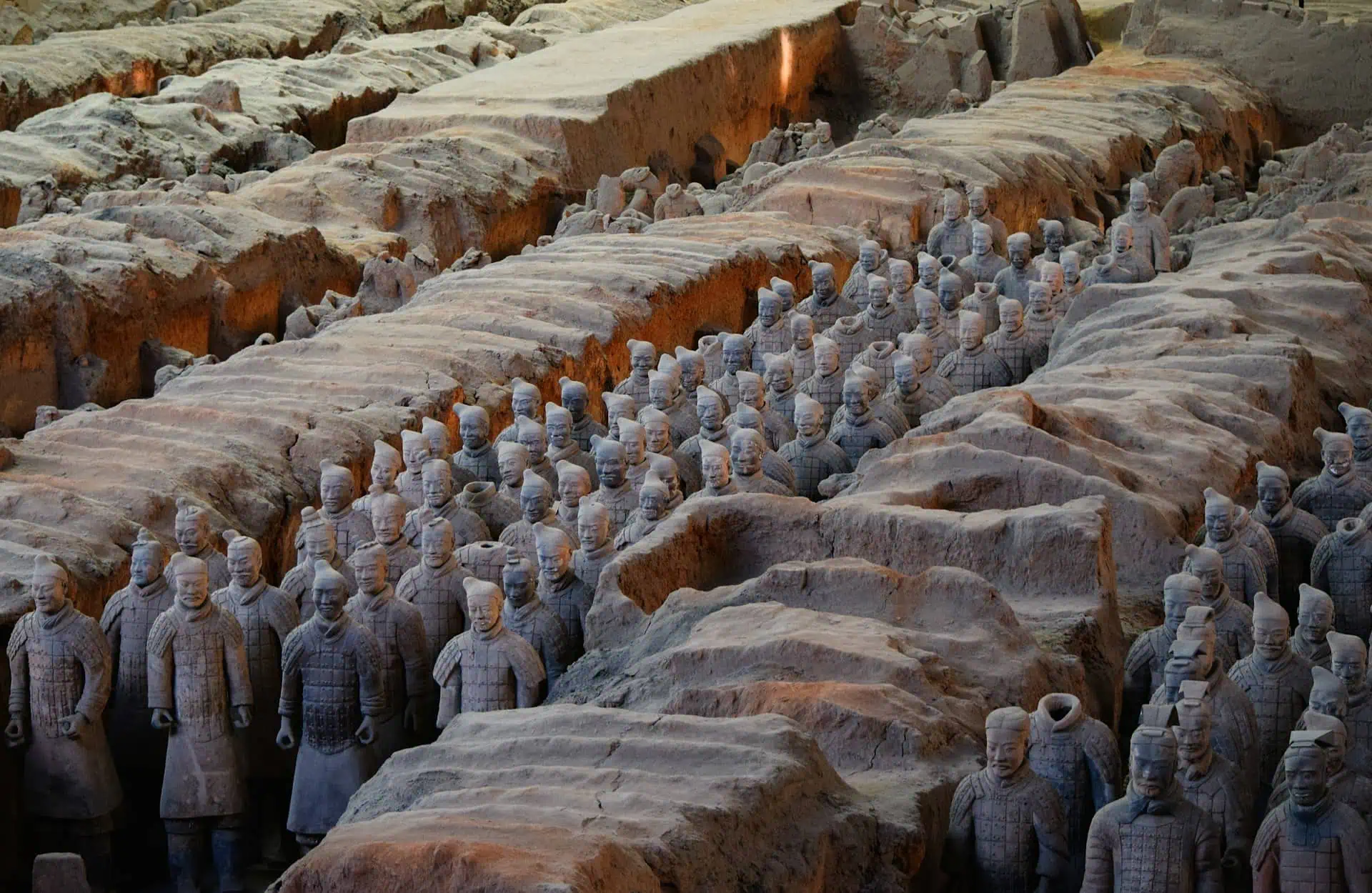
Lintong (临潼, Líntóng) is empire country — the First Emperor's tomb county, a district 35 km east of downtown Xi'an that holds two of the region's heaviest hitters: the Terracotta Army and Huaqing Palace, with Mount Li (骊山, Líshān) rising behind them. It has been the imperial getaway ever since the First Emperor chose the foot of the mountain for his tomb — the hot springs did the marketing. Understand its character before you plan: Lintong is a day-trip district, not a base. The sights fully justify the journey; the town itself is a functional sprawl with little reason to linger after dark. Sleep in Xi'an proper — ideally inside the city wall — and treat Lintong as a single well-organized day. Here's how the day works. Leave Xi'an around 8:00. Metro Line 9 is the spine: ride it to Huaqing Pool (华清池) station, then hop a taxi or local bus (602/613) for the last 15 minutes to the Terracotta Army. The classic budget alternative is tourist bus 306 from the railway station's east square (about ¥7, roughly an hour); a DiDi runs ¥120–150 door to door. Do the army first, before the tour-bus waves, then double back to Huaqing Palace for the afternoon, when the light drops onto Mount Li. You're home for dinner — our 3-day itinerary lays the whole day out hour by hour. One evening footnote: in season (roughly April to October), Huaqing Palace stages *The Song of Everlasting Sorrow* (长恨歌, Chánghèn Gē), an open-air drama performed against the mountain itself. It's worth staying for — but pre-book a car home, because the last metro won't wait.

2 places inside →

10Empire Time · the Qin origin story

Xianyang & the airport corridor

Xianyang (咸阳, Xiányáng) is Xi'an's sister city, 25 km northwest across the Wei River (渭河, Wèi Hé) — China's first imperial capital, seat of the fifteen-year dynasty that invented empire, and today the home of Xi'an's airport. The Qin (秦, Qín) dynasty ruled its newly unified empire from here (221–206 BC) before the Han built their capital, Chang'an, across the river and eclipsed it for good. Today Xianyang is a mid-size industrial city fused to Xi'an's northwest flank, and the reason you know its name is the airport: Xi'an Xianyang International (西安咸阳国际机场, Xī'ān Xiányáng Guójì Jīchǎng, code XIY) sits between the two cities, on Xianyang's side of the line. Your flight to "Xi'an" technically lands in another city. What will you actually use the corridor for? Arrivals and departures, above all — our getting to Xi'an guide walks through them. But it holds one genuinely worthwhile sight: the Hanyangling Mausoleum (汉阳陵, Hànyánglíng), the tomb of the Han emperor Jingdi (汉景帝, Hàn Jǐngdì), where glass floors carry you directly over the excavated burial pits. It sits on the airport road, about 20 minutes from the terminals — convenient for flyers, awkward from downtown, which is why the stop strategy below matters. Deep-history travelers can continue to the Qin capital ruins on the Wei's north bank; go knowing that two millennia have left rammed-earth platforms rather than standing palaces, and that the Terracotta Army covers the Qin story far better — see Qin Shi Huang for why. Transit between the airport and the city is better than most travelers expect. Metro Line 14 runs from the terminals to Xi'an North station in about 35 minutes, where Lines 2 and 4 continue downtown — allow roughly an hour all-in to the Bell Tower, for a fare of a few yuan. Airport shuttle buses (about ¥25, 60–90 minutes depending on traffic) fan out to several city points, and a DiDi or taxi door to door runs roughly ¥100–180 depending on where you're headed. If you're continuing straight onto the high-speed rail network, Line 14 hands you to Xi'an North station directly. The Hanyangling stop strategy: because the tomb is minutes from the airport but a detour from the city, visit it on an arrival or departure day. Land, take a DiDi to the tomb, allow two to three hours, then continue into Xi'an — or reverse the sequence on your way out. Luggage storage on site is limited, so the clean version is a driver who waits while you walk the pits. It pairs naturally with a visa-free layover if you're transiting.

2 places inside →