Xi'an and the Silk Road: where it all began
The Silk Road had one fixed eastern anchor: Chang'an, today's Xi'an. Zhang Qian's accidental mission, the goods and ideas that moved both ways, the Sogdian middlemen — and the Hui quarter that remains its living legacy.
The eastern terminus
Every map of the Silk Road begins at the same dot: Chang'an (长安, Cháng'ān), today's Xi'an. The "Silk Road" was never a single road — it was a shifting network of caravan tracks linking China with Central Asia, Persia and, at the far end, the Mediterranean. Even the name is modern: the German geographer Ferdinand von Richthofen coined "Seidenstraße" in 1877. But for over a thousand years the network had one fixed anchor in the east. Goods leaving China were assembled in Chang'an's markets; goods arriving were uncrated there. If one city can claim to be where it all began, it's this one.
Zhang Qian's mission
The man who opened the road did it by accident. In 138 BC, Emperor Wu of Han (汉武帝, Hàn Wǔdì) sent a courtier named Zhang Qian (张骞, Zhāng Qiān) west to find the Yuezhi (月氏, Yuèzhī), a people the Han hoped to recruit as allies against the nomadic Xiongnu (匈奴, Xiōngnú). The Xiongnu captured him almost immediately and held him for about a decade. He escaped, carried on anyway — reaching Fergana, Sogdiana and Bactria — and was captured again on the way home. He finally walked back into Chang'an in 126 BC, thirteen years after leaving, with a handful of survivors and the first reliable Chinese account of the Western Regions: its kingdoms, its horses, its trade goods, its routes. Emperor Wu listened. Han armies and envoys pushed west, garrisons secured the corridor, and the caravans began to move.
What moved along the road
Westbound, the star commodity was silk — China's monopoly, so prized in Rome that Roman writers grumbled about the silver drain. Ceramics, bronze, paper and later tea followed. Eastbound, Chang'an took delivery of "heavenly horses" from Fergana, grapes, alfalfa, walnuts, sesame and pomegranates — several still carry the prefix 胡 (hú, "foreign") in Chinese — plus glass, wool, jade, gold and silver. The heaviest cargo was ideas: Buddhism traveled these routes from India into China by the first century AD, reshaping the civilization, followed by Zoroastrianism, Nestorian Christianity and Manichaeism. And almost nothing traveled end-to-end: goods passed hand to hand through relay traders, growing more expensive at every oasis.
The Sogdians: middlemen of the road
The great brokers of this traffic were the Sogdians (粟特, Sùtè) — merchants from the oasis cities of Samarkand and Bukhara, in modern Uzbekistan. They spoke the lingua franca of the routes, ran the caravanserais, and settled in Chang'an in large numbers, especially around the West Market. Tang tombs are full of their bearded, big-nosed clay figurines leading camels, and hoards of Sasanian Persian and Byzantine coins still turn up in the city's soil. The arrangement soured in 755, when the general An Lushan (安禄山, Ān Lùshān) — himself of Sogdian descent — launched a rebellion that nearly destroyed the Tang. Suspicion of foreigners never fully lifted.
Tang cosmopolitanism and the roots of the Hui
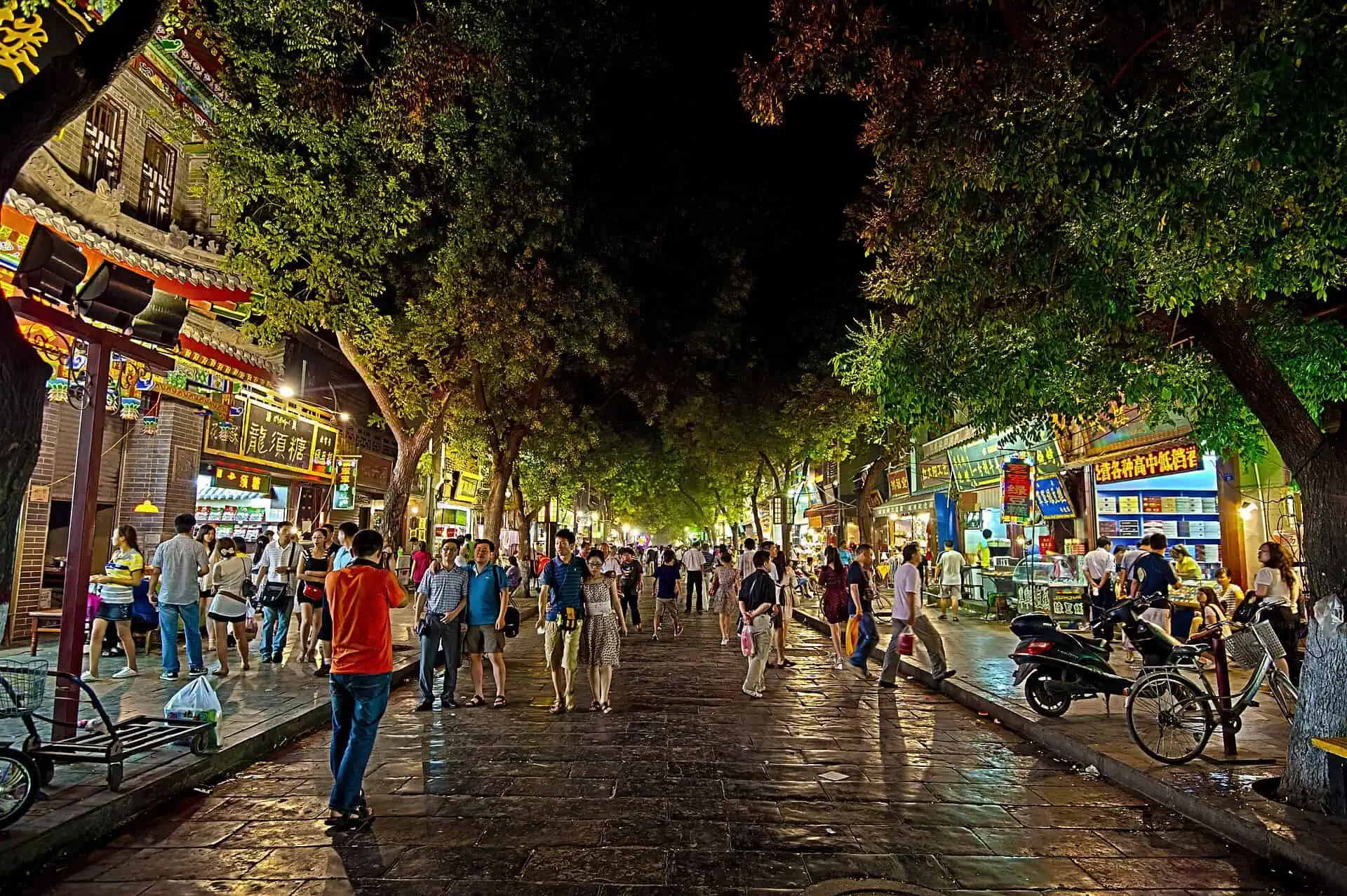
At its eighth-century peak, Chang'an may have been the most international city on Earth: Persian and Arab merchants, Turkic envoys, Japanese and Korean monks, Sogdian wine-shop singers. Muslim traders from Persia and Arabia arrived by the Silk Road and by sea, and some settled permanently, intermarrying over generations. Their descendants — joined by later Muslim arrivals — became the Hui (回族, Huízú), the Chinese-speaking Muslim community whose quarter still sits beside the Drum Tower. The Muslim Quarter you eat your way through today is, in a very real sense, the Silk Road's longest-running legacy in the city.
Where to see this today
- Shaanxi History Museum: Tang gold and silver, Sasanian coins, Sogdian and camel figurines — the Silk Road in one building. Free, but reserve a timed slot in advance (no full page on this site yet).
- The Muslim Quarter: the lanes around the Great Mosque (大清真寺, Dà Qīngzhēnsì) — one of China's oldest mosques, founded under the Tang by tradition, with buildings largely from the Ming and later — and the Hui food streets that surround it.
- The food itself: grapes, walnuts, sesame and pomegranates on every Xi'an menu are Silk Road imports, and the Quarter's lamb-and-bread classics descend from the merchants' kitchens. Start with our Xi'an food guide.
- The bigger frame: how Chang'an rose, ruled and fell in A short history of Xi'an.
Questions, answered
Did the Silk Road really start in Xi'an?
In effect, yes. Chang'an — modern Xi'an — was the network's eastern anchor under the Han and Tang: the city where westbound goods were assembled and eastbound goods arrived. The routes beyond shifted constantly, but the terminus didn't.
Who was Zhang Qian?
A Han-dynasty envoy sent west by Emperor Wu in 138 BC to find allies against the Xiongnu nomads. Captured twice, he spent thirteen years reaching Central Asia and returning. He failed at the alliance but brought back the first reliable Chinese account of the Western Regions — the intelligence that opened the Silk Road.
What goods were traded on the Silk Road?
Westbound: silk above all, then ceramics, bronze, paper and tea. Eastbound: Fergana horses, grapes, walnuts, sesame, pomegranates, glass, wool, jade and precious metals. Ideas traveled too — Buddhism reached China over these routes by the first century AD.
Is Xi'an's Muslim Quarter connected to the Silk Road?
Yes. Persian and Arab Muslim merchants arrived in Chang'an via the Silk Road and the sea routes, and some settled permanently. Their descendants, together with later Muslim arrivals, became the Hui — the community that still lives and cooks around the Drum Tower today.