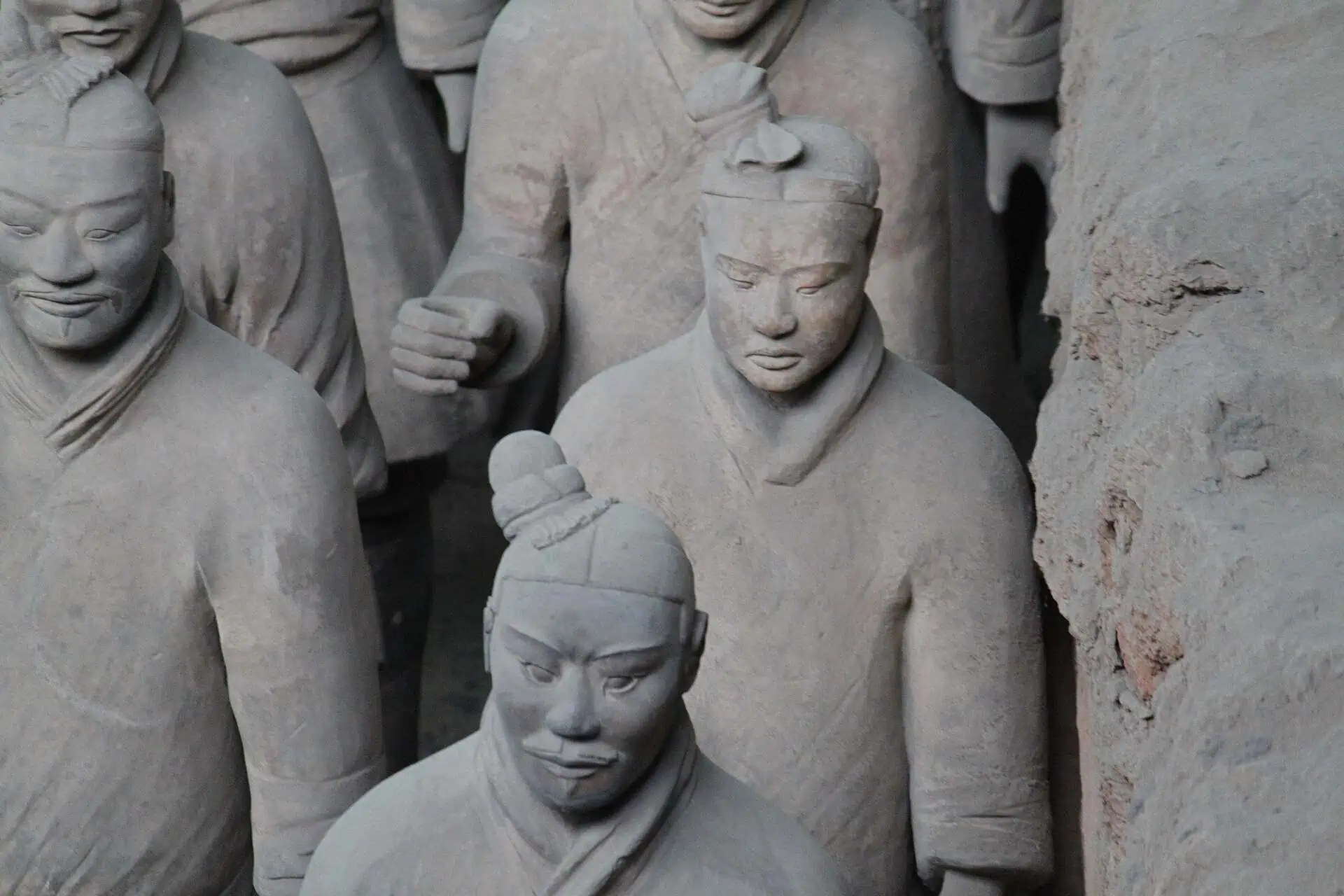
Qin Shi Huang and the story of the Terracotta Army
A 13-year-old king, a decade of conquest that created China, and a tomb built by 700,000 workers — then collapse, arson and 2,000 years of silence, until farmers digging a well in 1974 hit a terracotta head. The full arc of the First Emperor and his clay army.
The boy king
In 246 BC, a 13-year-old named Ying Zheng (嬴政, Yíng Zhèng) became king of Qin (秦, Qín), a hard, half-frontier state on the western edge of the Chinese world. He was too young to rule — the merchant-turned-chancellor Lü Buwei (吕不韦, Lǚ Bùwéi) ran the court for years — but one project started in his name almost immediately: his own tomb, at the foot of Mount Li (骊山, Líshān), east of the capital at Xianyang (咸阳, Xiányáng). Chinese kings began their mausoleums early, but nothing before or since matched what this particular boy would demand. By the time the tomb was sealed, work had run for roughly 38 years — and he had spent the middle decade of it conquering everything in sight.
Ten years that ended eight centuries
Between 230 and 221 BC, Qin armies swallowed the six rival states one after another — Han, Zhao, Wei, Chu, Yan, Qi. In 221 BC the last of them fell, and for the first time the Chinese world had a single ruler. Ying Zheng invented a title to match: Qin Shi Huang (秦始皇, Qín Shǐhuáng), "First August Emperor of Qin." The Zhou kings had presided over a loose family of feudal states for some eight centuries; he replaced the whole arrangement with provinces, appointed officials and direct taxation. He proclaimed that his dynasty would last ten thousand generations. It lasted about fifteen years.
Standardizing an empire
What the First Emperor did in his single decade as emperor is why he still matters. His chancellor Li Si (李斯, Lǐ Sī) imposed one written script — the small-seal script (小篆, xiǎozhuàn) — one currency, the round banliang (半两, bànliǎng) coin with its square hole, uniform weights and measures, and even standardized axle widths, so every cart could run in the same ruts on the new imperial highways. In the north, the general Meng Tian (蒙恬, Méng Tián) drove back the Xiongnu (匈奴, Xiōngnú) and connected older frontier walls into a single defensive line — the ancestor of the Great Wall, though almost nothing of his rammed-earth version survives beneath the Ming brick wall tourists know. The same iron efficiency had a dark register: dissenting books were burned, and whole districts were marched off to forced labor. The empire was unified, exhausted and angry.
The tomb: 700,000 workers and rivers of mercury
The historian Sima Qian (司马迁, Sīmǎ Qiān), writing about a century later in the Shiji (史记, Shǐjì), records that 700,000 laborers — convicts, conscripts and craftsmen — worked on the Mount Li complex. His account of the burial chamber itself reads like legend: a bronze-sealed vault where the hundred rivers of China flowed in mercury, driven by hidden machines; the constellations inlaid across the ceiling; crossbows rigged to fire at intruders; and the craftsmen who knew the tomb's secrets sealed inside when it closed. For two thousand years this was the only description anyone had — until modern soil tests around the mound found mercury levels far above normal, exactly where Sima Qian said the rivers ran. Nobody has opened the chamber. Chinese archaeologists, burned by earlier digs where artifacts decayed on contact with air, are waiting for technology they trust, and mercury contamination is a genuine hazard. The grassy mound you see from the mausoleum park at the Terracotta Army is still guarding everything.
Three years from emperor to ashes
The First Emperor died in 210 BC, on tour in the east — probably chasing another immortality elixir. The eunuch Zhao Gao (赵高, Zhào Gāo) hid the corpse in a cart of salted fish to mask the smell, forged the succession, and installed a pliable younger son, Hu Hai (胡亥, Húhài). The court then ate itself: ministers were executed, princes forced to suicide, and rebellions ignited across the exhausted empire. In 207 BC, three years after the founder's death, the dynasty he designed to last forever simply ended. The rebel leader whose men reached the Qin heartland, Xiang Yu (项羽, Xiàng Yǔ), burned the capital's palaces — and by the best evidence available, his troops also broke into the terracotta pits, stole the real bronze weapons, smashed the clay soldiers and set fire to the wooden roofs. The burning roofs collapsed, crushing the army into the fragments archaeologists still piece together today. Charred beams and burn marks remain visible in the pits, and the museum's own experts name Xiang Yu as the prime suspect.
1974: the well that hit an army
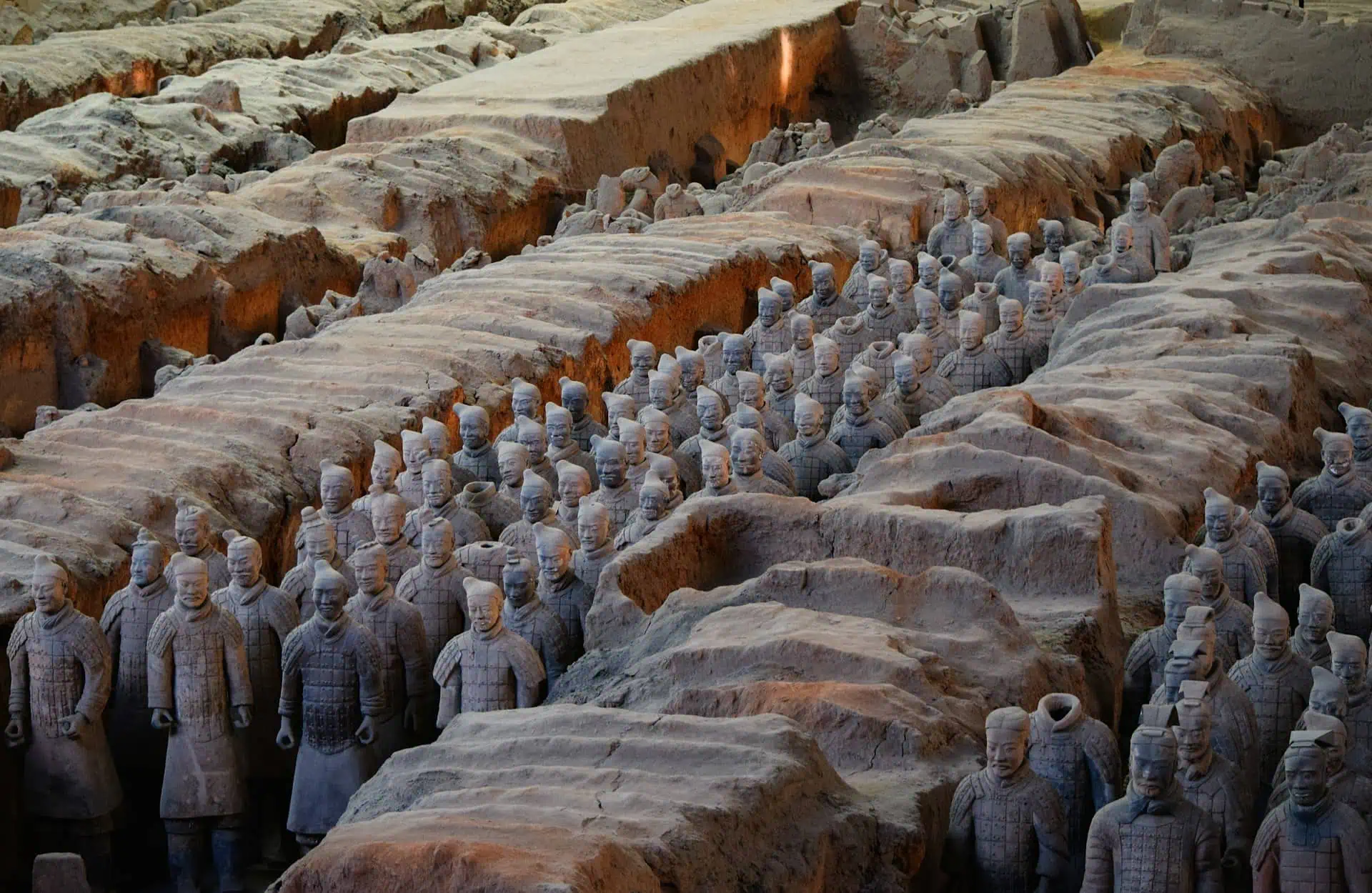
In March 1974, during a drought, farmers from Xiyang village (西杨村, Xīyángcūn) in Lintong (临潼, Líntóng) were digging a well about 1.5 km east of the tomb mound when their shovels struck baked clay — then a life-sized terracotta head. One of the diggers, Yang Zhifa (杨志发, Yáng Zhìfā), carted the fragments to the county cultural bureau; archaeologists arrived that summer and realized they were standing on one of the greatest finds of the twentieth century. Pit 1 opened to visitors in 1979, UNESCO listed the site in 1987, and the digging has never really stopped. Two half-scale bronze chariots, unearthed in 1980 west of the mound, proved the complex held far more than one army. And much of it stays buried on purpose: the figures were painted in vivid colors, and the ancient lacquer beneath the pigment curls and flakes within minutes of exposure to dry air. Until conservation catches up, thousands of soldiers are safer underground. For the visitor's side of the story — tickets, timing, transport — use our Terracotta Army guide, and see how the day fits into a 3-day Xi'an itinerary.
Where to see this today
- The Terracotta Army: Pits 1–3, the glass-case master figures, and — via the free shuttle — the Lishan Garden mausoleum park with the bronze chariots and the unopened tomb mound. One ticket covers it all.
- The Qin beyond the army: the Shaanxi History Museum's early galleries hold banliang coins, standard weights and Qin bronze weapons (free, but reserve a timed slot ahead; no full page on this site yet).
- The dynasty that learned from him: Hanyangling, the tomb of the Han emperor Jing — a deliberately modest, human-scaled answer to Qin excess, and a fascinating comparison.
- The big frame: where the Qin sits among the thirteen dynasties that ruled from this plain — the thirteen-dynasties timeline and a short history of Xi'an.
- Sleep near the site: the Lintong area puts you at the gates at opening time, before the tour buses.
Questions, answered
Why did Qin Shi Huang build the Terracotta Army?
The army was the garrison of an underground empire built to serve him in the afterlife: infantry, cavalry, chariots and command staff in full battle formation, facing east toward the states he had conquered. Qin belief treated the afterlife as a continuation of this one — so he took the machinery of power with him, down to the officials, acrobats and stable hands found in satellite pits.
How many terracotta warriors are there?
The standard estimate for the main pits is about 8,000 soldiers, 130 chariots with 520 horses and 150 cavalry horses — and large areas remain unexcavated, so the real total is likely higher. Only a fraction is on display; the rest stays buried for conservation reasons.
Will Qin Shi Huang's tomb ever be opened?
Not soon. The burial chamber is sealed and deliberately unexcavated: archaeologists don't yet trust conservation technology (the painted warriors showed how fast artifacts degrade in air), and mercury is a real hazard — soil tests confirm the ancient account of mercury rivers inside. Think decades, not years.
Why are the terracotta warriors broken?
A few years after the emperor's death, around 206 BC, rebels smashed the figures, looted the real weapons and set fire to the pits' wooden roofs, which collapsed onto the army. The museum names the rebel leader Xiang Yu as the prime suspect. Nearly every figure you see has been reassembled from fragments by conservators.
How did Qin Shi Huang change China?
In one decade he imposed a single script, currency, weights and measures, standardized cart axle widths, connected the northern walls into an early Great Wall, and replaced feudal states with centrally appointed officials. His dynasty collapsed three years after he died — but the unified template he forced through lasted two thousand years.