Xi'an in 3 Days: The Flagship First-Timer Itinerary
Three days, three thousand years: the plan we hand to friends visiting Xi'an (西安, Xī'ān) for the first time — greatest hits, realistic timing, no wasted motion. Day 1 stays inside the Ming city wall — the historic core, done by bike and on foot, ending in the food lanes of the Muslim Quarter. Day 2 is the Lintong run — the Terracotta Army early, Huaqing Palace after, back in town for noodles. Day 3 slows down for the province's great museum and the pagoda district, then closes with Xi'an's best night walk.
Two things to arrange before you arrive: Terracotta Army tickets (real-name booking, passport required) and a free reservation slot for the Shaanxi History Museum — details are in the stops below. Everything else is walk-up.
Budget: roughly ¥700–1,100 per person (about US$100–150 / €90–140) excluding hotels — admissions, food and local transport. Seasons: spring and autumn give you the weather this plan assumes; summer works with earlier starts, and winter is fine if you dress for the wall. You'll ride the metro constantly — read Getting around Xi'an once and you're set.
Day 1
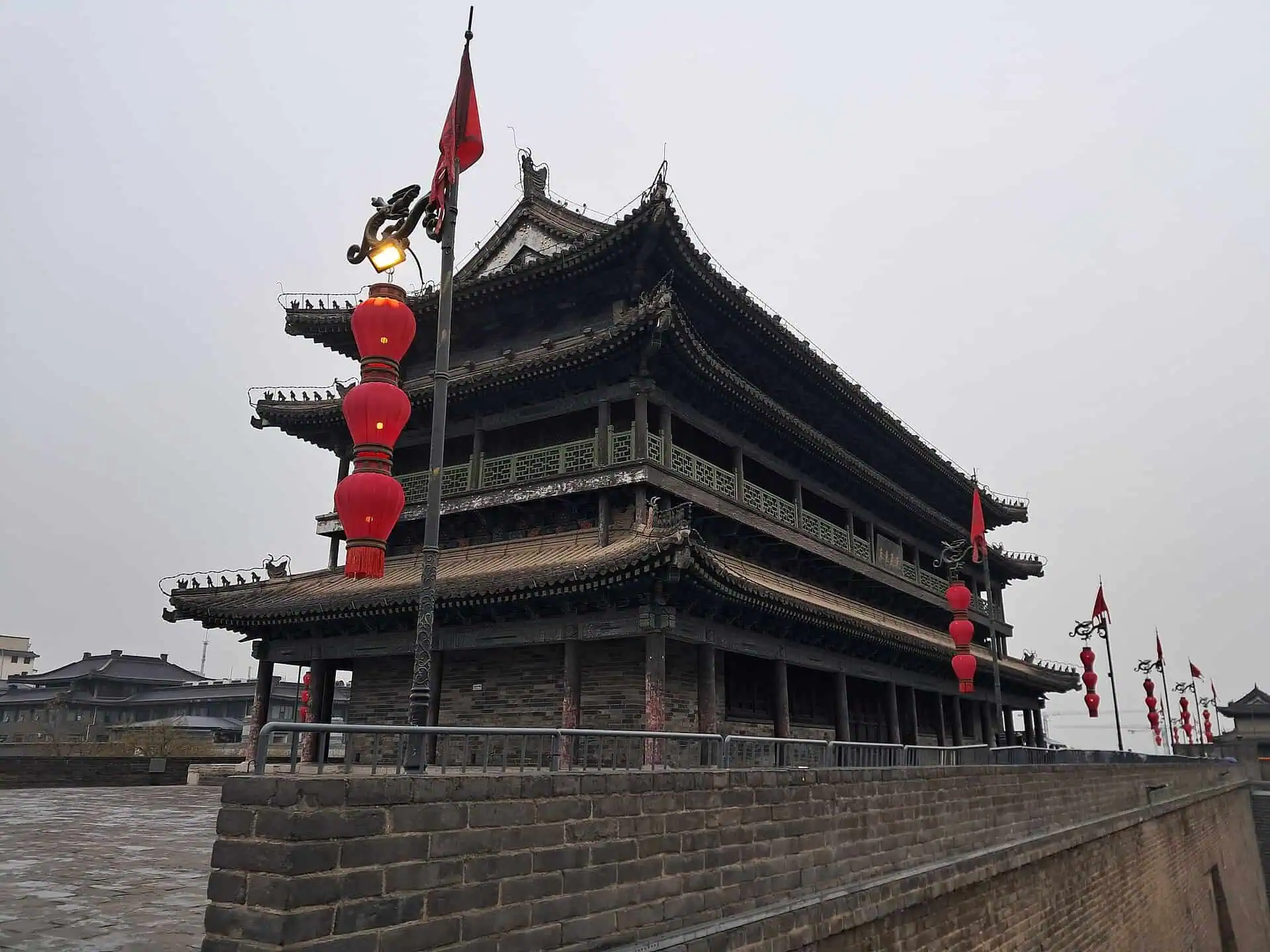
Start at the South Gate (永宁门, Yǒngníngmén), the wall's main and most photogenic entrance, and rent a bike on the ramparts. Ride as much of the 14 km rectangle as you enjoy — the full loop takes 1.5–2 hours at sightseeing pace. Go early: by late morning the top is hot and busy. Full details in the City Wall guide.
Metro Line 2 from Yongningmen one stop north to Zhonglou (Bell Tower), or walk 15 minutes up South Street.
- 12:00–13:00Lunch: roujiamo near the Bell Tower
Time for Xi'an's answer to the burger: roujiamo (肉夹馍, ròujiāmó) — slow-braised meat stuffed into a crisp baked bun. The streets radiating from the Bell Tower are full of options; add a cold liangpi or a soda and lunch lands around ¥20–35. Order at the counter, eat standing, keep moving.
The afternoon is all on foot — the two towers are a 10-minute walk apart.
- 13:30–16:30Bell Tower & Drum Tower stroll
The Bell Tower (钟楼, Zhōnglóu) marks the exact center of the Ming street grid — circle it through the pedestrian underpass for the classic angles. A few minutes west, the Drum Tower (鼓楼, Gǔlóu) fronts the entrance to the old Muslim quarter. Climbing one tower is enough for the view; the square between them is the photo you actually want.
The Muslim Quarter begins directly north of the Drum Tower — a two-minute walk.
Come hungry — this is dinner. The main lane is spectacle; the side alleys toward Dapiyuan (大皮院, Dàpíyuàn) and Sajinqiao (洒金桥, Sǎjīnqiáo) are where the eating gets serious, so graze, share and pace yourself. Our Muslim Quarter guide maps the lanes, and the street-by-street eats guide has the hit list.
Zhonglou station (Line 2) is a 10-minute walk back through the underpass; taxis wait at the Quarter's southern end.
Day 2
Leave Xi'an by 8:00 — the Terracotta Army (秦始皇帝陵博物院, Qínshǐhuángdì Líng Bówùyuàn) is 35 km east and Pit 1 before the tour-bus waves is a different experience from Pit 1 at noon. Tickets are real-name and booked online days ahead; the passport you booked with is your ticket, so bring it. Route: Pit 1 first, then Pit 3, then Pit 2 for the glass-case figures, and the bronze chariots at Lishan Garden if you have the legs.
Taxi or local bus 602/613 from the museum to Huaqing Palace — about 15 minutes.
The Tang emperors' hot-spring retreat (华清宫, Huàqīng Gōng) sits at the foot of Mount Li (骊山, Líshān): imperial bath pools, the Yang Guifei romance, and a cable car up the mountain if you're still going strong. Afternoon light suits it, and it's a gentler, greener counterweight to the morning's intensity. Details in the Huaqing Palace guide.
Metro Line 9 from Huaqing Pool station (华清池) back toward the city, or a ¥120–150 DiDi straight downtown — about an hour either way.
- 19:00Dinner back downtown: biangbiang noodles
You've earned noodles. Find a bowl of biangbiang noodles (biángbiáng面, biángbiáng miàn) — belt-wide ribbons slapped against the counter, dressed with chili oil and vinegar. Any busy shop near your hotel works; the crowd is the review.
Day 3
Shaanxi History Museum (陕西历史博物馆, Shǎnxī Lìshǐ Bówùguǎn) is free, but a real-name timed reservation is essential — slots release days ahead and popular dates go fast, so book as soon as your plans are fixed. It is closed on Mondays — pick your museum day around that. The run from Zhou bronzes to Tang gold is the context for everything you've seen this trip; the Tang murals hall costs extra and rewards the keen. Take metro Line 2 or 3 to Xiaozhai (小寨) and walk 10 minutes east — metro basics in Getting around Xi'an.
A 15-minute walk or one metro stop south to the Big Wild Goose Pagoda — no taxi needed.
The Big Wild Goose Pagoda (大雁塔, Dàyàntǎ) has held the sutras the monk Xuanzang (玄奘, Xuánzàng) carried home from India since 652 — the real journey behind Journey to the West. Climb the pagoda if the queue is short; the temple grounds and the enormous north square are the atmosphere. Leave time for tea in the area — tonight ends late.
Stay put — the Ever-Bright City pedestrian boulevard starts at the pagoda's south square. Have an early dinner nearby, then re-emerge as the lights come on.
Grand Tang Dynasty Ever-Bright City (大唐不夜城, Dàtáng Bùyèchéng) is Xi'an's flagship night walk: a free, roughly 2 km boulevard of Tang-style facades, light shows and street performers that is genuinely spectacular after dark. Weeknights beat weekends by a wide margin. When you're done, Dayanta station (Lines 3 and 4) takes you home — a fitting last night.