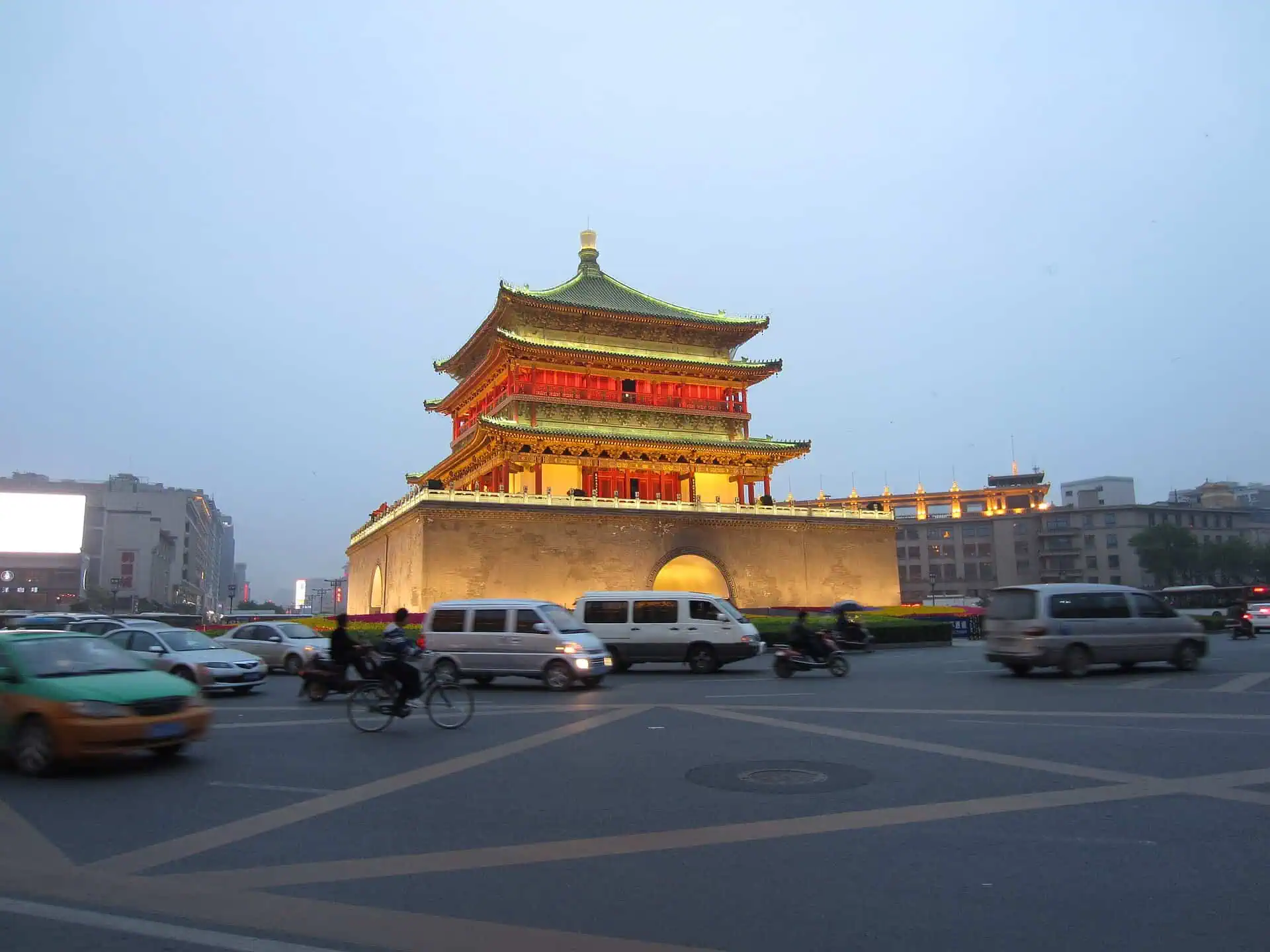
Xi'an Bell Tower
Xī'ān Zhōnglóu
A Ming tower from 1384 at the dead center of the walled city — best admired at dusk, floodlit above the roundabout.
Entry
From ¥30
Hours
Apr 1 – Oct 10 · 8:30
Time needed
30 min–1 hours
Metro
Line 2 · Zhonglou (钟楼) · C
Since 1384, this wooden tower has marked the exact middle of Xi'an, where the four main streets meet. Going inside takes 30 minutes and is pleasant rather than essential — the tower's real performance is exterior and free, when it lights up after dark over the ring road. See it at dusk on your way from the City Wall to the Muslim Quarter, and buy the ¥50 combo if you're also climbing the Drum Tower.
What you're looking at
The Bell Tower (钟楼, Zhōnglóu) was raised in 1384, early in the Ming dynasty — and not here. It first stood two blocks west at the Guangji Street junction; in 1582, as the Ming city's center of gravity shifted east, the entire timber structure was dismantled and re-erected on a new brick base at this crossing. It has anchored the city ever since: East, South, West and North Streets run straight from its four sides to the four gates of the City Wall.
The building is a 36-meter stack: a square brick base pierced by cross-shaped archways where traffic once passed, carrying a triple-eaved wooden tower with dark green glazed tiles, gilded finial, and classic Ming joinery that uses no iron nails. From the top gallery you get the planner's view — four dead-straight avenues radiating to the wall gates, with the Drum Tower (鼓楼, Gǔlóu) visible to the northwest.
The bell that made it famous is the Jingyun bell (景云钟, Jǐngyún Zhōng), cast in 711 AD under the Tang — centuries older than the tower. It hung here for hundreds of years; the original now lives in the Forest of Steles Museum, and the tower keeps a faithful replica. Together with the drums of the Drum Tower it formed the city's clock — "morning bell, evening drum" (晨钟暮鼓, chén zhōng mù gǔ) — marking the day's start and end for everyone inside the walls. Inside, a small exhibition and short chime-bell performances at intervals during the day (times posted at the ticket office) fill out the visit.
Visiting strategy
Time it for dusk. Go up in late daylight for the four-street axis view, then come down and watch the tower ignite as the sky darkens — floodlit gold above a carousel of headlights. This is the single best free sight in the old town, and it costs nothing.
The honest verdict on the interior: nice, not unmissable. The exhibition is modest, the bell is a replica, and the view from the gallery is good but partial. At ¥30 it's a fair trade; if your legs or budget are rationed, the exterior at night delivers most of the magic. If you're choosing one tower interior, the Drum Tower edges it — drumming performances and a balcony over the Muslim Quarter rooftops — but the ¥50 combo makes doing both easy.
The classic photo isn't from the tower, it's of it: the pedestrian ring at street level, or the viewing terrace of the Kaiyuan Mall (开元商城) opposite, frames the tower with the roundabout's light trails. Bring your phone up around 19:00 in summer, earlier in winter.
Build it into an evening: Bell Tower at dusk, walk five minutes northwest to the Drum Tower, then straight into the Muslim Quarter for dinner — the towers light your way in. Our 1-day itinerary runs exactly this sequence.
One logistical quirk: you can't cross to the tower at street level — entry is through the pedestrian underpass that also serves the metro. Follow the signs; it's easier than it sounds.
Getting there
You're aiming for the geographic center of the old city — everything converges here.
- Metro: Lines 2 and 6 both stop at Zhonglou (钟楼) station, directly beneath the roundabout. Use the underpass exits signed for the Bell Tower (the Exit C area lands you by the ticket office). See our getting around guide for metro basics.
- On foot: 10 minutes south from the Drum Tower / Muslim Quarter, or 10–15 minutes north from the South Gate of the City Wall — the tower is visible the whole way, you cannot get lost.
- Taxi/DiDi: ask for 钟楼. Drivers drop you at the ring around the tower; the last 50 meters are through the underpass. Around rush hour the roundabout crawls — the metro is faster.
Coming from the airport or Xi'an North station, the metro drops you underneath the tower with no changes to think about; see getting to Xi'an.
Practical notes
- Tickets: ¥30 at the underpass ticket office or via WeChat; the ¥50 Bell + Drum Tower combo pays off if you're doing both. No passport or advance booking required.
- Stairs: the underpass and the tower's upper floors are stairs only. If steps are a problem, enjoy it from street level — you lose little.
- Best light: roughly sunset through about 22:00, when the tower is floodlit. Midday visits are flat and hot in summer.
- Holidays: during Chinese public holidays the roundabout area packs with people and the underpass runs crowd control — doable, but allow extra time. Our crowds guide explains the rhythm.
- Toilets: use the surrounding malls (Kaiyuan Mall is closest) before or after — there are none in the tower.
- Evening safety: the underpass and ring are busy but well lit and policed; keep phones in front pockets in the holiday crush.
Questions, answered
How much does the Xi'an Bell Tower cost?
Entry is ¥30, with no advance booking required — buy at the ticket office in the pedestrian underpass. A ¥50 combo ticket covers both the Bell Tower and the Drum Tower, five minutes' walk apart.
Bell Tower or Drum Tower — which should I visit?
If you only climb one, pick the Drum Tower for its drumming performances and the balcony view over the Muslim Quarter. The Bell Tower's magic is mostly exterior — floodlit above the roundabout after dark — and that's free. The ¥50 combo makes doing both interiors easy.
What time does the Xi'an Bell Tower light up at night?
The tower is floodlit from dusk until late evening (roughly 22:00 or later). The best window is the hour after sunset, when the sky still holds color and the tower glows gold over the ring road. Street-level viewing is free.
How long do you need at the Bell Tower?
30–45 minutes covers the climb, the small exhibition and the gallery views. Combine it with the Drum Tower and a Muslim Quarter dinner for a full evening — everything is within a 10-minute walk.
How do you get inside the Xi'an Bell Tower?
Through the pedestrian underpass beneath the roundabout — the same passage that serves Zhonglou metro station (Lines 2 and 6). Follow signs for the Bell Tower; the Exit C area brings you up by the ticket office. You cannot cross at street level.
Why is the Xi'an Bell Tower famous?
Built in 1384, it marks the exact center of the Ming dynasty city, where the four main streets meet on their way to the four wall gates. Its 711 AD Jingyun bell (now in the Forest of Steles Museum, with a replica in the tower) rang out the city's mornings for centuries.
Keep exploring
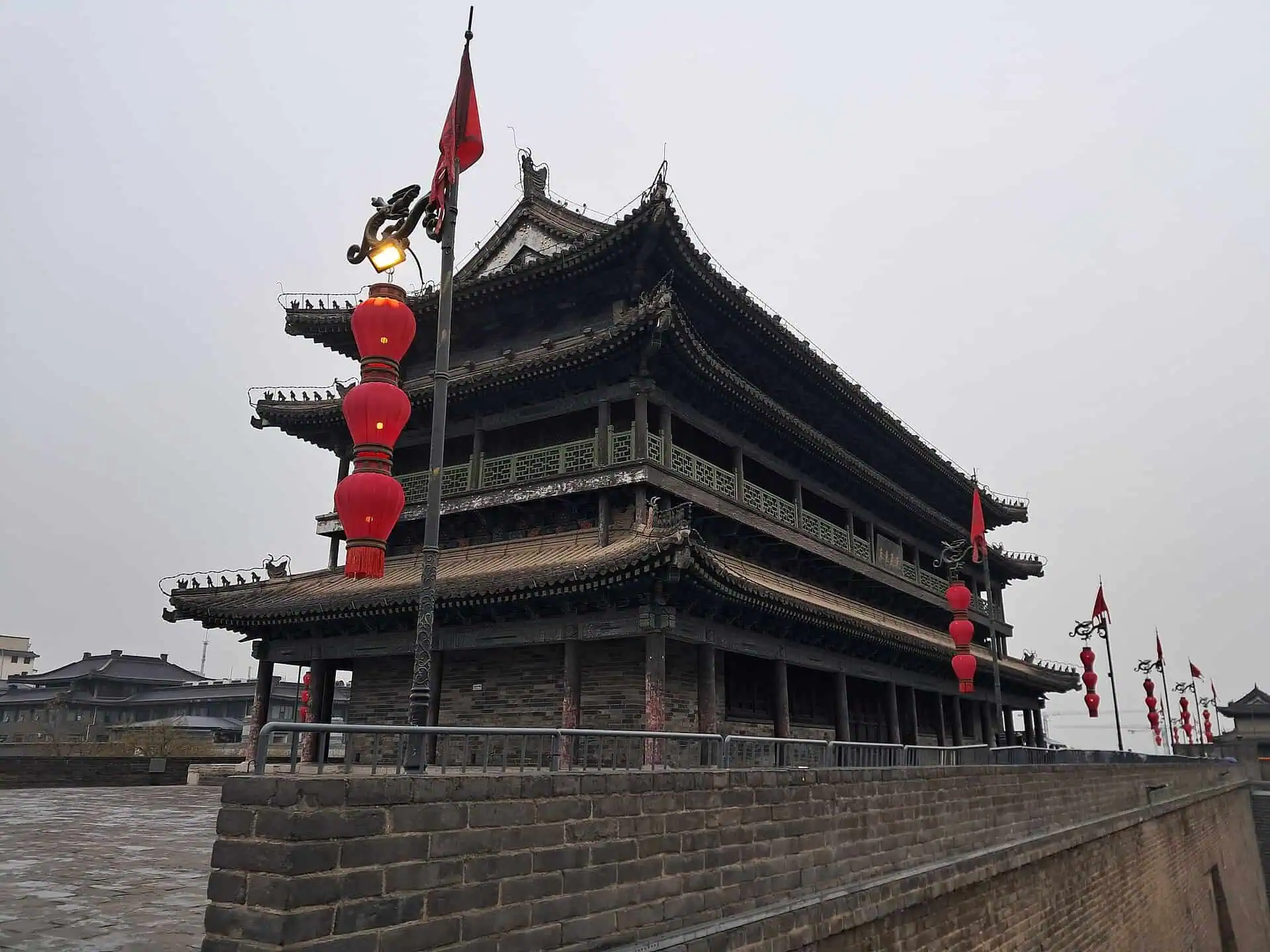
Xi'an City Wall
A 14-kilometer Ming dynasty rectangle you can cycle on top of — 650 years old and still the city's favorite commute.
Learn more →
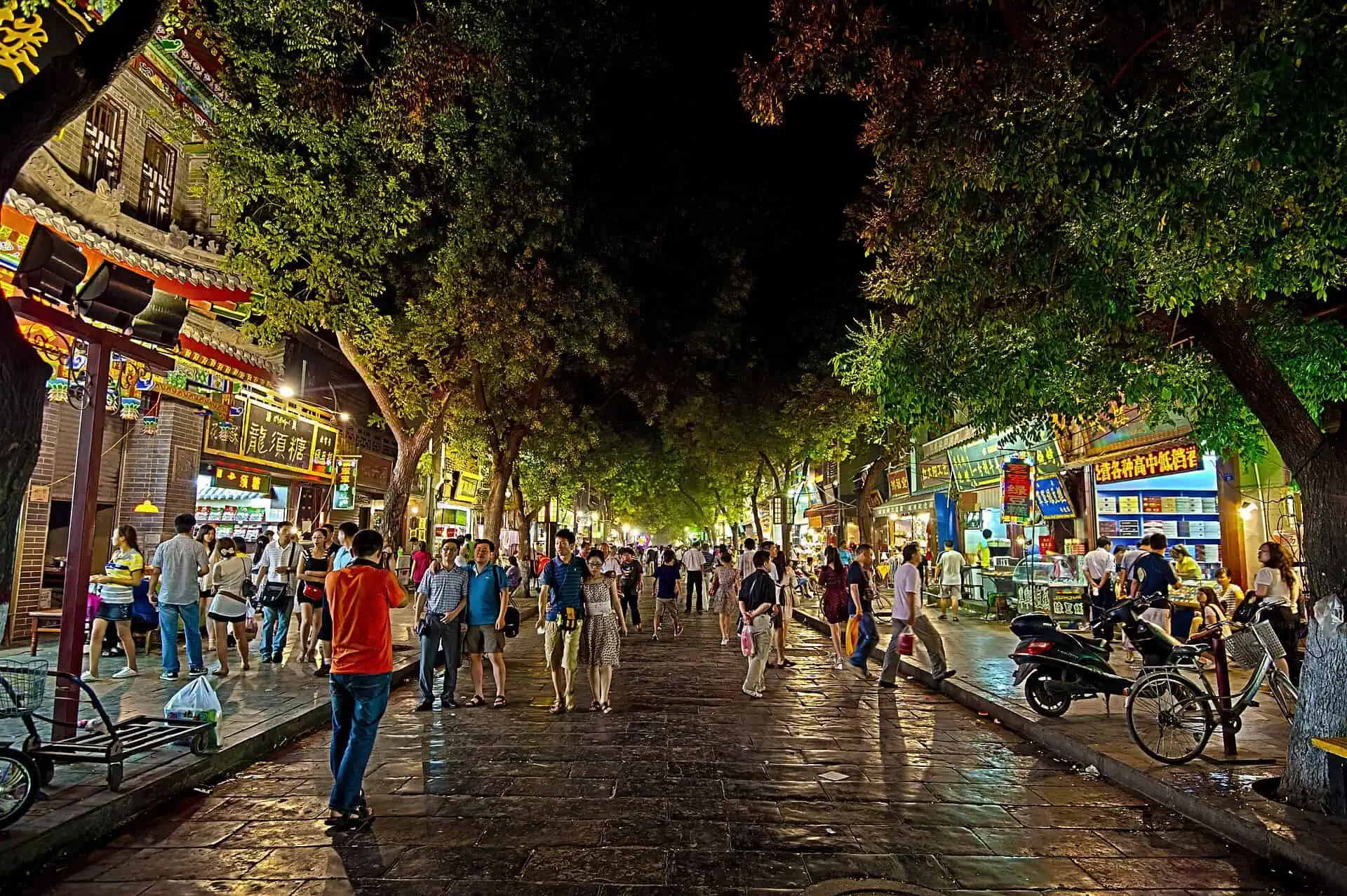
Muslim Quarter
Feeding Xi'an since the 700s — the loudest, smokiest, best-smelling streets of its Hui community.
Learn more →
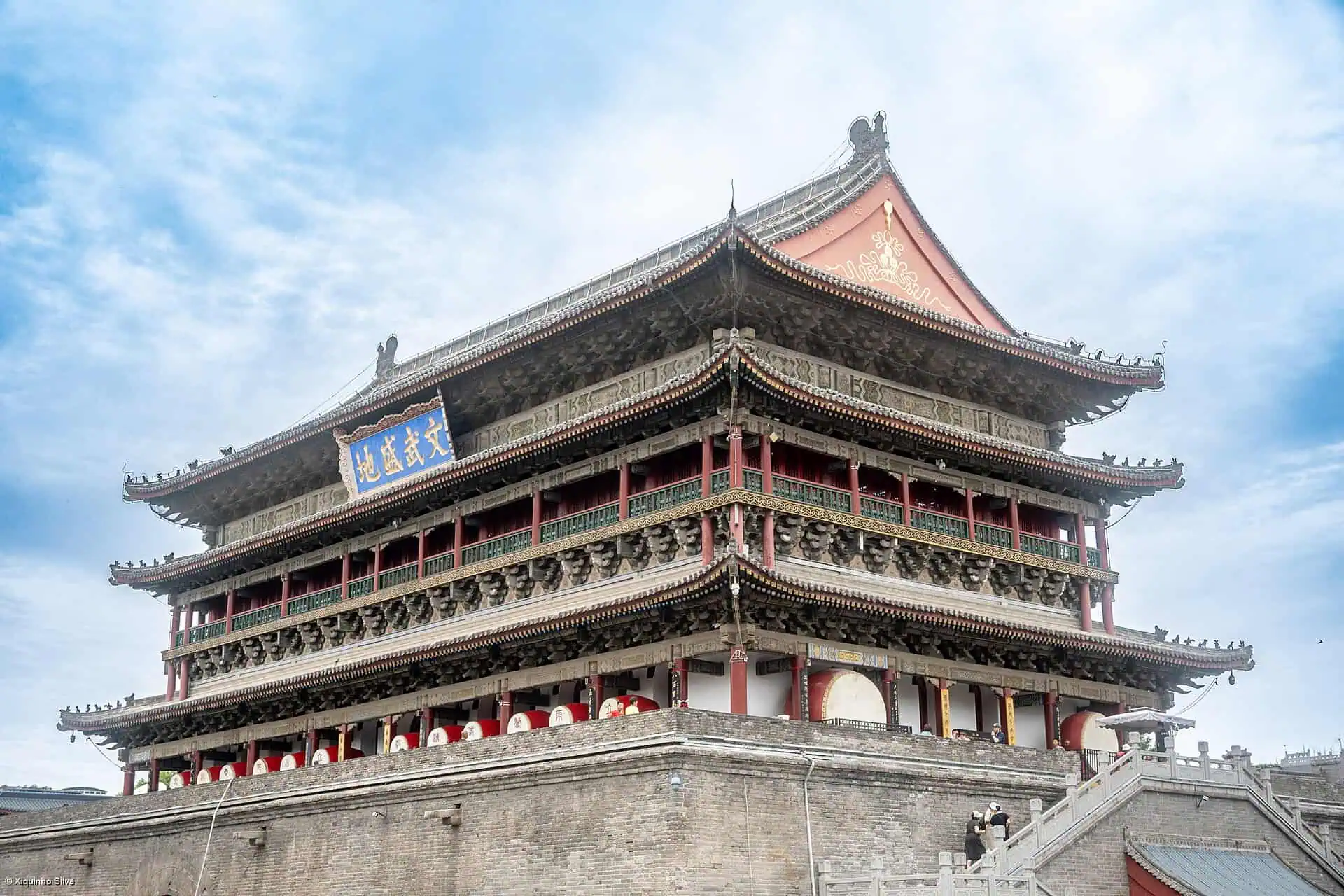
Xi'an Drum Tower
Built in 1380, four years before its famous sister — the tower whose drums closed every Xi'an day, and the gateway to the Muslim Quarter.
Learn more →
Related stories
Where to stay in Xi'an: the honest area-by-area guide
Xi'an is a compact city with a decisive metro, so the choice of base matters more for mood than logistics. For most first-timers the answer is inside the City Wall near the Bell Tower; below is every realistic alternative, with the character, the crowd it suits and what a room actually costs in each.
Accessibility in Xi'an: an honest audit
Xi'an is a 3,000-year-old city running on modern infrastructure, and accessibility splits exactly along that line: the metro and the big modern museums are genuinely step-free, while anything involving a 600-year-old gate, tower or pagoda usually means stairs. Here's what works, what doesn't, and what to confirm before you fly.
Xi'an vs Beijing: how to split your China trip
The classic first-timer's dilemma, settled honestly: Beijing has the Forbidden City and the Great Wall, Xi'an has the Terracotta Army and a wall you can cycle — and they're different enough that most trips should include both. Here's what each city actually gives you, what it costs, and how to divide a week between them.
Xi'an vs Luoyang: the two ancient capitals, compared honestly
Both cities claim thirteen dynasties, both are 1.5 hours apart by high-speed train, and they complement each other better than they compete: Xi'an has the Terracotta Army and Tang cosmopolitanism at full volume, Luoyang has the Longmen Grottoes and a slower, quieter, cheaper rhythm. Here's the category-by-category comparison, and how to fit both into one trip.
Tang Dynasty show & dumpling banquet — worth it?
The Tang Dynasty Palace dinner show is Xi'an's longest-running tourist evening: a dumpling banquet followed by an hour of Tang court music and dance in a plush theater. It's polished, comfortable and unashamedly aimed at visitors — and whether it's ¥400 well spent depends entirely on who you are. Families and first-time visitors to China tend to love it; travelers chasing the raw and local should spend the evening at Ever-Bright City for free instead.
Xi'an at night: lights, shows & evening walks
Xi'an is a different city after dark — Tang-style streetscapes floodlit gold, a pagoda floating over fountain shows, gate towers glowing above the moat. The best of it is free: the Grand Tang Ever-Bright City pedestrian street alone is worth an evening, and the pagoda fountain show costs nothing. Add a late dinner in the Muslim Quarter and, in season, the open-air Song of Everlasting Sorrow, and your nights may outshine your days.
Nightlife & craft beer in Xi'an
Xi'an is not Shanghai — nobody flies here for the clubs. But the city has bar streets with real history clustered around the South Gate, a small but genuine craft beer scene, a working livehouse circuit, and KTV as a full-contact local pastime. Here's what's actually worth your evening, what it costs, and what to skip.
The photographer's Xi'an: best spots & times
Xi'an rewards photographers who plan around light, not locations. The city's great subjects — walls, towers, pagodas, night markets — are all floodlit after dark, which means the magic window is the same almost everywhere: the hour around sunset. Here's where to stand, when to be there, and the rules that can cost you your drone.
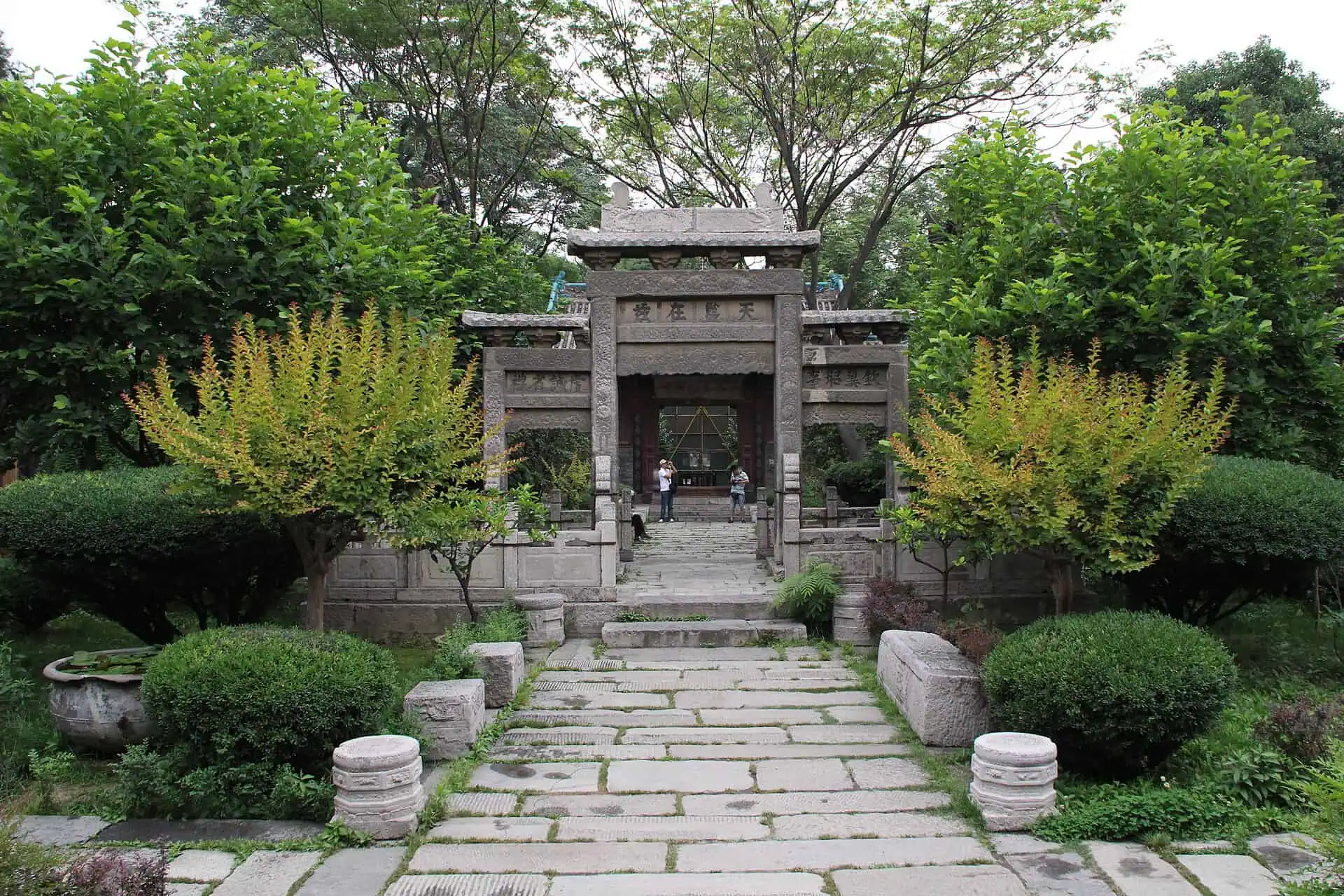
The Hui community and Islam in Xi'an
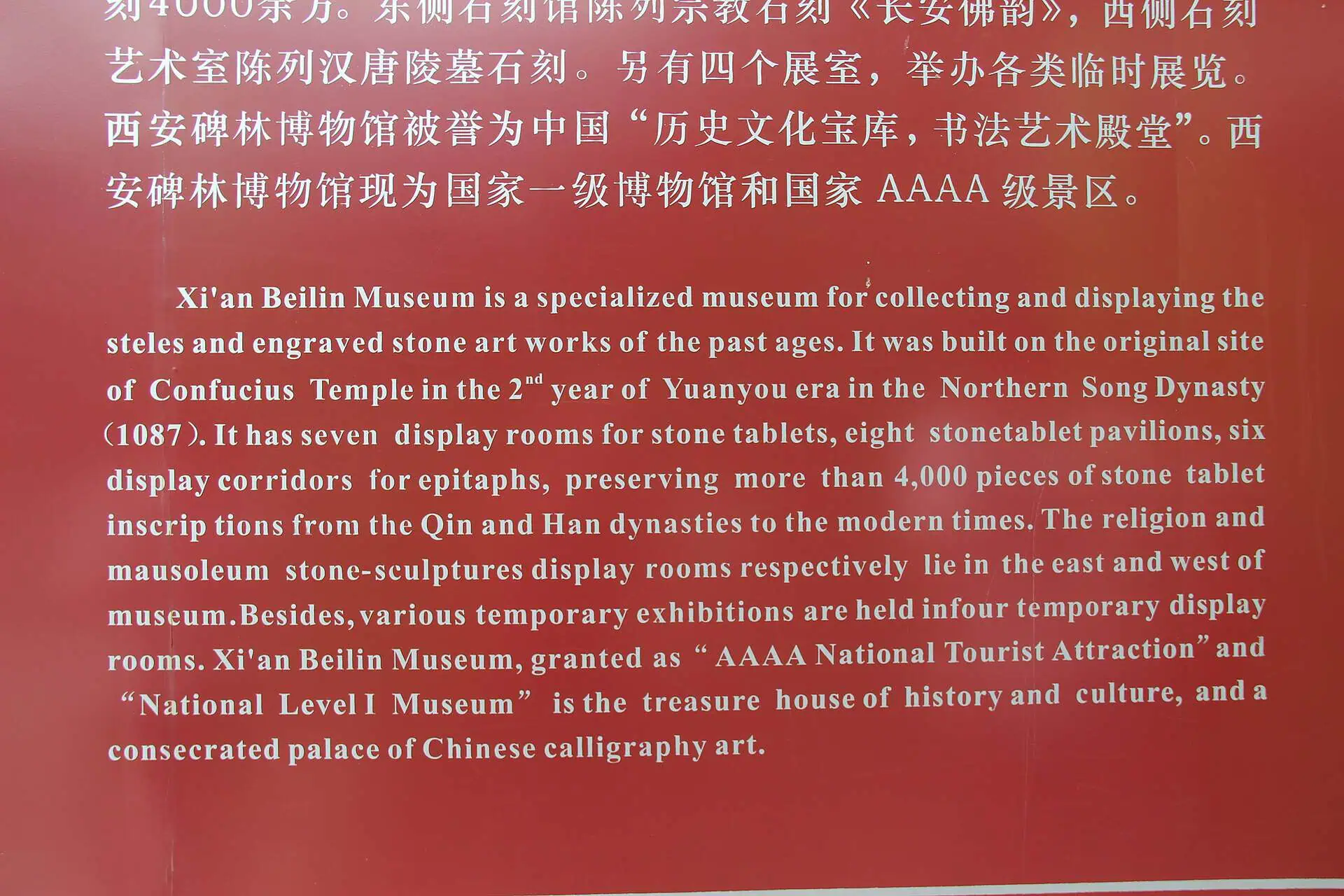
Thirteen dynasties: Xi'an as capital, a visual timeline
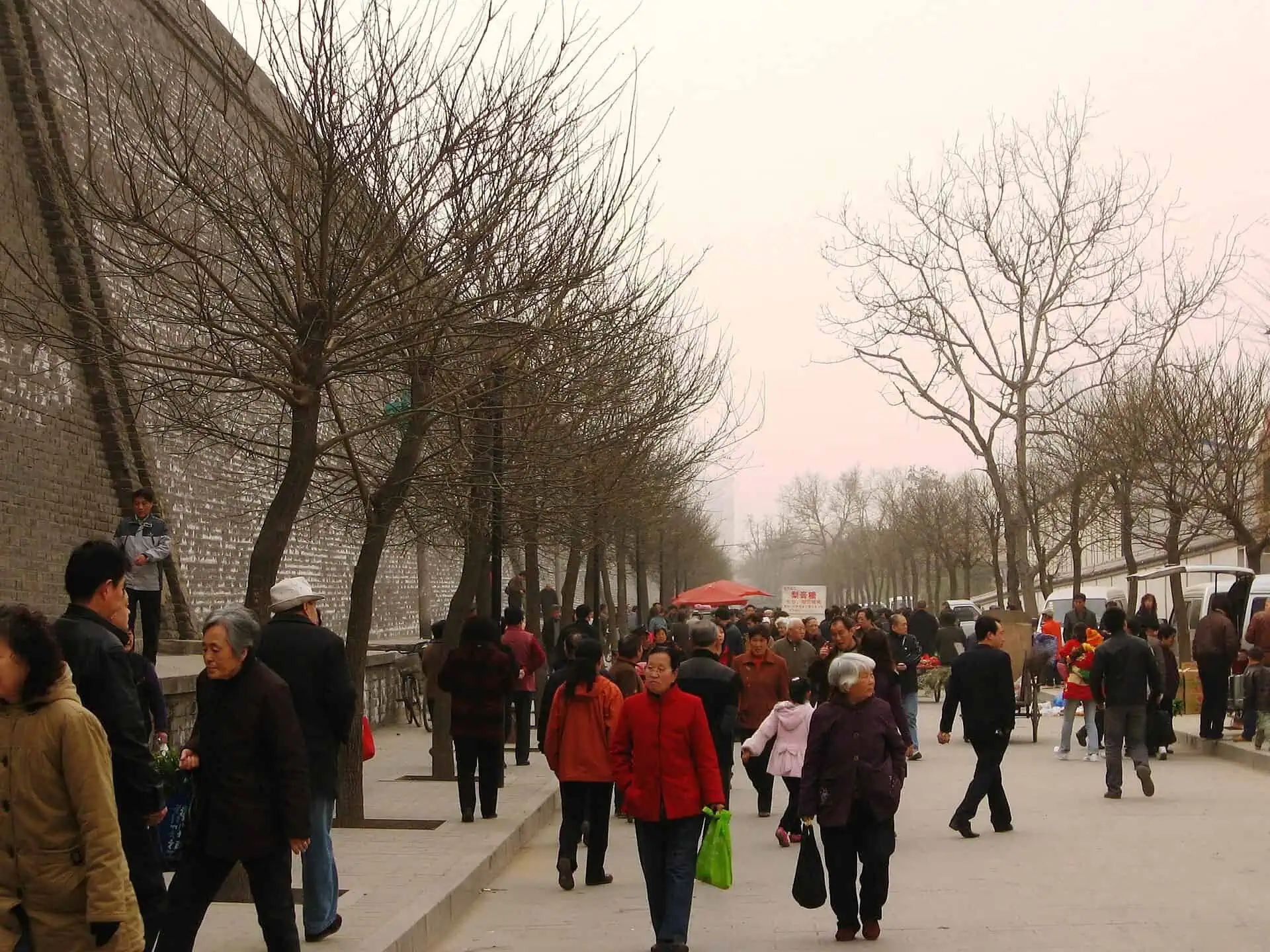
Market hours: Xi'an at dawn and after dark
Qinqiang: the bellowing opera that's the soul of Shaanxi
Qinqiang (秦腔) is Shaanxi's regional opera — the oldest of China's clapper operas, sung high, loud and raw to the crack of a wooden bangzi. It is not polite Peking opera; it is the sound of the loess plateau shouted back at itself, and locals call it the soul of Shaanxi. See it at Yisushe (易俗社), the century-old theatre a few minutes from the Bell Tower.
Is Xi'an safe for solo and women travelers? An honest answer
By the consensus of Western travel writing, Xi'an is one of the safer major Chinese cities for people traveling alone — violent crime against tourists is rare, and women walking at night inside the city wall report few problems. The risks worth planning for are mundane ones: pickpockets in the Muslim Quarter and Terracotta Army queues, scam touts, and the logistics of getting around without fluent Mandarin. Here is an honest, specific assessment — the reassurance and the caveats.