Terracotta Army
Qínshǐhuángdì Líng Bówùyuàn (Bīngmǎyǒng)
8,000 life-sized soldiers buried for China's First Emperor — and still on guard 2,200 years later.
Entry
From ¥120
Hours
Mar 16 – Nov 15 · 8:30
Time needed
2½–4 hours
Booking
Required · 7 days ahead
Metro
Line 9 · Huaqing Pool (华清池) · C
For 2,200 years, an army has been standing at attention in the Lintong clay — and Pit 1 still knocks the wind out of everyone who sees it. Pit 1 alone — a battle formation of thousands of unique, life-sized soldiers — is worth the trip to China. Go early, bring your passport, and don't skip the mausoleum park included in your ticket.
What you're looking at
In 246 BC, a 13-year-old king became ruler of the Qin state and immediately ordered work to begin on his tomb. By the time Ying Zheng had conquered every rival state and crowned himself Qin Shi Huang — First Emperor of a unified China — an estimated 700,000 laborers had spent decades building him an underground empire. The terracotta army was its garrison: a full military formation of infantry, cavalry, chariots and generals, built to protect him in the afterlife.
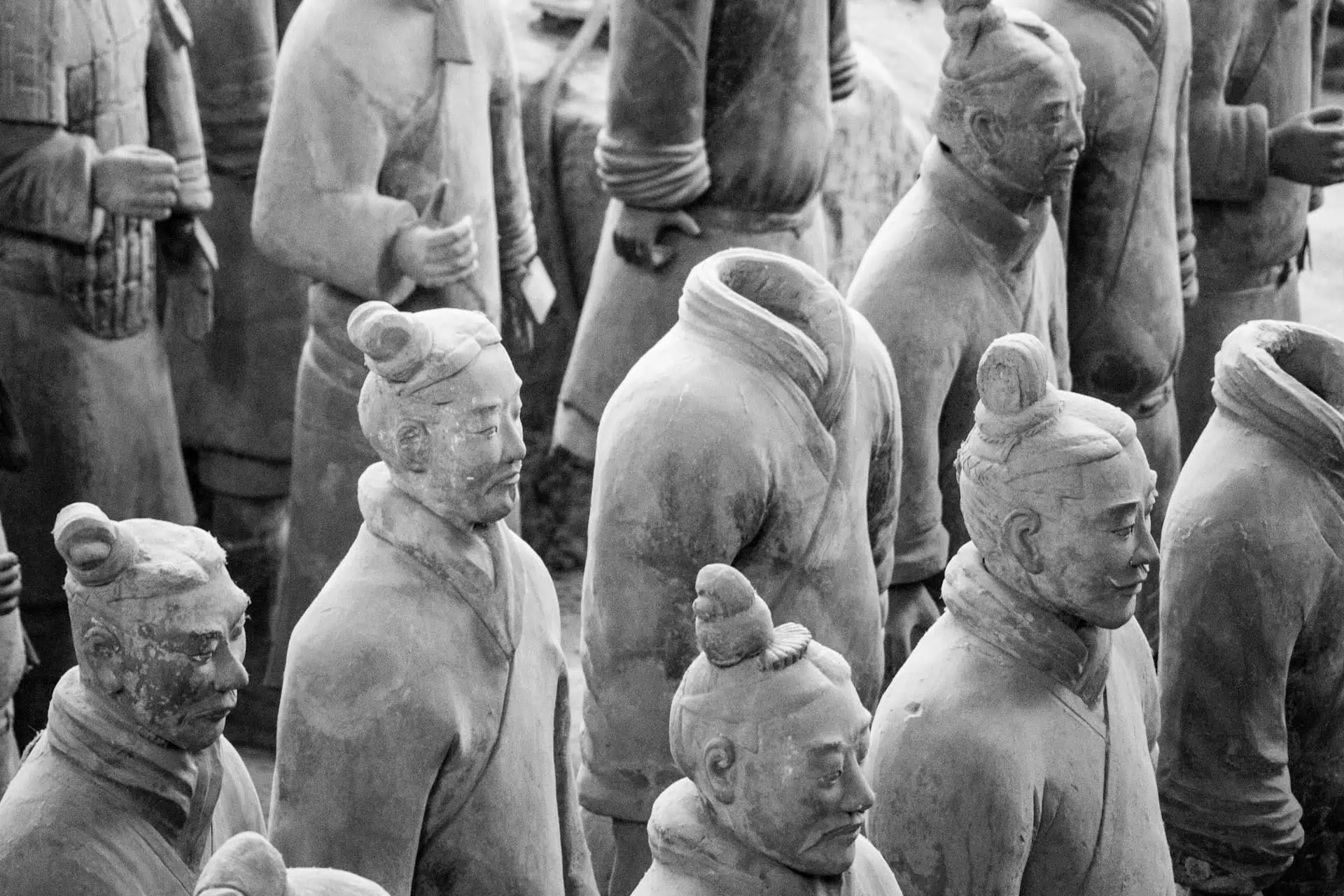
Every figure is an individual. Faces, topknots, armor plates and even shoelaces differ — soldiers were assembled from standard body parts, then finished by hand so no two are alike. They were originally painted in vivid mineral colors (traces survive on a handful of figures) and carried real bronze weapons, many still sharp when excavated thanks to a chrome-salt coating that prevented rust for two millennia.
The army was forgotten for over 2,000 years until March 1974, when farmers digging a well during a drought hit a terracotta head. What archaeologists eventually mapped:
- Pit 1 — the one from the photographs. A 230-meter hangar holding a battle formation of some 6,000 infantry and horses, still emerging from the earth in the rows where they were found. This is the emotional knockout.
- Pit 2 — the tactically interesting one: cavalry, archers, chariots and mixed units. Several of the finest individual figures (including the famous kneeling archer) are displayed here in glass cases at eye level.
- Pit 3 — small but significant: the command post, with senior officers and a war chariot.
- Lishan Garden — the mausoleum park around the emperor's tomb mound, 1.5 km west and included in your ticket, with a free shuttle bus. The tomb itself remains unexcavated (Sima Qian's account of rivers of mercury inside has kept archaeologists cautious — soil tests confirm abnormally high mercury levels). The two half-scale bronze chariots, the finest bronzes ever found in China, are displayed in the park's museum.
One honest note: you view the pits from elevated galleries, not from among the warriors. The scale still overwhelms — but anyone promising you a walk between the ranks is selling something.
Visiting strategy
Timing beats everything here. Tour buses arrive in waves between about 10:00 and 14:30. Come at opening (8:30) and you'll photograph Pit 1 with a railing to yourself; come after 15:00 and the day-trippers are already back on the highway. Weekdays beat weekends; Chinese public holidays are a different sport entirely.
A route that works: Pit 1 first, while it's quiet — nothing else on site competes with it, so take the impact early. Then Pit 3 (small, five minutes) and Pit 2, where the glass-case figures let you study faces and armor up close. Finish at the exhibition hall, then, if you have the legs, take the free shuttle to Lishan Garden for the bronze chariots and the tomb mound.
Budget your time: the main museum deserves 2–3 hours; add 60–90 minutes for Lishan Garden. Combined with transport, this is a half-day trip minimum — don't schedule anything before lunch.
Common mistakes to avoid:
- Forgetting your passport. Real-name ticketing means the passport you booked with is your ticket. No passport, no entry.
- Buying at the gate. There is effectively no walk-up ticket window for foreign visitors — book online before you go (see fact box).
- Falling for the "fake pits." Touts — and some private tour buses — divert first-timers to side "exhibition pits" of modern reproductions near the approach road, often luring them with "here you can touch the warriors" (you cannot, anywhere — the real pits are behind glass). The genuine museum is signed 秦始皇帝陵博物院 (Emperor Qinshihuang's Mausoleum Site Museum) and Pit 1 holds the actual excavated army. Don't let a "guide" talk you into a sideshow first.
- The "farmer who discovered the warriors" book signing. For years a man has sat in a gift shop signing books as one of the 1974 well-diggers. It's a canned photo-op — the discovery was a team of villagers digging a well, not a lone hero, and the signing exists to move overpriced books. Politely skip it.
- Bus 306 (游5) no longer leaves from Xi'an Station. Since October 2019 the municipal tourist bus 306 (游5) — grey-green, ¥5–7 fare — departs from Fangzhicheng Transit Hub (纺织城枢纽站) at Metro Line 1/9 Fangzhicheng Station, NOT the station's east square. Many older guides still say "east square" — that's years out of date and you'll waste a trip. Fake "游5" private minibuses still lurk near the station: they charge more and detour to commission shops; the real 306 boards only at Fangzhicheng.
- Following the "terracotta factory" detours. The road from the parking lot to the entrance is lined with souvenir shops and unofficial "guides." Official licensed guides wait inside, near the entrance hall.
- Skipping Lishan Garden. Many visitors don't realize it's included. The bronze chariots alone justify the shuttle ride.
Keep reading — 2 more sections
Getting there
The museum sits in Lintong District, about 35 km east of downtown Xi'an. You don't need a tour. Every option below is cheaper than one, independent visitors use exactly the same real-name passport ticketing, and licensed guides wait just inside the entrance hall if you want narration after all.
| Getting there | Time | One-way cost |
|---|---|---|
| Tourist bus 306 (游5) from Fangzhicheng | about 1 h | ¥5–7 |
| Metro Line 9 + Lintong bus 613 (or a short DiDi) | about 1.5 h | metro fare + ¥2 bus |
| DiDi / taxi from downtown | 40–60 min | ¥100–150 |
- Tourist bus 306 (游5) departs from Fangzhicheng Transit Hub (纺织城枢纽站) at Metro Line 1/9 Fangzhicheng Station — NOT Xi'an Railway Station's east square, where it stopped leaving from in October 2019 (many older guides still say east square; that's years out of date). Fare is ¥5–7 and the ride takes roughly an hour. Fake "游5" private minibuses still lurk near the railway station — they charge more and detour to commission shops. The real 306 boards only at Fangzhicheng.
- Metro Line 9 to Huaqing Pool station (华清池, exit C), then the Lintong 613 bus (about ¥2) or a 15-minute taxi hop to the museum. The metro leg avoids road traffic and works well if you're starting near a Line 9 connection.
- DiDi or taxi from downtown runs ¥100–150 and takes 40–60 minutes. Worth it at 7:30 in the morning when it buys you a near-empty Pit 1.
Many visitors combine the army with Huaqing Palace, two metro stops away — see our 3-day itinerary for how the day fits together.
Practical notes
- Food: on-site options are overpriced and forgettable. Eat a big breakfast, bring snacks, or eat back in Lintong town. The Muslim Quarter is a fine reward for your return.
- Payments: ticket booking is online-only, so have Alipay or WeChat Pay set up before you visit. The row of souvenir shops outside is cashless almost everywhere too.
- Toilets: available near each pit hall and at the visitor center; carry tissues as a habit anywhere in China.
- Luggage: storage at the visitor center — workable if you're coming straight from the airport or station, but a hotel drop-off is more comfortable.
- Kids: Pit 1's scale lands with children too; the galleries are stroller-friendly. Bring snacks and make Lishan Garden optional.
- Accessibility: ramps and elevators throughout the main halls; wheelchairs can be borrowed at the visitor center.
Questions, answered
Is the Terracotta Army worth visiting?
Yes — it's one of the few globally famous sights that exceeds expectations in person. Pit 1's scale doesn't translate to photographs. It's the single most-visited sight in Xi'an for a reason.
How long do you need at the Terracotta Army?
Allow 2–3 hours for the three pits and exhibition hall, plus 60–90 minutes if you add Lishan Garden (the mausoleum park, included in the ticket). With transport from Xi'an, it's a half-day trip minimum.
Can I buy Terracotta Army tickets at the gate?
Effectively no. The museum uses real-name timed-entry booking — reserve online via the official site or WeChat mini program up to 7 days ahead, and bring the passport you booked with. Third-party platforms (e.g. Trip.com) also sell tickets and are foreigner-friendly.
How far is the Terracotta Army from Xi'an?
About 35 km east of the city center — roughly an hour by tourist bus 306 (¥5–7, from Fangzhicheng Transit Hub, not the railway station), 40–60 minutes by DiDi or taxi (¥100–150), or metro Line 9 plus a short local bus or taxi hop.
Can I visit the Terracotta Army without a tour?
Yes — easily, and for less money. Take tourist bus 306 (¥5–7) from Fangzhicheng Transit Hub, ride metro Line 9 to Huaqing Pool and hop the Lintong 613 bus, or take a DiDi (¥100–150 each way). Book the real-name ticket online with your passport before you go. If you want narration, licensed guides wait inside the entrance hall — going independent costs you nothing but the guide's fee.
What is the best time of day to visit?
Opening time (8:30) or after 15:00. Tour groups flood the site between roughly 10:00 and 14:30. Avoid Chinese public holidays entirely if you can.
Can you go inside Qin Shi Huang's tomb?
No — the tomb mound itself is unexcavated. Ancient accounts describe rivers of mercury inside, and soil tests confirm high mercury levels, so archaeologists are waiting for technology that can preserve whatever is in there. You can visit the surrounding mausoleum park (Lishan Garden), which is included in your ticket.
Keep exploring

Huaqing Palace & Hot Springs
Tang emperors soaked here in the 700s — China's most famous love story, and the site of a 1936 kidnapping that changed the country.
Learn more →

Shaanxi History Museum
Every layer of Xi'an's time stack under one roof — Zhou bronzes, Han gold and Tang treasure.
Learn more →

Forest of Steles (Beilin Museum)
Stone books since 1087 — nearly 3,000 steles, and the home of Chinese calligraphy itself.
Learn more →
On video
Xi'an on video
What this place looks like on video.