
Shaanxi History Museum
Shǎnxī Lìshǐ Bówùguǎn
Every layer of Xi'an's time stack under one roof — Zhou bronzes, Han gold and Tang treasure.
Entry
From ¥270
Hours
May – mid-Nov · 8:30
Time needed
2½–4 hours
Booking
Required · 5 days ahead
Metro
Line 2 / 3 · Xiaozhai (小寨)
Every layer of this city's stacked past — Zhou bronzes, Han gold, Tang treasure — is gathered under one roof here, in the region's deepest collection. The Terracotta Army shows you one emperor's army; this shows you the 3,000 years around him — and entry is free. The catch: reservations are real-name, released in batches, and weekend slots can vanish within minutes. Sort your booking before anything else on your Xi'an list.
What you're looking at
Every sight in Xi'an is a fragment. The Shaanxi History Museum (陕西历史博物馆, Shǎnxī Lìshǐ Bówùguǎn) is where the fragments get assembled. Opened in 1991 in a Tang-style complex of courtyards and hip roofs, it holds around 1.7 million objects — the province's official share of a region that was China's capital for thirteen dynasties.
The basic exhibition runs chronologically through three halls, and the hits start early:
- Zhou bronzes — ritual cauldrons cast 3,000 years ago, including great ding tripods like the Duo You Ding, its interior covered in a long inscription recording a battle against steppe raiders. These were the state documents of their age, cast in metal.
- Han gold and jade — including a snarling gold beast with griffin antlers from the northern frontier, and the jade seal of an empress, found by a schoolboy on his way home from class.
- Tang tri-color (唐三彩, Táng sāncǎi) — the glazed tomb figures Xi'an is famous for: camels, grooms, polo players, and the star piece, a camel carrying a full band of musicians mid-performance.
- The Hejiacun hoard (何家村窖藏, Héjiācūn jiàocáng) — in 1970, workers in Xi'an dug up two clay pots packed with over a thousand gold and silver objects, buried in haste around the time of the An Lushan rebellion (755 AD) and never retrieved. The agate cup mounted with a gold beast-head and the silver flask of dancing horses are the finest Tang metalwork anywhere. This gallery alone justifies the trip.
- Tang tomb murals — a separate, climate-controlled hall holds wall paintings prised from the tombs of Tang princes and princesses: polo matches, hunting scenes, court ladies. Admission is steep (¥270) and photography is banned inside; it is unambiguously for connoisseurs.
One expectation to set: labels in the main halls have decent English, but the museum is dense, dim and usually packed. You will not see everything, and you don't need to — the galleries above are the core.
Visiting strategy
Booking is the whole game here. Entry is free but requires a real-name timed reservation, and demand wildly exceeds the daily cap (around 12,000–14,000). Slots release about five days ahead in batches — set an alarm, be inside the WeChat account (陕西历史博物馆) before release time, and take whatever slot you get. Details change seasonally, so read our guide to booking attractions in Xi'an first. If everything is gone, guided ticket packages on Trip.com or GetYourGuide are the practical fallback — you pay for the guide, the ticket comes with it.
A route that works: the basic exhibition halls in order (prehistory through Zhou, Qin and Han to Tang), then the Hejiacun hoard gallery while you still have energy — it's the single best room in the building. Add the mural hall only if Tang painting genuinely moves you; at ¥270 it's a specialist ticket, and the Hejiacun gold covers the "Tang treasure" fix for free.
Timing: come at opening or after about 14:30, when group tours thin out. Weekdays beat weekends; on Chinese public holidays the reservation battle alone makes it not worth attempting. The museum is closed Mondays except holidays.
Budget your time: 2.5 hours is a disciplined highlights run; connoisseurs should allow 4. Pair it with the Big Wild Goose Pagoda, a 15-minute walk east, and the Grand Tang Ever Bright City after dark — this is the natural anchor for a day in Qujiang.
Keep reading — 3 more sections
The Qin-Han branch (秦汉馆) — a 2024 alternative
Since 18 May 2024 the museum runs a second, separate site: the Qin-Han branch (秦汉馆, Qínhàn guǎn), out in Qinhan New City in the Xixian New Area — China's first museum devoted entirely to Qin-Han civilization, opened on International Museum Day. It sits beside the ruins of Qin's Xianyang capital and the Western Han imperial mausoleum belt, with an inaugural "Qin-Han Civilization" exhibition and a "City and Mausoleum" (城与陵) hall pairing the buried cities with the tombs around them.
For visitors, the practical point is this: if the main hall's reservation battle is lost, the branch is the escape hatch. It's bookable through the same Shaanxi History Museum WeChat account, far less crowded, modern, and the English guidance is solid. The trade is distance — a roughly 40-minute DiDi north-west of the city centre — so treat it as a dedicated half-day, ideally paired with the Han tombs (Hanyangling or Maoling) out the same way. If your time is short and you only do one, keep the main hall — but know the branch exists.
Getting there
The museum sits on Xiaozhai East Road, south of the city wall — see our getting around Xi'an guide for the metro system as a whole.
- Metro Line 2 or 3 to Xiaozhai (小寨), then a 7–8 minute walk east along Xiaozhai East Road. This is the easiest route from most hotels.
- Metro Line 3 or 4 to Dayanta (大雁塔), then about 10 minutes on foot heading west — handy if you're coming from the Big Wild Goose Pagoda.
- Bus routes 5, 19, 24, 26, 30 and 400 all stop at the museum (陕西历史博物馆站).
- DiDi or taxi from the Bell Tower area costs roughly ¥20 and takes about 15 minutes outside rush hour — worth it if your slot is at opening time.
There is no visitor parking worth relying on; nearby malls are the usual overflow.
Practical notes
- Passport: the passport you booked with is your ticket — it's checked at the gate along with a security screening. No passport, no entry.
- Payments: the museum itself is free, but the audio-guide deposit and gift shop are cashless — have Alipay or WeChat Pay set up.
- Food: the on-site options are basic. The malls around Xiaozhai station (a 10-minute walk) have everything from noodle shops to restaurants; eat there before or after.
- Photography: fine in the main halls without flash; banned entirely in the mural hall.
- Bags: large bags must be checked at the entrance — bring as little as you can.
- Kids: the tri-color animals and the gold work well with children; the dense bronze galleries less so. Two hours is a realistic family ceiling. More in our Xi'an with kids guide.
- Crowd reality: this is one of the most-visited museums in China. Even with a timed slot, expect the Hejiacun gallery to be shoulder-to-shoulder at midday.
Questions, answered
Is the Shaanxi History Museum free?
Yes — the basic exhibition is free, but you must reserve a timed, real-name slot in advance via the official WeChat account (陕西历史博物馆), and slots for weekends and holidays go fast. The separate Tang Mural Treasures Hall costs ¥270, bought on-site after entry.
How do foreigners book Shaanxi History Museum tickets?
Register on the museum's official WeChat account or website with your passport number. Slots release about 5 days ahead in timed batches (reported around 10:00, 11:00, 18:00 and 19:00) — be ready at release time. If you miss out, guided ticket packages on Trip.com or GetYourGuide are the usual fallback. Bring the passport you booked with.
Is the Shaanxi History Museum worth it if I've already seen the Terracotta Army?
Yes — they answer different questions. The Terracotta Army is one emperor's burial project; this museum covers the 3,000 years before and after him, from Zhou bronzes to the Tang gold of the Hejiacun hoard. If anything, see this first and the warriors second.
What day is the Shaanxi History Museum closed?
Mondays, except public holidays. Peak-season hours run roughly 8:30–19:00 (May to mid-November) and 9:00–17:30 in winter, with last entry about an hour before closing — confirm on the WeChat account before you go.
How long do you need at the Shaanxi History Museum?
Allow 2.5 hours for a highlights run through the three main halls plus the Hejiacun hoard gallery, or up to 4 hours if you add the Tang mural hall and like to read labels.
Is the Tang mural hall worth ¥270?
For specialists, yes — these are original wall paintings from Tang royal tombs, and photography is banned, so what you see is the real thing in controlled conditions. For most visitors, no: the free Hejiacun hoard gallery delivers the Tang gold-and-silver wow factor at a tenth of the price (nothing).
Keep exploring

Daxingshan Temple
The 1,700-year-old temple where Japanese Buddhism was born — free, pigeon-filled, and five minutes from Xi'an's busiest mall.
Learn more →

Saige International Shopping Center
A 50-meter escalator, an indoor waterfall and the busiest mall in western China — modern Xi'an's consumer engine under one roof.
Learn more →
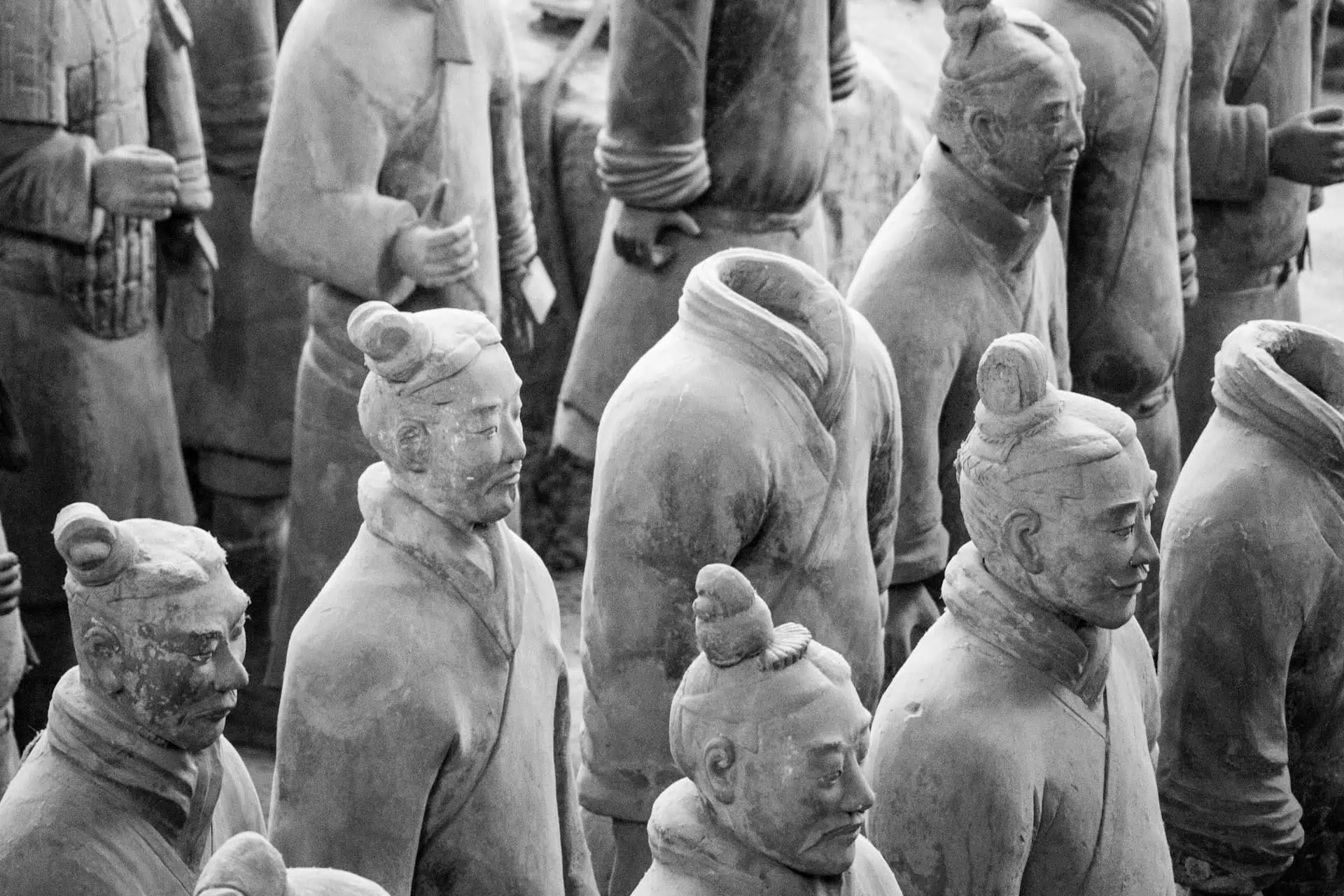
Terracotta Army
8,000 life-sized soldiers buried for China's First Emperor — and still on guard 2,200 years later.
Learn more →