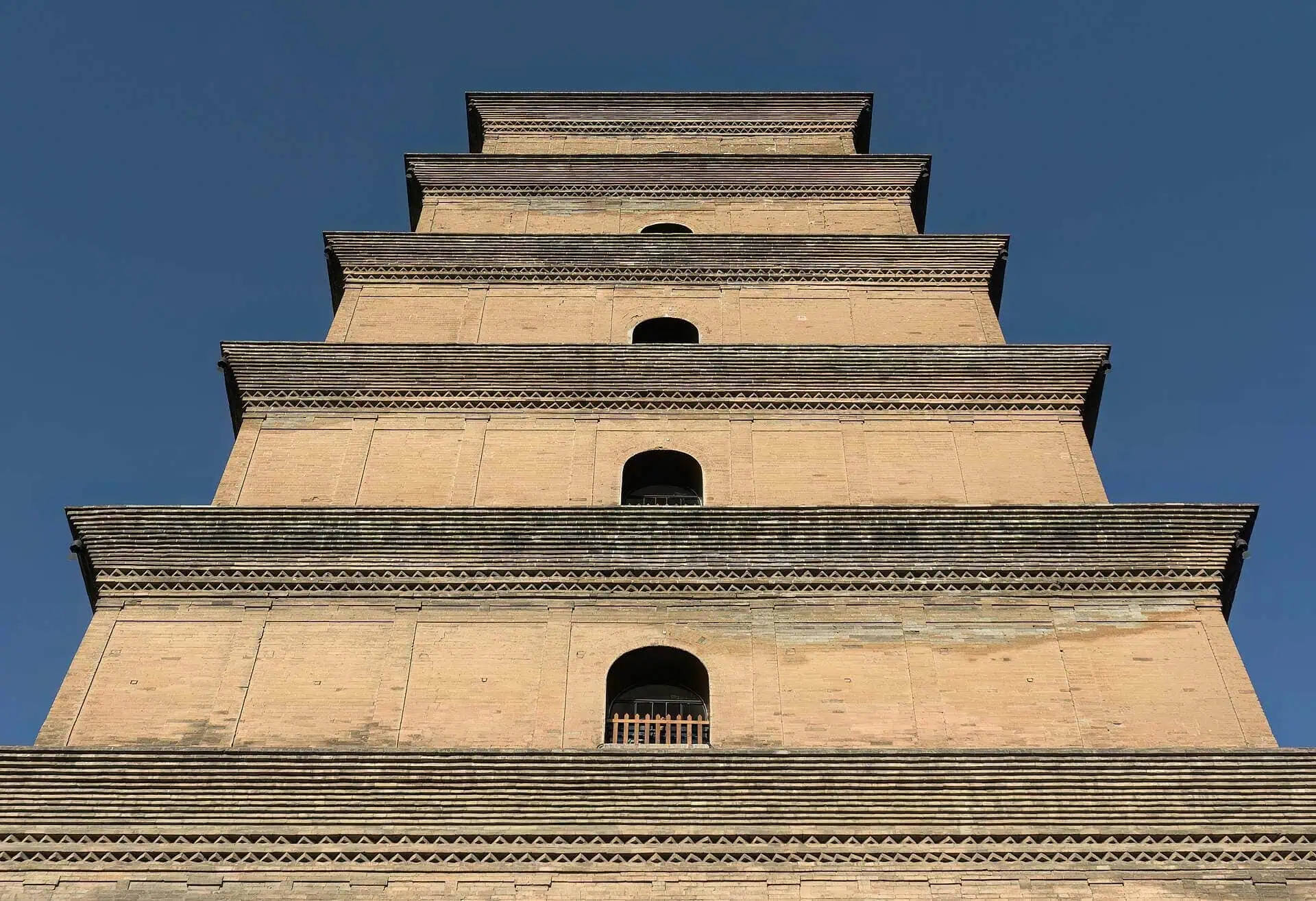
Big Wild Goose Pagoda
Dàyàntǎ (Dà Cí'ēn Sì)
A Tang brick pagoda raised in 652 AD for a monk's 17-year journey to India — still Xi'an's defining landmark.
Entry
From ¥10
Hours
Mar – mid-Oct · 8:30
Time needed
1½–3 hours
Booking
Required
Metro
Line 3 · Dayanta (大雁塔) · B
Raised in 652 AD to house the scriptures Xuanzang carried home from India, this seven-story pagoda has been Xi'an's defining landmark for over 1,300 years — and it still stands inside a working temple that costs all of ¥10 to enter. The temple visit itself is calm and quick. Climb the pagoda if the line is short and skip it if it isn't — then stay into the evening, because the squares around it put on the city's best free night out.
What you're looking at
The Big Wild Goose Pagoda (大雁塔, Dàyàntǎ) stands inside Da Ci'en Temple (大慈恩寺, Dà Cí'ēn Sì), once the grandest temple of the Tang capital Chang'an (长安, Cháng'ān). The temple was founded in 648 by the crown prince Li Zhi (李治, Lǐ Zhì) in memory of his mother; the pagoda followed in 652, built at the request of the temple's abbot — the most famous monk in Chinese history.
Xuanzang (玄奘, Xuánzàng) left Chang'an in 629, against imperial orders, and spent some 17 years traveling to India and back, studying at the great Buddhist university of Nalanda and collecting Sanskrit texts. When he returned in 645 the emperor welcomed him as a hero and installed him here, where he spent his final years directing the translation of the scriptures he had carried home. The pagoda was built to store them. The wild goose in the name comes from a legend Xuanzang reportedly borrowed from India — a goose that sacrificed itself to turn meat-eating monks toward vegetarianism.
The building itself has had a hard life. Begun as a five-story tower, it was rebuilt grander under Empress Wu Zetian (武则天, Wǔ Zétiān), battered by medieval wars, and finally re-cased in brick under the Ming — which is why a Tang pagoda wears Ming brick. What stands today is a seven-story, 64.5 m square pavilion-style tower, the earliest and largest surviving Tang brick pagoda of its kind, and a UNESCO World Heritage site as part of the Silk Roads listing since 2014. Inside, steep brick stairs wind up through low-ceilinged floors to small windows with views over the Qujiang (曲江, Qūjiāng) district.
Around the pagoda, the temple is an active monastery: halls of gilded Buddhas, a Xuanzang hall holding relics of the monk, a small forest of stupas for past abbots. Outside the walls, two enormous squares flank the complex — the South Square with its bronze statue of Xuanzang (the classic photo, statue in front of pagoda), and the North Square with a musical fountain billed as Asia's largest. For the era that produced all this, see our Tang Chang'an history and Silk Road story.
Visiting strategy
The sweet spot is late afternoon into evening. Arrive around 16:00–17:00, when the temple is at its quietest, do the halls and the pagoda at an unhurried pace, and exit as the squares fill with local life. Then catch the fountain's 19:00 show on the North Square and walk south into Grand Tang Ever-Bright City as it lights up — that sequence is one of the best evenings in Xi'an, and our 3-day itinerary builds a day around it.
Is the pagoda climb worth it? For ¥25, yes if there's no queue — the windows up top frame the city grid and you feel the building's age in your thighs. But the stairs are steep, the ceilings low, and the view is of modern Qujiang rather than Tang Chang'an. If the line at the pagoda base is long, skip it without regret: the pagoda's real power is from the ground, rising over the temple roofs.
Mornings have their own appeal — the temple is near-empty and both squares belong to locals: tai chi groups, dancers, calligraphy practiced in water on the pavement.
Pairings: the Shaanxi History Museum is one metro stop away (book it days ahead), and Tang Paradise is a short walk south. The commercial costume-and-souvenir zone wrapped around the temple is skippable — the temple and pagoda are the real thing.
One practical note: the temple ticket entrance is on the south side, by the Xuanzang statue — don't queue at the fountain square looking for a gate.
Getting there
The pagoda anchors the Qujiang area, southeast of the old town — see our Qujiang area guide for the neighborhood.
- Metro: Lines 3 and 4 both stop at Dayanta (大雁塔) station, exits B or C. You surface near the North Square; walk the length of the fountain square south (about 10 minutes) to the temple gate. Our getting around guide covers riding the metro with Alipay.
- From the Shaanxi History Museum: one stop east on Line 3 (Xiaozhai direction), or a 20-minute walk.
- Taxi/DiDi: about 20 minutes and ¥20–25 from the Bell Tower. Ask for 大雁塔; drivers know the South Square (南广场) as the temple-side drop-off.
After dark, note that everyone leaves at once — if you're heading on to Ever-Bright City you won't need transport at all, it's straight through the South Square.
Practical notes
- Booking: real-name reservation via the 大慈恩寺 WeChat mini program; bring the passport you booked with. Outside Chinese public holidays, same-day slots are rarely a problem.
- Fountain shows: free, roughly 15 minutes, typically at 12:00, 16:00, 19:00 and 21:00 — the evening shows add the light display and are the ones to catch. Schedules shift seasonally and shows are occasionally cancelled for maintenance; boards on the square post the day's times. Arrive 15–20 minutes early for a railing spot at 19:00.
- Temple etiquette: it's a working monastery — modest dress, keep voices low inside the halls, and skip photography where signs ask.
- Toilets and food: facilities inside the temple and around both squares; the Joy City mall by the North Square has the best of both plus air conditioning.
- Payments: booking and on-site tickets run on mobile payment; have Alipay or WeChat Pay set up.
- Kids: the squares are perfect for burning energy and the fountain delights them; the pagoda stairs are tough on small legs (and tall heads).
Questions, answered
Is the Big Wild Goose Pagoda worth visiting?
Yes. It's Xi'an's emblem for good reason — a genuine Tang dynasty pagoda tied to Xuanzang's legendary India journey, entry costs just ¥10, and the squares around it host the city's best free evening: fountain show plus Grand Tang Ever-Bright City next door.
How much does it cost to visit the Big Wild Goose Pagoda?
Da Ci'en Temple entry is ¥10 (students about ¥5, free for over-65s and children under 1.2 m). Climbing the pagoda costs ¥25 on top, bought inside. The North Square fountain show and both squares are free.
Can you climb the Big Wild Goose Pagoda?
Yes — a ¥25 ticket sold at the pagoda base gets you up seven floors of steep, narrow brick stairs. The windows at the top give views over the Qujiang district. Skip it if the queue is long; the pagoda impresses most from the ground.
What time is the Big Wild Goose Pagoda fountain show?
Typically four free shows a day at about 12:00, 16:00, 19:00 and 21:00, each around 15 minutes. The evening shows add the light display and draw the crowds — get to the railing 15–20 minutes early. Times shift by season; check the boards on the square.
How long do you need at the Big Wild Goose Pagoda?
Allow 1.5–2 hours for the temple and pagoda climb. Most people then stay for the evening: the 19:00 fountain show and a walk through Grand Tang Ever-Bright City make it a full afternoon-to-night outing.
How do I get to the Big Wild Goose Pagoda?
Metro Lines 3 or 4 to Dayanta station (exits B/C), then a 10-minute walk south through the fountain square to the temple gate. A taxi from the Bell Tower takes about 20 minutes and costs roughly ¥20–25.
Keep exploring

Grand Tang Ever-Bright City
Two kilometers of free, floodlit Tang dynasty spectacle — the golden age, rebooted nightly.
Learn more →
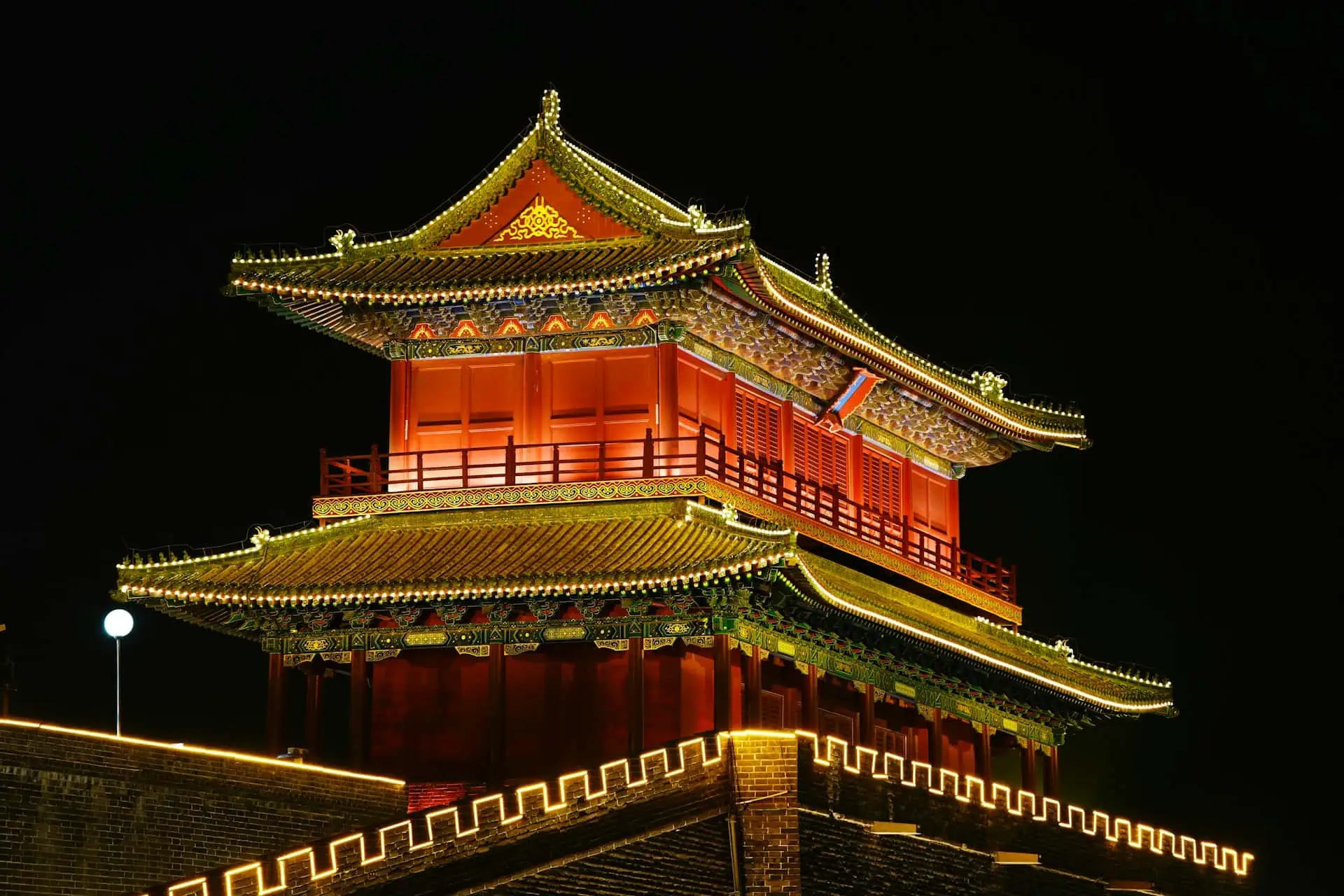
Tang Paradise
A royal Tang garden reimagined in 2005 — artificial, enormous, and genuinely beautiful after dark.
Learn more →
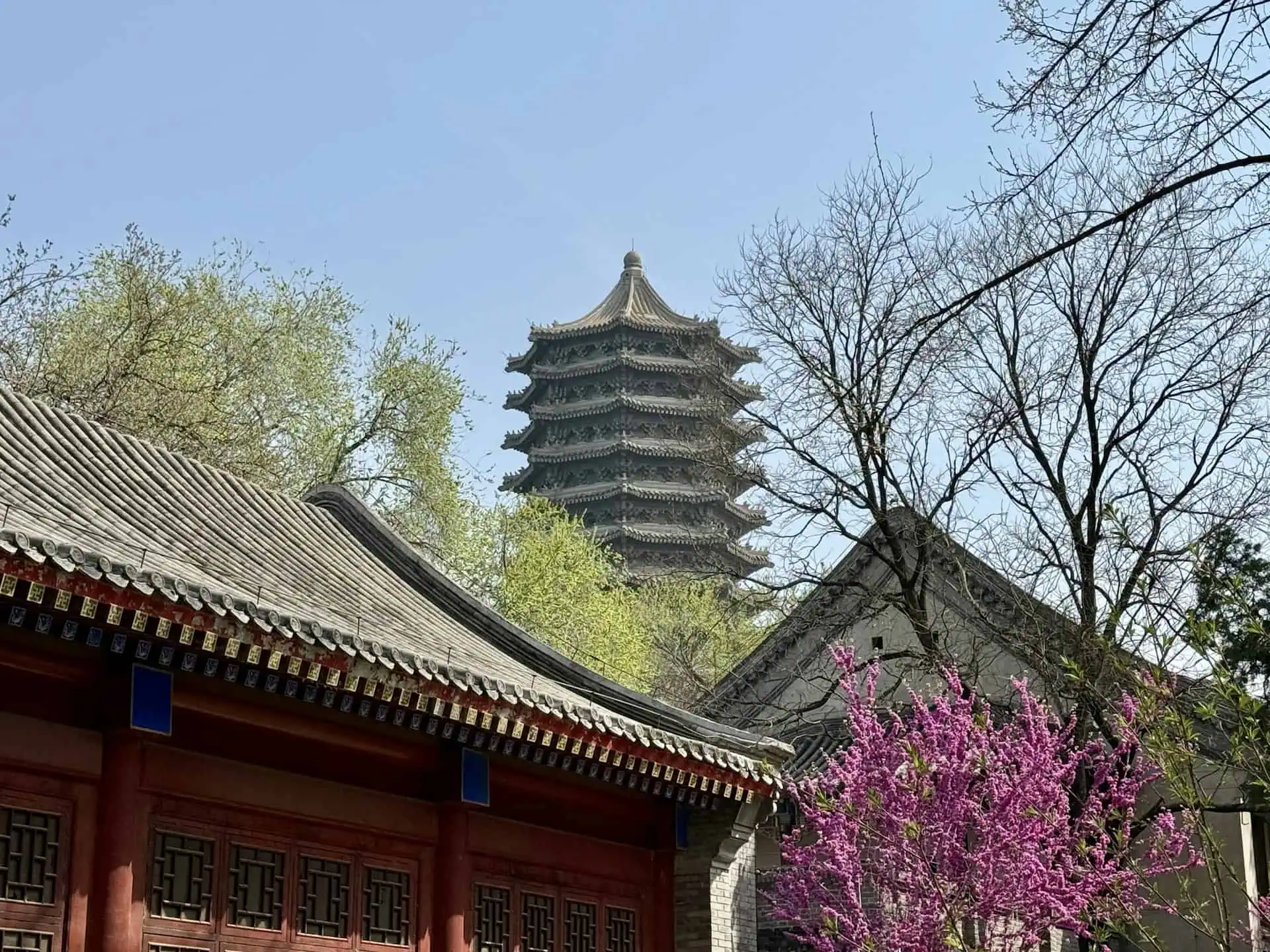
Qinglong Temple
The Tang temple that sent Buddhism to Japan in 804 AD — and still draws half of Xi'an every cherry blossom season.
Learn more →
Related stories
Where to stay in Xi'an: the honest area-by-area guide
Xi'an is a compact city with a decisive metro, so the choice of base matters more for mood than logistics. For most first-timers the answer is inside the City Wall near the Bell Tower; below is every realistic alternative, with the character, the crowd it suits and what a room actually costs in each.
Best time to visit Xi'an: an honest month-by-month guide
Xi'an has two golden windows — late March to May, and September to early November — and two seasons that demand a reason: a furnace-hot summer and a cold, dry, wonderfully empty winter. Weather is only half the story, though; the Chinese holiday calendar can matter more than the temperature. Here's every month, with the traps marked.
Accessibility in Xi'an: an honest audit
Xi'an is a 3,000-year-old city running on modern infrastructure, and accessibility splits exactly along that line: the metro and the big modern museums are genuinely step-free, while anything involving a 600-year-old gate, tower or pagoda usually means stairs. Here's what works, what doesn't, and what to confirm before you fly.
Shaanxi History Museum tickets: the foreigner's booking guide
The museum is free — and that's exactly why it's hard: entry is reservation-only, roughly 12,000 free slots a day vanish in minutes in high season, and the booking interface is Chinese-only. Here is the step-by-step way foreigners actually get in, what to do when it's sold out, and what the ¥270 Tang mural ticket really is.
Shopping in Xi'an: what's actually worth buying
Most of what's sold to tourists in Xi'an is factory stock you could buy anywhere in China — but a few things are genuinely local and worth suitcase space: a seal carved with your name on Shuyuanmen, a proper museum-shop terracotta figure, fu brick tea, and Shaanxi's dried persimmons. Here's what to buy, what to skip, and how the haggling works.
Vegetarian & dietary needs in Xi'an
The honest version first: Xi'an's signature dishes are built on meat broth, and no menu in town marks vegetarian options. But the city also has a centuries-old Buddhist vegetarian tradition, a whole halal district where pork and lard can't follow you, and a street-food canon in which several of the best things contain no meat at all. Vegetarians who learn a dozen dishes and three phrases eat well here; strict celiacs should treat Xi'an as hard mode.
Hanfu costume rental & photoshoot guide
Renting a Tang-style costume and having your photo taken against 1,300-year-old backdrops is Xi'an's signature tourist experience — and unlike most signature tourist experiences, it's actually good value. A full outfit with hair and makeup runs ¥100–300, the streets are so used to costumed visitors that nobody bats an eye, and the night scenery does the heavy lifting. Here's how to do it without getting upsold.
Xi'an at night: lights, shows & evening walks
Xi'an is a different city after dark — Tang-style streetscapes floodlit gold, a pagoda floating over fountain shows, gate towers glowing above the moat. The best of it is free: the Grand Tang Ever-Bright City pedestrian street alone is worth an evening, and the pagoda fountain show costs nothing. Add a late dinner in the Muslim Quarter and, in season, the open-air Song of Everlasting Sorrow, and your nights may outshine your days.
The photographer's Xi'an: best spots & times
Xi'an rewards photographers who plan around light, not locations. The city's great subjects — walls, towers, pagodas, night markets — are all floodlit after dark, which means the magic window is the same almost everywhere: the hour around sunset. Here's where to stand, when to be there, and the rules that can cost you your drone.
Cherry blossoms in Xi'an: Qinglong Temple & beyond (March–April)
Xi'an's cherry blossom season runs roughly mid-March to mid-April, and the classic place to see it is Qinglong Temple — a Tang dynasty temple with a 1,200-year-old connection to Japan, where hundreds of Japanese-donated cherry trees bloom against old temple walls. Entry is free but you'll need a reservation, weekends are a contact sport, and if you miss the petals, April's peonies are the consolation prize. Here's how to time it.
Chang'an in the Tang dynasty: the world's greatest city
Thirteen dynasties: Xi'an as capital, a visual timeline
Hotels in Xi'an: what to actually book
Xi'an's hotel scene splits cleanly into three workable tiers: international five-stars that cost less than you'd pay at home, Chinese mid-range chains that are the best value in the city, and courtyard guesthouses for character. The two things that actually trip foreigners up — which area to pick and whether the hotel can register you at all — are both solvable in about ten minutes of reading. Start here.
DiDi in English: ride-hailing in Xi'an without a Chinese number
DiDi is China's ride-hailing giant, and in 2026 it works end-to-end for foreigners: English interface, signup on your home phone number, payment by foreign card or through Alipay/WeChat. Set it up before you fly and every ride in Xi'an becomes a non-event.
Shared bikes in Xi'an: the last-kilometer answer
Xi'an's yellow and blue shared bikes turn the flat, spread-out city center into a 10-minute ride — unlocked with the Alipay or WeChat scan you already have, deposit-free, for about ¥1.5 per half hour. The one skill you need is parking inside the GPS zones.
Xi'an by season: Mid-Autumn, the film festival & the City Wall marathon
Student, senior & child discounts at Xi'an sights — the full table
Xi'an's big sights offer real discounts: students roughly half price at most attractions, seniors 65+ free at the Terracotta Army and most museums, children under 16 free at the flagship sights. The catch: it's physical ID at the gate, photos don't count, and some policies apply only to Chinese nationals. Here's the complete table.
On video
Xi'an on video
What this place looks like on video.