Eating where locals eat: Yongxingfang, Sajinqiao & beyond
Every visitor finds the Muslim Quarter's main strip; almost none find where Xi'an actually eats. The local circuit splits in two directions: Yongxingfang (永兴坊), a curated one-stop sampler of food from across Shaanxi province by the East Gate, and Sajinqiao (洒金桥), an uncurated working Hui street where breakfast queues form before 8:00. Add the Dongxin Street night market and a couple of side lanes, and you can eat like a local for your entire trip.
8 min read · 4 sections
The short version
- Yongxingfang (永兴坊) is the curated option: ~50 stalls handpicked from all eleven prefectures of Shaanxi in one courtyard near the East Gate — maximum variety per hour, prices a notch above the street, home of the viral bowl-smashing wine.
- Sajinqiao (洒金桥) is the real one: a working Hui neighborhood street ten minutes northwest of the Muslim Quarter's main strip — breakfast hulatang and zenggao, evening paomo and skewers, almost no tourists.
- Fill in the map with Dapiyuan (大皮院) and Xiyangshi (西羊市) lanes in the quarter, and the Dongxin Street night market (东新街夜市) for late-night local classics.
- Ordering is counter-service and QR-code payment everywhere; the queue of locals is the only review system that matters.
- Budget ¥40–80 per person for a serious multi-stop graze; most individual items run ¥5–25.
- Meals run early — lunch peaks 12:00–13:00, dinner 18:00–20:00, and the breakfast streets wind down by 10:00.
The two local food streets
Two names dominate any honest conversation about where Xi'an locals eat, and they could not be more different.
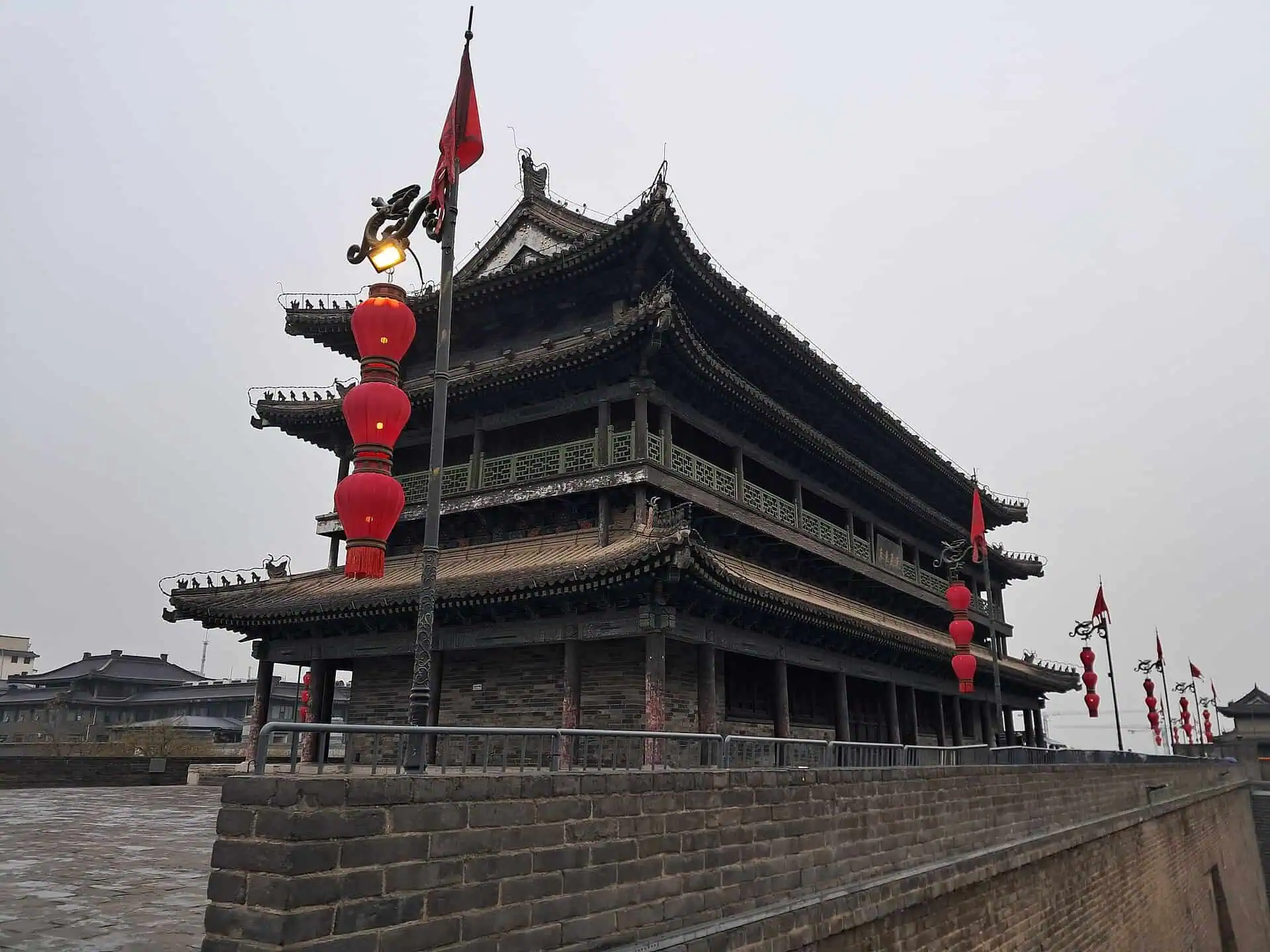
Yongxingfang (永兴坊, Yǒngxīngfāng) is the curated one: a walled food block just inside Zhongshan Gate (中山门, Zhōngshānmén — the "Little East Gate" of the City Wall), rebuilt in the style of a Tang-dynasty ward and officially rated as a 3A tourist sight. Its pitch is breadth. The roughly fifty stalls are handpicked to represent the cooking of all eleven prefectures of Shaanxi province, so in one courtyard you can graze your way across the whole province: Guanzhong wheat noodles, southern Shaanxi rice dishes, northern Shaanxi lamb. Stalls rotate, but look for the Tongguan roujiamo (潼关肉夹馍) counter — the crispy-flaky bun variant from the east of the province, a legitimate rival to the downtown roujiamo — and the Hanzhong hot rice noodles (汉中热米皮). This is also where the bowl-smashing wine (摔碗酒, shuāiwǎnjiǔ) went viral in 2018: a roughly ¥5 bowl of sweet, low-alcohol rice wine that you drink and then hurl, bowl and all, into a crash pit for the camera. The craze has cooled to a sideshow, but the stall still runs and it's fun exactly once. Verdict: touristy by design, prices a notch above the street — and genuinely useful if you want the province's greatest hits in ninety minutes. Hours run roughly 9:00–22:30; evenings are liveliest, with folk performances some nights.
Sajinqiao (洒金桥, Sǎjīnqiáo) is the uncurated one: a working Hui neighborhood street a ten-minute walk northwest of the Muslim Quarter's main strip. No performances, no souvenir counters, no price board in English — just paomo houses, grill stalls and breakfast carts feeding the people who live there. The name means "Sprinkle-Gold Bridge"; legend says a Tang emperor once scattered gold here, but today's currency is breakfast. Come before 10:00 and join office workers queuing for hulatang (胡辣汤) and zenggao (甑糕); come at dinner and the paomo-and-skewer crowd is mostly neighborhood regulars. It's cheaper and gruffer than the quarter, and it's the single best answer to "where do locals actually eat?" Our Muslim Quarter eats guide maps the quarter-side lanes; Sajinqiao is the level below.
Other local streets
- Dapiyuan (大皮院, Dàpíyuàn) — a lane running parallel to the quarter's main strip, one turn west. This is where several of the quarter's most respected sit-down names live, including Sheng Zhiwang (盛志望), the famous counter for sesame niangpi (麻酱酿皮) — cold noodles in sesame paste and chili, about ¥10 a bowl. The crowd here already looks local.
- Xiyangshi (西羊市, Xīyángshì) — the lane heading west off the middle of the Beiyuanmen strip. Noticeably cheaper than the strip for the same skewers and cakes, and noticeably better. It's the five-second fix when the main drag feels like a theme park.
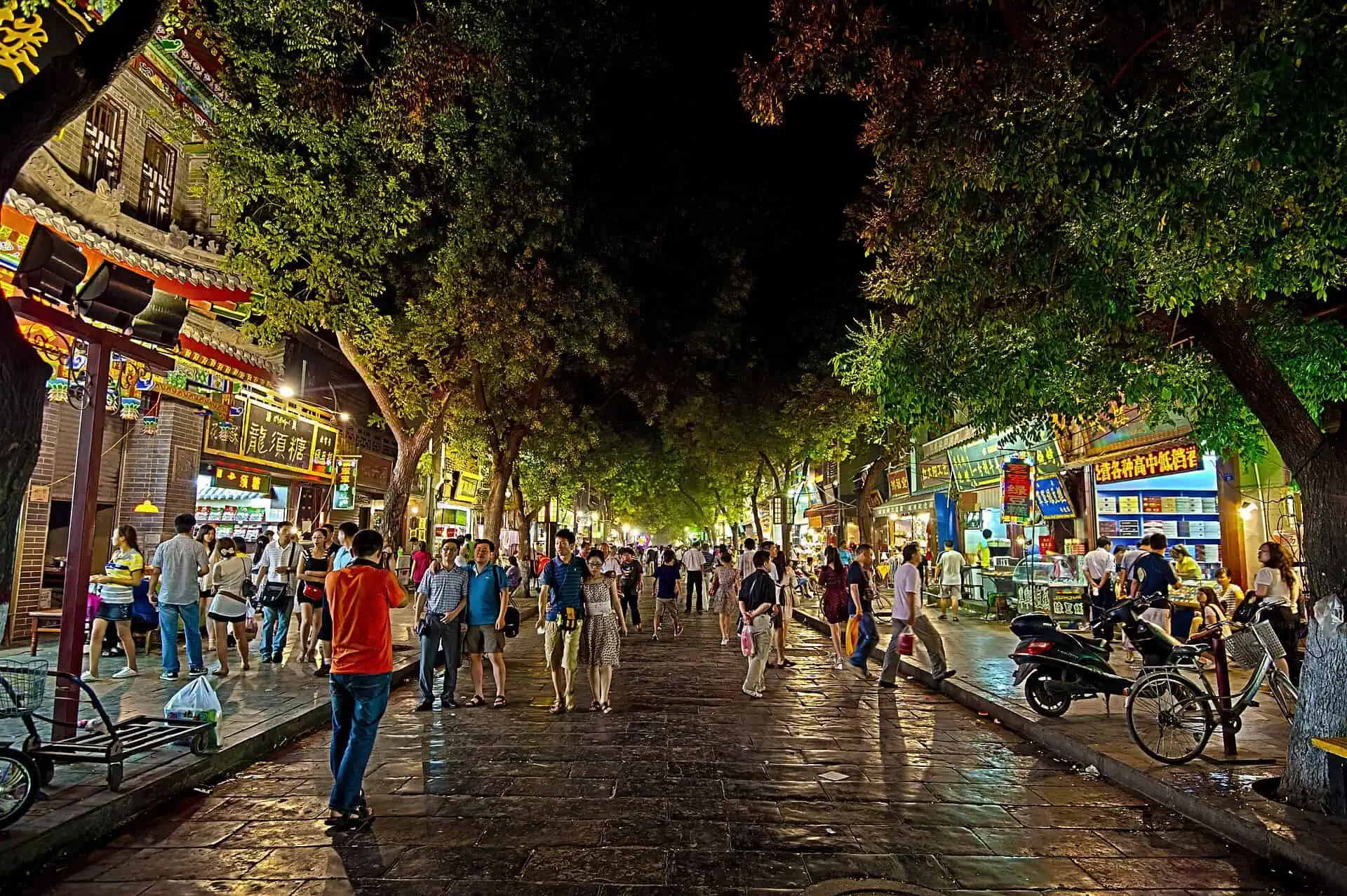
- Dongxin Street night market (东新街夜市, Dōngxīn Jiē yèshì) — the classic locals' night market along Dongxin Street near Jiefang Road, back in business and busy in recent years. Old-timers swear by the "three classics of Dongxin Street" (东新街三绝): Old Chen's braised stew (老陈家烩菜, Lǎochénjiā huìcài), the Zheng family baozi (郑家包子, Zhèngjiā bāozi) and the Wang family "barrel chicken" (王家桶子鸡, Wángjiā tǒngzijī). Around them: grilled fish, claypot rice noodles, skewers and stir-fry stalls — cheap, generous, and running late into the evening. Conveniently, Dongxin Street is the same street Yongxingfang sits on: do Yongxingfang at dusk, then walk ten minutes west for a second dinner among locals.
A note on the famous names: stall reputations outlive stalls. Use these as starting points, then let the longest queue of locals overrule any list — including this one.
How to order like a local
- Follow the queue. Nobody in Xi'an checks review apps before a ¥10 snack — the line is the review. A stall with delivery drivers and office workers waiting at 12:30 beats anything on a top-ten list. An empty stall with a tout out front is telling you something too.
- Pay first, eat second. Most counters work like this: order and pay at the till — almost always by QR code, so set up Alipay or WeChat Pay before you land — then take your receipt, number token or empty bowl to the kitchen window and hand it over. Watch what the person ahead of you does; it's always the same dance.
- Tear your own bread. Order yangrou paomo and you're handed a dense flatbread and a bowl. You tear the bread into fingernail-sized pieces — five to ten minutes of work — and the kitchen returns it drowned in lamb broth. Pre-torn bread is the mark of a tourist kitchen; the tearing is the dish.
- Share tables. At busy counters, strangers share tables (拼桌, pīnzhuō) without ceremony. Point at an empty chair and ask "有人吗?" (yǒu rén ma? — "anyone here?"). Don't hover waiting for a private table; there isn't one.
- Graze, don't dine. Locals treat food streets as a progressive dinner: a liangpi here, skewers there, a persimmon cake to finish. Four or five small stops beat one big sit-down meal, and at ¥5–20 a stop, mistakes are cheap.
- Chase the legacy names. Chinese social media now frames Xi'an as 碳水之都 — the "carb capital" — and routes crawls through time-tested institutions: 王魁肉夹馍 (Wáng Kuí, a long-running roujiamo name at about ¥10) and 老孙家 (Lǎo Sūn Jiā, the century-old yangrou paomo house). They're real, decades-old shops, not invented influencers' picks — but expect queues at peak, and the reason they're famous is the canonical dishes on the food hub, not novelty.
- Eat on local time. Lunch peaks 12:00–13:00 and dinner 18:00–20:00; breakfast carts pack up around 10:00. Night markets fill the gap until late. Arrive at 14:00 for lunch and you'll find the best stalls sold out or asleep.
Prices and expectations
Xi'an is one of China's cheapest big cities to eat in, and the local streets are cheaper than the tourist strip. Ballpark figures as of mid-2026 — every stall posts a price board (明码标价), so check before ordering:
- Snacks and small bowls: liangpi or sesame niangpi around ¥10; zenggao and hulatang breakfasts around ¥10; persimmon cakes a few yuan each; skewers roughly ¥10 each for the fat-marbled red-willow kind.
- Bigger commitments: beef roujiamo ¥10–15; a steamer of guantang baozi or a bowl of biangbiang noodles in the ¥15–25 range; a sit-down yangrou paomo ¥25–40.
- Yongxingfang: expect a modest markup over street prices — most items land somewhere in the ¥10–25 band, still cheap by any world-city standard.
- The bowl-smashing wine: about ¥5 a bowl. You're paying for the smash, not the wine.
A full evening graze — four or five stops with drinks — runs ¥40–80 per person on the local streets; ¥100 per person is feast territory. Set expectations accordingly: these are plastic-stool, self-serve-napkin operations where the food arrives fast and the ambience is volume. The hygiene heuristic is turnover, not tablecloths — choose stalls cooking to order in front of a queue, drink bottled or canned drinks, and you'll eat very well and very safely. Few stalls have English menus; picture menus, pointing, and the phrases in our Mandarin guide carry you through.
Questions, answered
Where do locals actually eat in Xi'an?
The short list: Sajinqiao for Hui breakfasts and paomo dinners, Dapiyuan lane in the Muslim Quarter for sit-down classics, and the Dongxin Street night market for late-night skewers and stews. Beyond those, every neighborhood has unglamorous counters — the universal signal is a queue of locals, not a signboard.
Is Yongxingfang worth visiting?
Yes, if you treat it as a one-stop sampler rather than an authentic street: around fifty stalls curated from across Shaanxi province, evening atmosphere, and the bowl-smashing wine as a sideshow. Prices run above street level and it's fully tourist-facing — for raw local atmosphere, Sajinqiao and Dongxin Street beat it.
Is the bowl-smashing wine still a thing in Xi'an?
Yes. The stall at Yongxingfang still sells its roughly ¥5 bowls of mild rice wine for drinking and smashing, but the 2018 viral peak has long passed — expect a short queue of curious visitors, not a mob. It's fun once and takes five minutes.
How much money do I need for a night of street food in Xi'an?
¥40–80 per person covers a proper graze: most items run ¥5–25, with skewers around ¥10, noodle bowls ¥10–15 and a sit-down yangrou paomo ¥25–40. Double that and you're in feast territory. Prices drift upward during Chinese public holidays.
Can I pay with cash or a foreign card at Xi'an's food streets?
QR-code payment is the default everywhere, down to ¥5 snacks — Alipay and WeChat Pay both accept foreign cards now, so set one up before you arrive. Foreign bank cards are essentially useless at stalls directly; cash works as a backup, but expect fumbling over change at busy counters.
Places in this story
Keep exploring
Where to Eat in the Muslim Quarter: A Street-by-Street Guide
The Muslim Quarter (回民街, Huímín Jiē) is Xi'an's loudest, smokiest, most delicious neighborhood — and its most touristed. The open secret is that almost nobody eating on the main strip is a local: the best food is one or two turns off it, at two-thirds of the price. Here's how the quarter is laid out, what to eat where, and how to dodge the traps.
Vegetarian & dietary needs in Xi'an
The honest version first: Xi'an's signature dishes are built on meat broth, and no menu in town marks vegetarian options. But the city also has a centuries-old Buddhist vegetarian tradition, a whole halal district where pork and lard can't follow you, and a street-food canon in which several of the best things contain no meat at all. Vegetarians who learn a dozen dishes and three phrases eat well here; strict celiacs should treat Xi'an as hard mode.
Halal eating in Xi'an
In most Chinese cities, halal travelers hunt restaurant by restaurant. In Xi'an you pick a neighborhood instead: the Hui Muslim community has been cooking here since the Tang dynasty, an entire district behind the Drum Tower sells no pork at all, and several of the city's signature dishes are halal by birth. Here's how to read the signs, what to eat, and what to watch for outside the quarter.