Zenggao
Zènggāo · say it: “zuhng-gow”
- Spice
- Not spicy
- Typical price
- ¥5–15
- Dietary
- HalalVegetarian
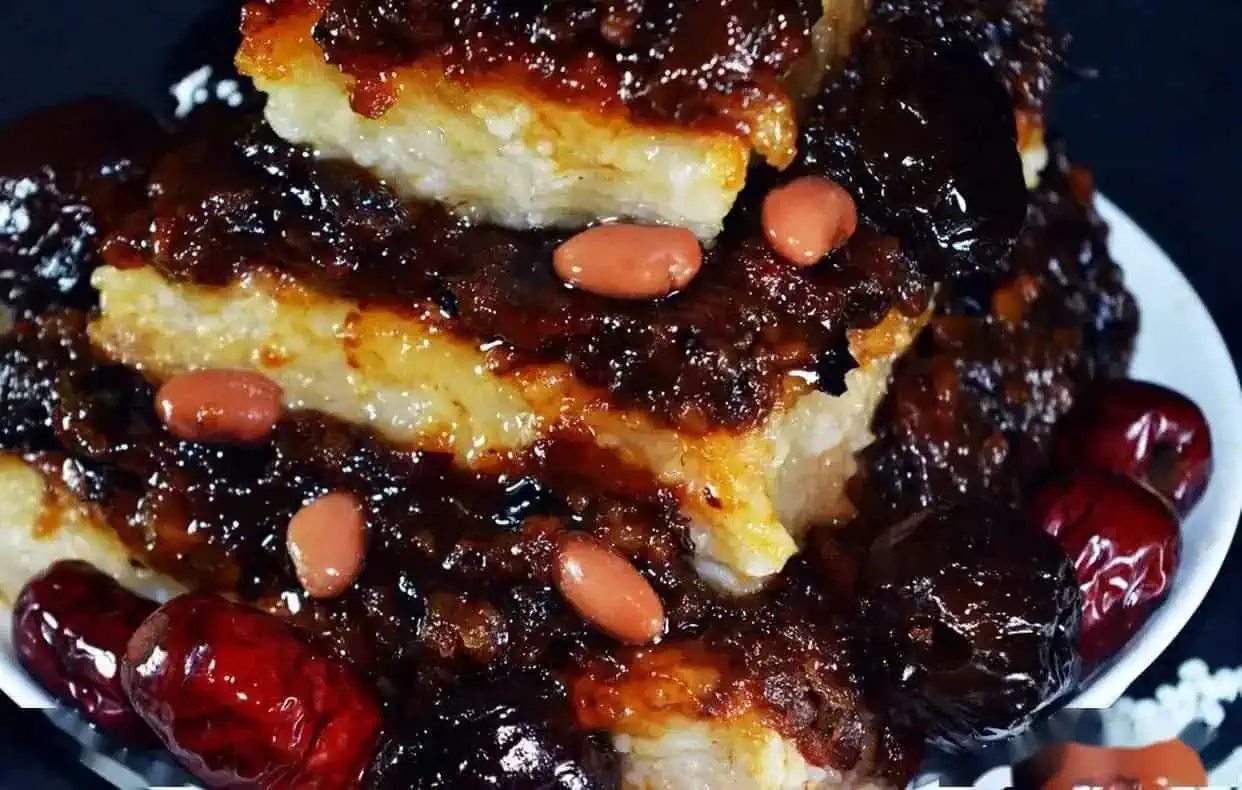
Six thousand years before Xi'an had bakeries, it had the zeng (甑, zèng) — a deep steam pot with a perforated bottom that cooks by rising vapor, a design Chinese kitchens have used since Neolithic times (pottery versions have been excavated at sites around the city, including the village displayed at the Banpo Museum). Zenggao (甑糕, zènggāo) is the cake named after the pot: layers of sticky glutinous rice, red dates and red beans, packed into the vessel and steamed for hours until the rice turns translucent, the dates collapse into dark jam, and the whole mass sets into something between a pudding and a cake. It is still sold the old way, from great lidded steamers that appear on Muslim Quarter corners at dawn: the vendor flips the lid, a cloud of date-scented steam rolls out, and a wedge is cut to order by weight, eaten hot on the spot. It costs almost nothing — ¥5 to ¥15 buys a portion that counts as a full breakfast — and being nothing but rice, beans and fruit, it's naturally halal, vegetarian and gluten-free. If the dish looks familiar, you probably watch Chinese television: in the 2017 hit drama Nothing Gold Can Stay (那年花开月正圆, Nà Nián Huākāi Yuèzhèngyuán), zenggao was the favorite sweet of the heroine Zhou Ying (周莹, Zhōu Yíng), and the show turned a workaday breakfast into a national craving overnight. The most famous beneficiary was a Muslim Quarter stall with the odd name Dongnanya (东南亚甑糕, Dōngnányà zènggāo — yes, "Southeast Asia Zenggao"), which still draws queues at the corner of Xiyangshi (西羊市, Xīyángshì) and North Guangji Street. One practical note: locals pronounce 甑 as "jing" in Shaanxi dialect, and the smaller steamed rice cakes sold nearby on sticks, jinggao (镜糕, jìnggāo), are a different snack entirely — if a vendor seems to correct your pronunciation, that is why.
How to eat it
Eat it hot, and in the morning if you can manage it. Zenggao is a dawn-to-late-morning trade; by afternoon the good steamers are sold out or down to the dry edges. Ordering is by weight, which means there is no menu to decode: point, hold up fingers, or simply name a price — vendors will cut a ¥10 wedge without blinking. It comes on a small plate or in a box with a spoon or stick, and it is walking food as much as sitting food. The prized bite is the top layer, where the dates have melted into a dark, toffee-like crust; regulars angle for an edge piece, and vendors know exactly why you're asking.
No drink is traditional — this is grab-and-go food — but it sits well next to something salty: locals happily follow a wedge of zenggao with a bowl of meatball hulatang from a steamer two doors down. If you are building a morning in the quarter, our street-by-street eating guide maps the lanes, and the halal food guide explains why this neighborhood feeds every diet at once.
Where to try it
Dongnanya Zenggao (东南亚甑糕)
The stall the TV drama made famous, at the corner of Xiyangshi and North Guangji Street. Around ¥10 a portion; expect a queue and accept it — it moves fast.
Read the guideFatty's Zenggao (胖子甑糕)
A long-standing Hui-quarter name that turns up on local lists for the morning trade, selling by weight from the steamer until it runs out.
Morning steamer carts, Sajinqiao and the side lanes
The anonymous dawn carts are the tradition the famous stalls came from. A steamer with a cloud of steam and a line of neighbors at 8 a.m. is all the credential you need.