Banpo Museum
Xī'ān Bànpō Bówùguǎn
A 6,000-year-old village under one roof — moat, kilns, and the deepest layer of Xi'an's time stack.
Entry
From ¥55
Hours
Mar – Nov · 8:00
Time needed
1½–2½ hours
Metro
Line 1 · Banpo (半坡) · A
Six thousand years ago — three millennia before the First Emperor — a Neolithic village stood on Xi'an's east side, and it's still there: the deep cut of Xi'an sightseeing, preserved where it was dug. Archaeology fans will find one of China's most important prehistoric sites here; casual visitors may see a field of foundations in a dated hall. If prehistory interests you even slightly, go — it's uncrowded, cheap, and sits on the same metro line you'll take toward the Terracotta Army.
What you're looking at
Around 4800–4200 BC — some 2,500 years before the first dynasty — a village of several hundred people stood on this terrace above the Chan River. They belonged to the Yangshao culture (仰韶文化, Yǎngsháo wénhuà), the painted-pottery civilization of the middle Yellow River, and they farmed millet, kept pigs and dogs, fished, and fired some of the most beautiful pottery of the Neolithic world.
The village turned up in 1953 when surveyors were siting a power plant. Archaeologists spent four years on the dig, and in 1958 China built a hall over the excavation itself — the country's first on-site prehistoric museum. What you walk through today:
- The site hall — the heart of the visit. From elevated walkways you look down on 45 house foundations (round and square semi-subterranean huts), more than 200 storage pits, six pottery kilns, and the trench of a defensive moat several meters deep that ringed the settlement. The large square foundation near the center is read as a communal meeting hall.
- The burials — adults went to a communal cemetery beyond the moat; small children were buried in pottery urns beside the houses. That pattern, and the richer grave goods found with women, is why Banpo is traditionally described as a matrilineal clan society.
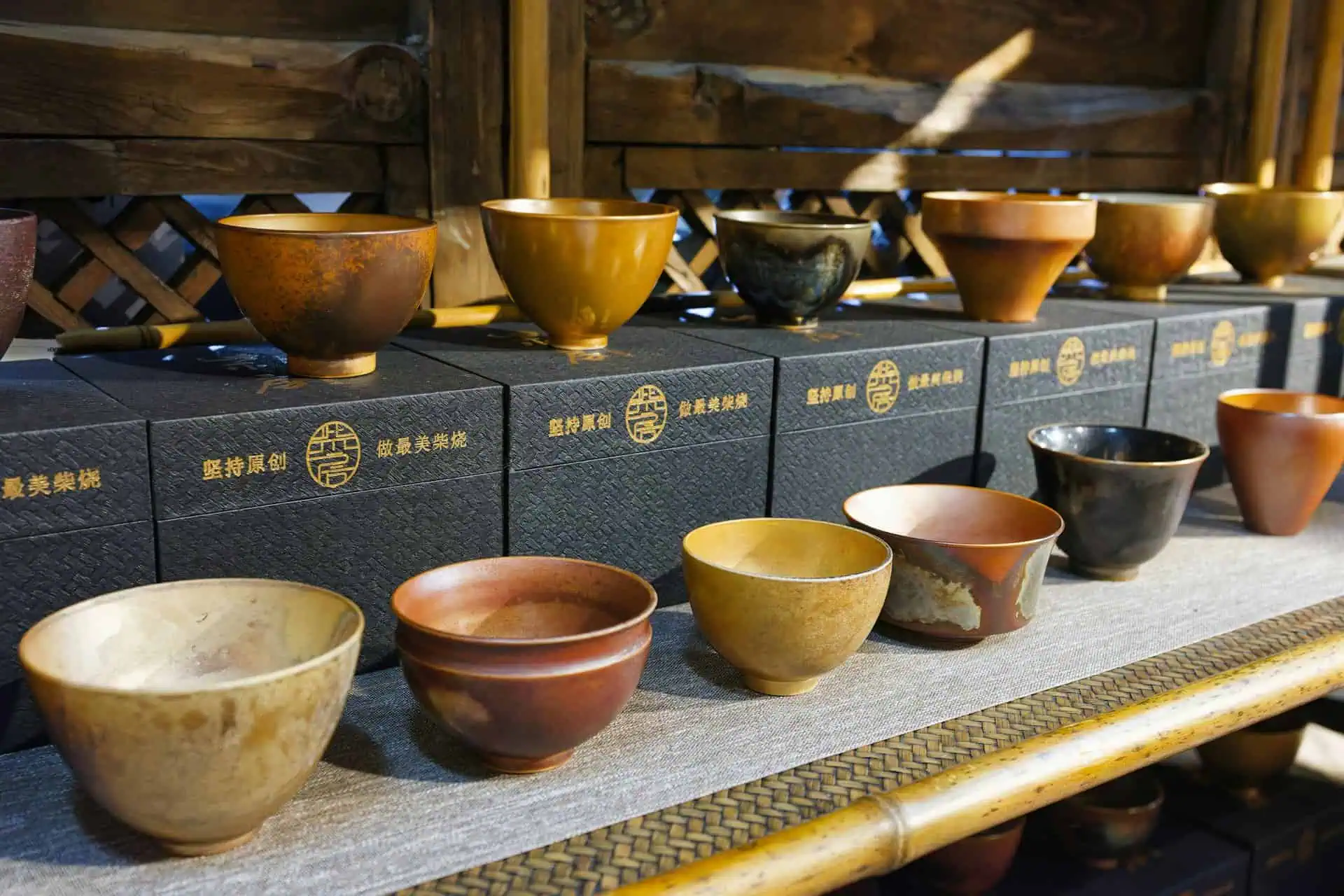
- The pottery galleries — painted basins and bowls with fish, deer and geometric designs, including the famous human-face-and-fish motif (人面鱼纹, rénmiàn yúwén): a round face with fish at the corners of the mouth, possibly a clan emblem or a shaman's mask. The single most famous example was taken to the National Museum in Beijing, as tends to happen — but the pieces left here are still remarkable. Look also for the pointed-bottom water jars (尖底瓶, jiāndǐ píng), engineered to tip and fill in the river, and pot shards bearing two dozen engraved symbols sometimes cited as ancestors of Chinese writing.
One honest note: this is a 1950s institution at heart. The site hall is evocative; the exhibition halls are old-school, and English labeling is thin. Read the history first (our short history of Xi'an covers the era) or come with a translation app.
Visiting strategy
Is it worth it? Depends who you are. If the words "Neolithic matrilineal clan village" make you lean forward, Banpo is essential — there is nothing else like it near Xi'an, and it completes the story that the Shaanxi History Museum only sketches in its first room. If your interest in archaeology starts and ends with the Terracotta Army, Banpo will feel austere: foundations, pots, and a lot of imagination required. Give it a miss and don't feel bad.
The smart combination: Banpo sits on metro Line 1, two stops west of Fangzhicheng (纺织城), where you transfer to Line 9 for Huaqing Pool and the Terracotta Army. Banpo in the morning (90 minutes), warriors after lunch is a coherent and uncrowded way to structure the east-side day — see how it slots into our 4–5 day itinerary.
Timing: the museum rarely gets busy, so there's no crowd strategy to game. Morning light through the site hall's windows is pleasant; on a wet or smoggy day it's a good indoor fallback. Allow 1.5–2 hours including the pottery galleries.
On site: start in the pottery galleries to learn what you're looking at, then the site hall — the foundations mean far more once you've seen the objects that came out of them.
Getting there
Banpo is in the eastern suburbs (Baqiao District, 灞桥区), about 8 km from the Bell Tower — and despite the distance it's one of the easiest out-of-center sights in Xi'an, because the metro goes straight to it. See our getting around Xi'an guide for how the system works.
- Metro Line 1 to Banpo station (半坡), exit A — then about a 10-minute walk. From the Bell Tower area it's a single line, no transfers, around 25 minutes.
- DiDi or taxi from the center costs roughly ¥30 and takes about 25 minutes outside rush hour.
- Bus 105 from the railway station area passes the site, but unless you're staying on that route the metro is simpler.
No tour is needed or worth paying for here. If you're combining it with the Terracotta Army, stay on Line 1 eastbound to Fangzhicheng (纺织城) and transfer to Line 9 toward Huaqing Pool.
Practical notes
- Tickets: buy at the gate — no reservation battle here. Carry your passport for the real-name check and a working payment app or cash.
- Language: English signage is limited. Download an offline translation app before you go (see essential apps) — the site hall labels repay the effort.
- Food: there's little around the museum; eat downtown before or after. This is a half-day commitment at most.
- Photography: fine without flash, including in the site hall.
- Kids: the urn burials and the "people lived in these pits" angle land well with children who like the gruesome details; the Xi'an with kids guide has more age-appropriate picks.
- Weather hedge: almost everything is indoors, making Banpo a useful rainy-day option when the city wall is off the table.
Questions, answered
Is the Banpo Museum worth visiting?
For archaeology and prehistory fans, absolutely — it's one of China's most important Neolithic sites, preserved in situ. For casual visitors, honestly, it can feel like a field of foundations in a dated hall. If you're already taking Line 1 toward the Terracotta Army side of town and have 90 minutes, it's a worthwhile stop; otherwise prioritize the central sights.
How old is the Banpo village site?
About 6,000 years — the village was occupied roughly 4800–4200 BC, during the Yangshao culture period of the middle Yellow River. That makes it some 4,000 years older than the First Emperor's terracotta army.
How do I get to the Banpo Museum by metro?
Take Line 1 to Banpo station (半坡), use exit A, and walk about 10 minutes. From the Bell Tower area it's a single direct line of around 25 minutes — one of the easiest out-of-center trips in Xi'an.
What is the Yangshao culture?
A Neolithic culture of the middle Yellow River valley, roughly 5000–3000 BC, famous for its painted red pottery — basins and jars decorated with fish, faces and geometric designs. Banpo is its best-known excavated village site.
Can I combine Banpo with the Terracotta Army in one day?
Yes, and it works well: Banpo in the morning (90 minutes), then continue east on Line 1 to Fangzhicheng, transfer to Line 9 toward Huaqing Pool, and spend the afternoon at the warriors. Book your Terracotta Army slot before setting out.
Keep exploring
Banpo International Art Zone
Xi'an's answer to Beijing's 798 — a dyeing factory's sawtooth sheds and chimneys turned studios, at a fraction of the scale and crowds.
Learn more →
Xi'an East Railway Station (new, 2026)
The newest gateway — opened 2026, slicing through the Qinling to the south.
Learn more →
Terracotta Army
8,000 life-sized soldiers buried for China's First Emperor — and still on guard 2,200 years later.
Learn more →