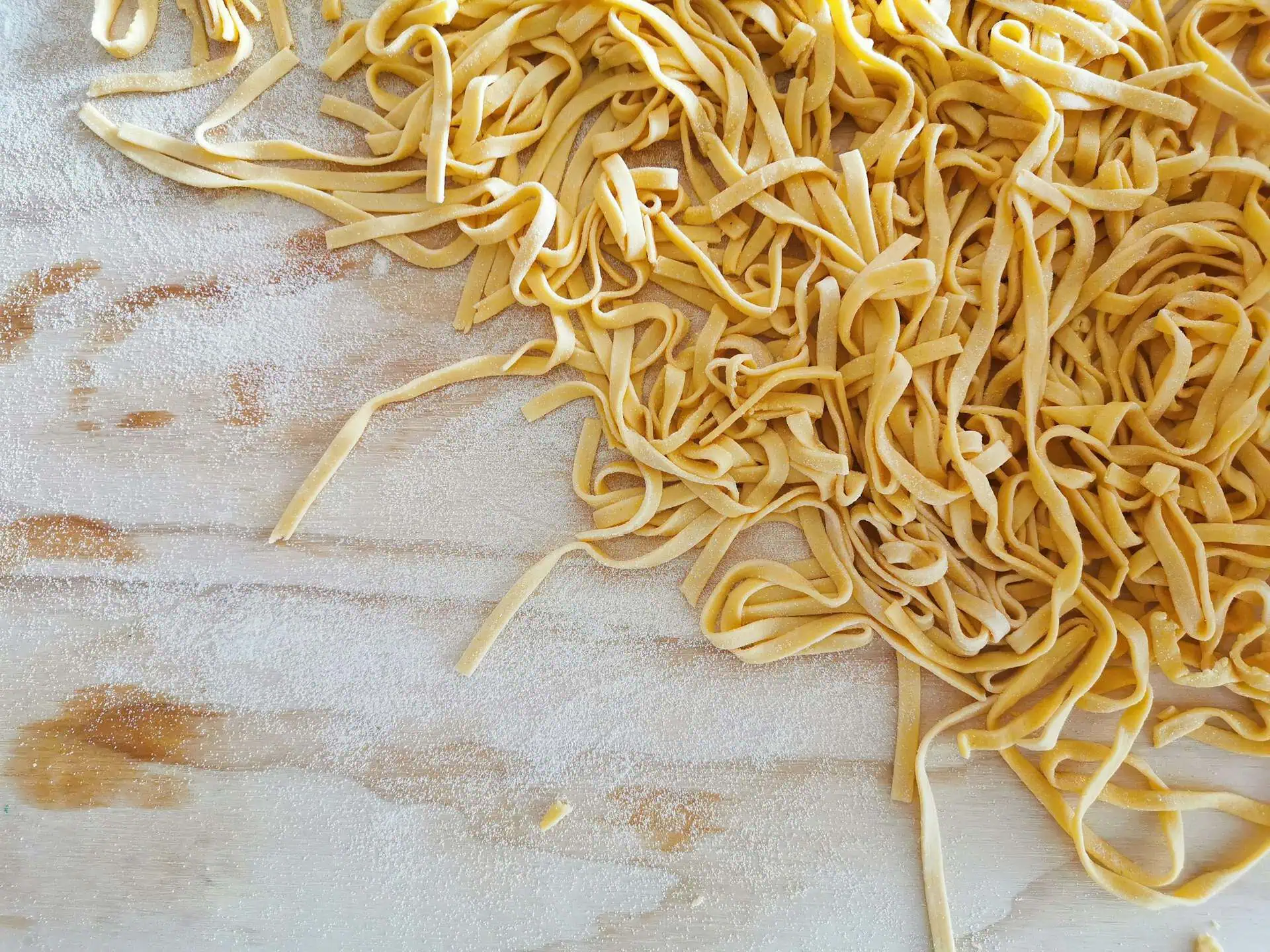
Liangpi (Cold-Skin Noodles)
Liángpí · say it: “lyahng-pee”
- Spice
- Medium heat
- Typical price
- ¥8–18
- Dietary
- Vegetarian
Shaanxi has been steaming grain into cold noodles since, by local telling, the Qin dynasty — two thousand years of summers in a bowl. Ask a Xi'an person what "cold skin" is and they'll hand you lunch. Liangpi (凉皮, liángpí) is the umbrella name for Shaanxi's cold steamed-sheet noodles — soft, slippery ribbons served cold, slicked with chili oil, black vinegar and garlic water, then piled with cucumber slivers and blanched bean sprouts. It sounds simple; the balance of sour, hot and nutty is anything but, and every shop guards its chili oil like a trade secret. It's ¥8–18 a bowl, it's everywhere, and in summer it's what the city runs on — most often as one third of the "Three Qin set" (三秦套餐, Sānqín tàocān): liangpi, a roujiamo and a Bingfeng (冰峰, Bīngfēng) orange soda.
Ordering gets easier once you see the family tree — liangpi splits by raw material:
- Mipi (米皮, mǐpí) — rice-based. The prestige version is Qinzhen mipi (秦镇米皮, Qínzhèn mǐpí) from Qinzhen town in Huyi District (鄠邑区, Hùyì Qū), southwest of the city, where shops steam rice slurry into silky white sheets and cut them to order. Soft, lush, dressed bright with chili oil — the style on Shaanxi's intangible-heritage list since 2013. In Hanzhong (汉中, Hànzhōng), further south, the same rice sheets come warm as hot mipi (热米皮, rè mǐpí) — the winter breakfast of the family.
- Mianpi (面皮, miànpí) — wheat-based. The dough is washed to separate starch from gluten; the starch sets into the noodle, and the leftover gluten cake (面筋, miànjīn) is steamed, cubed and tossed back into the bowl — the springy beige cubes are many people's favorite part. The chewiest branch is ganmianpi (擀面皮, gǎnmiànpí), "rolled" wheat skin from Baoji (宝鸡, Bǎojī) and Qishan (岐山, Qíshān) to the west: firmer, tangier, more vinegar-forward.
Xi'an's own contribution is majiang liangpi (麻酱凉皮, májiàng liángpí) — cold ribbons under a thick sauce of toasted sesame paste, chili oil and vinegar. This is the style the Hui cooks of the Muslim Quarter made famous, and it's the richest of the lot — order it when you're not planning to eat again for a while.
Gluten, honestly: the rice versions (mipi) contain no wheat in the noodle itself, so they're effectively gluten-free. The wheat versions (mianpi, ganmianpi) are the opposite — and the gluten cake they come with is exactly what it sounds like. Dressings vary by shop, so if you avoid gluten strictly, say 不要面筋 (bù yào miànjīn, "no gluten cake") and confirm the dressing.
How to eat it
Eat it like the locals do: as a fast, cheap meal, not a side dish. Toss everything together before the first bite — the dressing pools at the bottom — and don't be timid with the chili oil, which here is roasted and fragrant rather than face-melting. If you are timid, 少辣 (shǎo là) gets you the mild version. The sprouts and cucumber are there for crunch against the soft noodles; a good bowl disappears in five minutes, ideally next to a roujiamo for the full Three Qin set.
Season matters less than you'd think — mipi is eaten year-round, and Hanzhong's warm version exists precisely for winter. What matters is freshness: proper liangpi shops steam sheets through the day and cut and dress each bowl to order. If you see premixed bowls wilting in a display case, walk on. Vegetarians are well served — the standard dressing is plant-based (see our vegetarian guide) — and the sesame-paste version in the Quarter doubles as a halal meal; the Muslim Quarter eats guide maps the good lanes. More of the canon on our Xi'an food hub.
Where to try it
Weijia Liangpi (魏家凉皮)
The homegrown chain, running since 1999, with branches all over the city — some open around the clock. Two house styles: mizhi (秘制, mìzhì), the sour-spicy „secret recipe,” and majiang (麻酱), the sesame-paste version. Not the most romantic bowl in town, but consistent, cheap and there at 11pm.
Qinzhen mipi at the source
Qinzhen town in Huyi District, a drive southwest of the city, is effectively a street of mipi shops serving the rice-noodle original where it was born. Only worth the trip for dedicated eaters — but this is the pilgrimage.
Muslim Quarter sesame-paste liangpi
The Hui-run stalls of the Quarter are where majiang liangpi lives. Look for 麻酱凉皮 on the sign and a cook dressing bowls to order; it slots naturally into a crawl — see the guide linked above.
Read the guide