Qinglong Temple
Qīnglóng Sì
The Tang temple that sent Buddhism to Japan in 804 AD — and still draws half of Xi'an every cherry blossom season.
Entry
Free
Hours
Mon–Sun · 8:30
Time needed
1–2½ hours
Booking
Required · 1 days ahead
Metro
Line 3 · Qinglongsi (青龙寺) · A
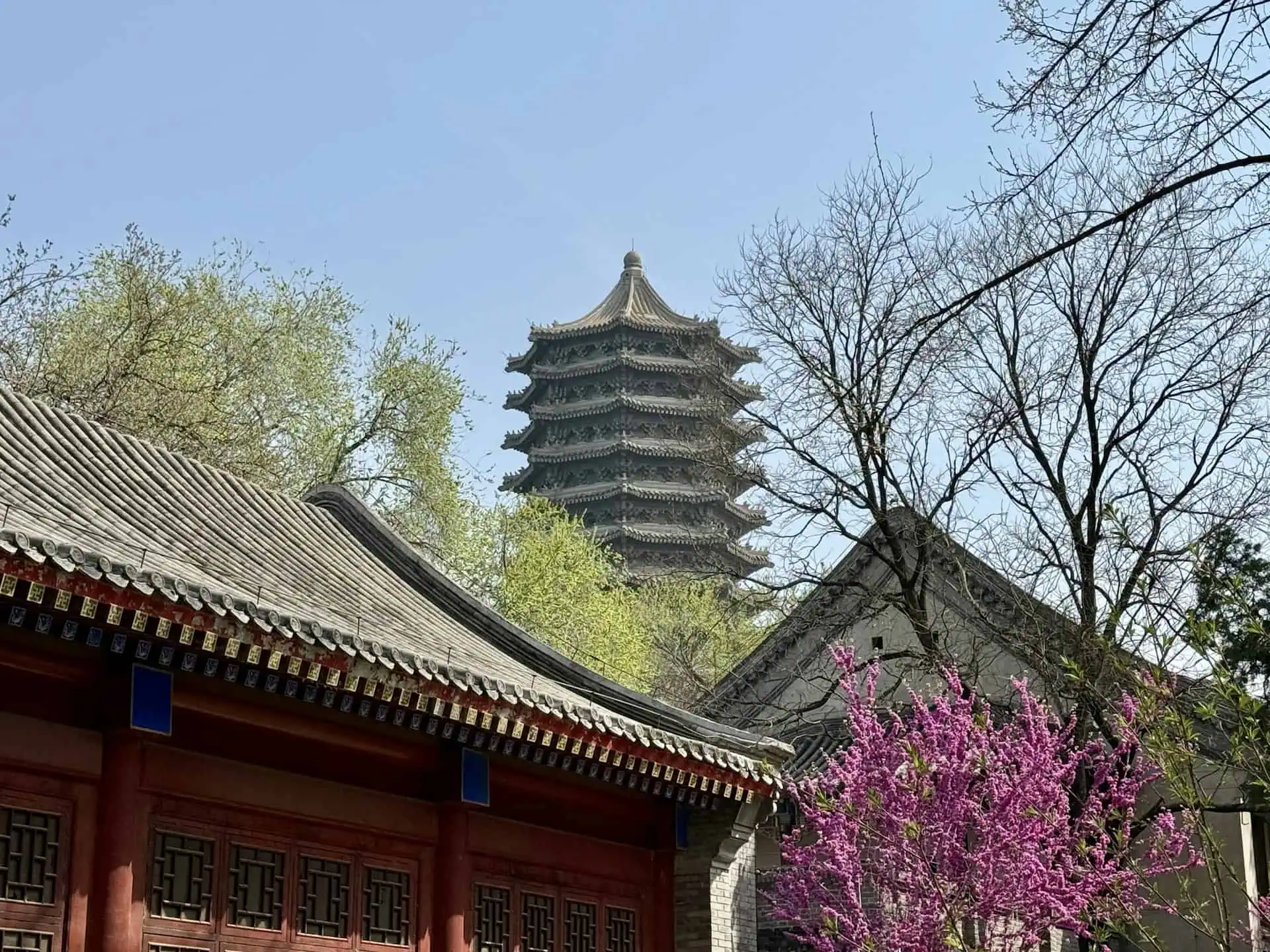
In 804 AD, the Japanese monk Kūkai studied esoteric Buddhism here, then carried it home to found Japan's Shingon school — an outsized story for a small, free ruins park in the southeast suburbs. Japanese pilgrims still come. So do half of Xi'an in late March, when a thousand cherry trees — many donated from Japan — turn the park pink. In blossom season it's a must; the rest of the year it's a pleasant, quiet hour if you're already in the Qujiang area.
What you're looking at
Qinglong Temple (青龙寺, Qīnglóng Sì) began as a Sui-dynasty temple in 582 and took its current name under the Tang. Its moment in world history came in 804, when a young Japanese monk named Kūkai (空海, Kōnghǎi — later honored as Kōbō Daishi) arrived in Tang Chang'an and studied esoteric (Vajrayana) Buddhism under the abbot Huiguo (惠果, Huìguǒ), one of the great tantric masters of the age. Within about two years Kūkai had received full transmission; he sailed home and founded Shingon, the esoteric school that still has millions of followers in Japan. For Japanese Buddhists, this modest hillside is effectively a birthplace — memorial halls, steles and a Kūkai monument on site, many funded by Japanese Buddhist associations, honor the connection.
The original Tang temple didn't survive — it faded in the religious suppressions and wars of the late Tang and was gone within a few centuries. What you visit today is the Qinglong Temple Ruins Park (青龙寺遗址公园, Qīnglóngsì Yízhǐ Gōngyuán): excavated foundations, a small museum of Tang artifacts dug from the site, and reconstructed halls in Tang style from the 1980s.
Then there are the cherries. In 1986 Japanese Buddhist groups donated cherry trees to the park — some sources count over a thousand now, in varieties from the pale Yoshino to rarer late bloomers. From late March to mid-April they turn the ruins into Xi'an's signature blossom scene: Tang-style roofs behind drifts of pink, and crowds to match. See our cherry blossom guide for timing the bloom.
Visiting strategy
Is it worth it? That depends entirely on the calendar.
- Late March–mid-April (blossom season): absolutely yes. This is the city's most concentrated cherry display, free, and a direct metro ride away. Come on a weekday morning at opening; on blossom-season weekends the paths jam by 10:00 and the reservation system caps entries for a reason.
- The other eleven months: a pleasant, quiet park with a genuinely good story, but not a destination on its own unless you're a Japanese-Buddhist-history pilgrim. Fold it into a Qujiang day — the Big Wild Goose Pagoda is two metro stops away — rather than crossing town for it.
How to do it. Allow 60–90 minutes: the museum first for context (it's small), then the reconstructed halls and the Kūkai memorials, then a loop of the grounds. In blossom season, budget up to 2.5 hours — half of it spent shuffling politely behind other people's phones.
Booking is the catch. Entry is free but requires a reservation through the official WeChat account (青龙寺遗址公园) — see the fact box. In blossom season, treat it like a ticketed sight and book the day before at minimum. Our booking-attractions guide walks through the WeChat reservation drill if you're new to it.
Getting there
The park sits in the Tielumiao area of Yanta District, southeast of the center — easy by metro, which also beats the blossom-season traffic.
- Metro: Lines 3 and 5 both stop at Qinglongsi (青龙寺) station. From Line 3 use exit A, from Line 5 use exit G, then walk about 300 meters north along Yanxiang Road (雁翔路, Yànxiáng Lù) to the east gate. From the Big Wild Goose Pagoda it's about two stops east on Line 3.
- Taxi/DiDi: ask for 青龙寺遗址公园. Cheap and quick from anywhere in Qujiang; from the Bell Tower area expect 20–30 minutes depending on traffic.
- Blossom-season warning: on peak weekends the roads around the park clog and taxis crawl. Take the metro — everyone else who got the memo is on it too. Our getting around guide covers metro ticketing basics.
Practical notes
- Reservations: free but mandatory via the official WeChat account; bring your passport in case staff verify ID at the gate.
- Blossom timing: the bloom usually runs late March to mid-April, shifting a week either way with the weather — check our best time to visit guide and recent photos on WeChat/Trip before betting a day on it.
- Facilities: toilets and drink kiosks inside the park; for a real meal, head back toward the Big Wild Goose Pagoda area afterward.
- Photography: unrestricted in the park; the classic frame is cherry branches against the reconstructed Tang eaves. Tripods are fine outside, impractical in weekend crowds.
- Conduct: this is still a religious site with active halls — keep voices down inside buildings and don't picnic on the memorial lawns.
Questions, answered
Is Qinglong Temple free to enter?
Yes, entry is free — but you must reserve a timed slot in advance through the temple's official WeChat account (青龙寺遗址公园). The reservation rule is strictly enforced during cherry-blossom season, when weekend slots sell out.
When is the cherry blossom season at Qinglong Temple?
Usually late March to mid-April, shifting about a week with the year's weather. The park holds roughly a thousand cherry trees — many donated by Japanese Buddhist associations in 1986 — and it's Xi'an's most famous blossom spot.
Why do Japanese tourists visit Qinglong Temple?
Because Japanese esoteric Buddhism effectively started here. The monk Kūkai (Kōbō Daishi) studied under the Tang master Huiguo at Qinglong Temple from 804, then carried the teachings to Japan and founded the Shingon school. The park has memorials to him, and Japanese pilgrims and Buddhist groups visit regularly.
How do I get to Qinglong Temple by metro?
Take Line 3 or Line 5 to Qinglongsi (青龙寺) station. Use exit A from Line 3 or exit G from Line 5, then walk about 300 meters north along Yanxiang Road to the east gate. It's about two stops east of the Big Wild Goose Pagoda on Line 3.
Is Qinglong Temple worth visiting outside cherry blossom season?
If you're already in the Qujiang area, yes — it's a free, quiet park with excavated Tang foundations, a small museum, and the Kūkai story. But it's not worth a cross-town trip on its own; combine it with the Big Wild Goose Pagoda, which is two metro stops away.
How long do you need at Qinglong Temple?
60–90 minutes covers the museum, reconstructed halls and a loop of the grounds. In blossom season allow up to 2.5 hours — the crowds slow everything down, and you'll want time in the cherry groves.
Keep exploring
Big Wild Goose Pagoda
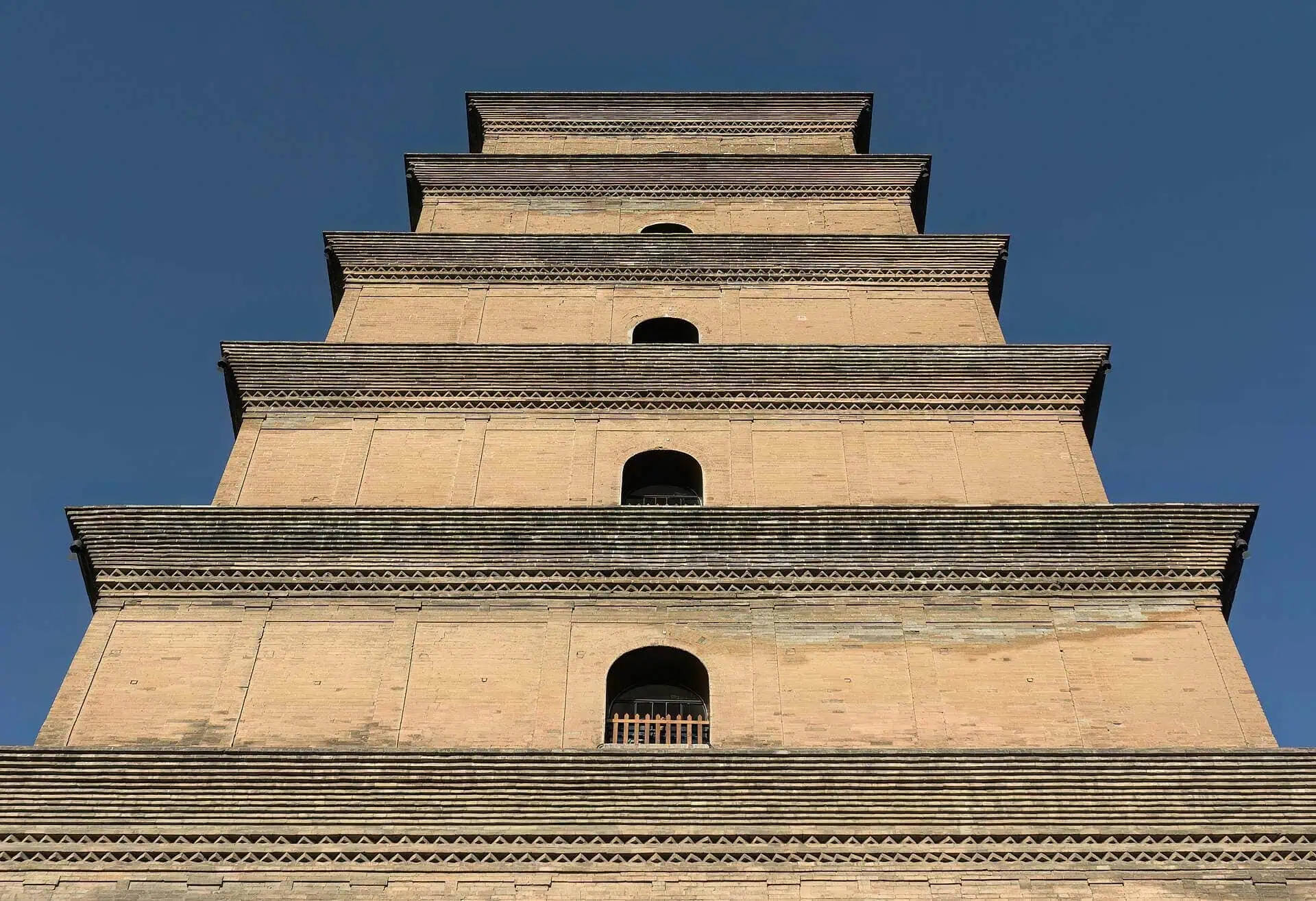
A Tang brick pagoda raised in 652 AD for a monk's 17-year journey to India — still Xi'an's defining landmark.
Learn more →

Grand Tang Ever-Bright City
Two kilometers of free, floodlit Tang dynasty spectacle — the golden age, rebooted nightly.
Learn more →
Tang Paradise
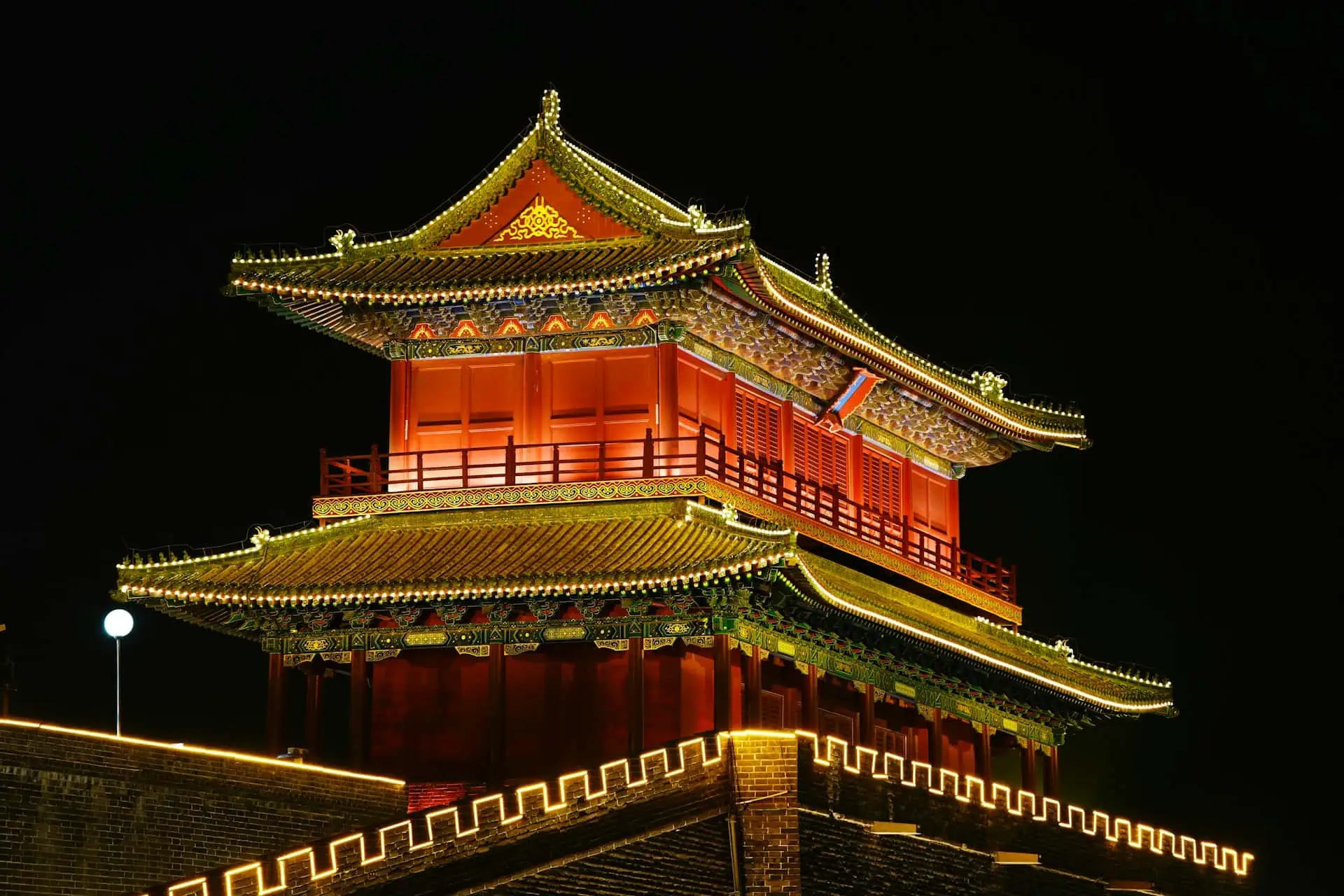
A royal Tang garden reimagined in 2005 — artificial, enormous, and genuinely beautiful after dark.
Learn more →
Related stories
Best time to visit Xi'an: an honest month-by-month guide
Xi'an has two golden windows — late March to May, and September to early November — and two seasons that demand a reason: a furnace-hot summer and a cold, dry, wonderfully empty winter. Weather is only half the story, though; the Chinese holiday calendar can matter more than the temperature. Here's every month, with the traps marked.
Hanfu costume rental & photoshoot guide
Renting a Tang-style costume and having your photo taken against 1,300-year-old backdrops is Xi'an's signature tourist experience — and unlike most signature tourist experiences, it's actually good value. A full outfit with hair and makeup runs ¥100–300, the streets are so used to costumed visitors that nobody bats an eye, and the night scenery does the heavy lifting. Here's how to do it without getting upsold.
Cherry blossoms in Xi'an: Qinglong Temple & beyond (March–April)
Xi'an's cherry blossom season runs roughly mid-March to mid-April, and the classic place to see it is Qinglong Temple — a Tang dynasty temple with a 1,200-year-old connection to Japan, where hundreds of Japanese-donated cherry trees bloom against old temple walls. Entry is free but you'll need a reservation, weekends are a contact sport, and if you miss the petals, April's peonies are the consolation prize. Here's how to time it.