The photographer's Xi'an: best spots & times
Xi'an rewards photographers who plan around light, not locations. The city's great subjects — walls, towers, pagodas, night markets — are all floodlit after dark, which means the magic window is the same almost everywhere: the hour around sunset. Here's where to stand, when to be there, and the rules that can cost you your drone.
10 min read · 8 sections
How to shoot Xi'an
The logic of photographing Xi'an is simple: the city lights up at night, so sunset is everything. Almost every major monument — the Bell Tower, Drum Tower, City Wall gates, Big Wild Goose Pagoda — is floodlit from dusk until about 23:00. The best frames happen in the 30–40 minutes after sunset ("blue hour"), when the sky is still deep blue but the lights are fully on. In Xi'an that window falls around 18:00 in midwinter and around 20:00 in midsummer — check the actual sunset time for your dates and arrive 45 minutes early to scout and claim a railing.
The other two rules: mornings belong to you (the City Wall at 8:00 is empty; by 10:00 it's not), and haze is part of the deal — winter air can be flat and grey, while the two or three days after rain or a cold front deliver the clearest skies. If you wake up to a crisp, transparent morning, drop everything and shoot.
A note on gear: a fast lens (f/2.8 or better) earns its keep at night markets and in museums where flash is banned. Tripods are fine on the street and in public squares but prohibited inside the Terracotta Army — details below.
City Wall: South Gate at blue hour
The single best elevated frame in Xi'an. Go up at the South Gate (永宁门, Yǒngníngmén) — it keeps the longest hours of any gate, roughly 8:00–22:00 — about 90 minutes before sunset. Shoot the barbican and gate towers in warm late light, then turn north along the wall's walkway for the classic leading-line shot: ramparts, lanterns and battlements converging toward the Bell Tower, glowing at the center of the old city. After dark, the gate towers are floodlit gold and you can shoot the illuminated South Gate complex from the wall itself, or descend and shoot it from the plaza outside.
Practicalities: entry is ¥54; if you also want to cycle the loop, rental desks stop hiring around 20:00, so ride first and shoot second — our City Wall guide has the logistics. A tripod up top is no problem; wind on the parapet is the real enemy, so weight it. In summer, do this on a weekday — the South Gate is the most popular stretch of wall in the city.
Bell Tower: the free terrace shot
The Bell Tower (钟楼, Zhōnglóu) sits in the middle of a roundabout, which makes street-level shots awkward: traffic, fences, and a tower that's always slightly too close. The fix is the Kaiyuan Shopping Mall (开元商城, Kāiyuán Shāngchéng) on the roundabout's southeast corner: its 5th-floor open-air viewing platform looks straight across at the tower, high enough to clear the traffic. It's free, open roughly during mall hours (about 10:00–22:00), and a three-minute walk from Zhonglou metro station (Line 2, exit C).
The shot: the tower floodlit amber against a blue-hour sky, with the roundabout's light trails below if you bring something to steady the camera for a 2–5 second exposure. Be in position 30 minutes after sunset; the lights stay on until about 23:00 if you want a true night frame. Daytime here is a wasted stop — this is strictly a dusk and night location. The Drum Tower (鼓楼, Gǔlóu), a few hundred meters west, is best shot from the plaza between the two towers with a wide lens, and pairs naturally with this stop.
Big Wild Goose Pagoda: fountains at dusk
The Big Wild Goose Pagoda (大雁塔, Dàyàntǎ) gives you two distinct frames. The first is the north square fountain show (大雁塔北广场, Dàyàntǎ Běi Guǎngchǎng): a huge musical fountain array with the floodlit pagoda rising behind it. Evening performances are typically listed around 19:00 and 21:00 — each only about ten minutes — though the schedule shifts by season and daytime shows are sometimes canceled for maintenance (Tuesdays are the traditional maintenance day), so confirm the times on the day. Arrive 20–30 minutes early: the front railing fills completely. For reflections, shoot from the edge of the dry fountain grid just after a show ends, when the pavement is still wet and the crowd is leaving.
The second frame is the south square: the bronze statue of the monk Xuanzang silhouetted against the pagoda — shoot from a low angle at dusk. From there you can walk straight into the Grand Tang Ever-Bright City below. This is the most crowd-managed photography you'll do in Xi'an; on holiday weekends, treat it as a spectator sport and protect your gear accordingly.
Ever-Bright City: hanfu crowds at night
The Grand Tang Ever-Bright City (大唐不夜城, Dàtáng Bùyèchéng) — the pedestrian boulevard south of the pagoda — is Xi'an's most photogenic street after dark: Tang-style facades washed in warm light, lantern trees, street performers, and above all the people. Hundreds of visitors rent Tang-dynasty hanfu and arrive fully styled, hairpieces and all, which turns the whole street into an unintentional costume drama. For a photographer it's a gift: portraits, street scenes and detail shots everywhere you look.
Shoot with a fast prime at f/1.8–2.8 and high ISO rather than fighting the crowd with a tripod. The light is entirely artificial and mixed (warm floods plus neon accents), so set white balance manually or shoot raw. The street is busiest 19:00–22:00; after 22:30 it empties fast and the architectural shots get easier. If the hanfu scene grabs you, renting a set yourself is half the fun — our hanfu photoshoot guide covers how it works.
People etiquette, here and everywhere on this list: styled hanfu crowds generally expect to be photographed — a smile and a raised camera with a questioning look gets a yes most of the time. For close portraits of anyone else — vendors, elders, children — always ask first.
Muslim Quarter: steam and neon
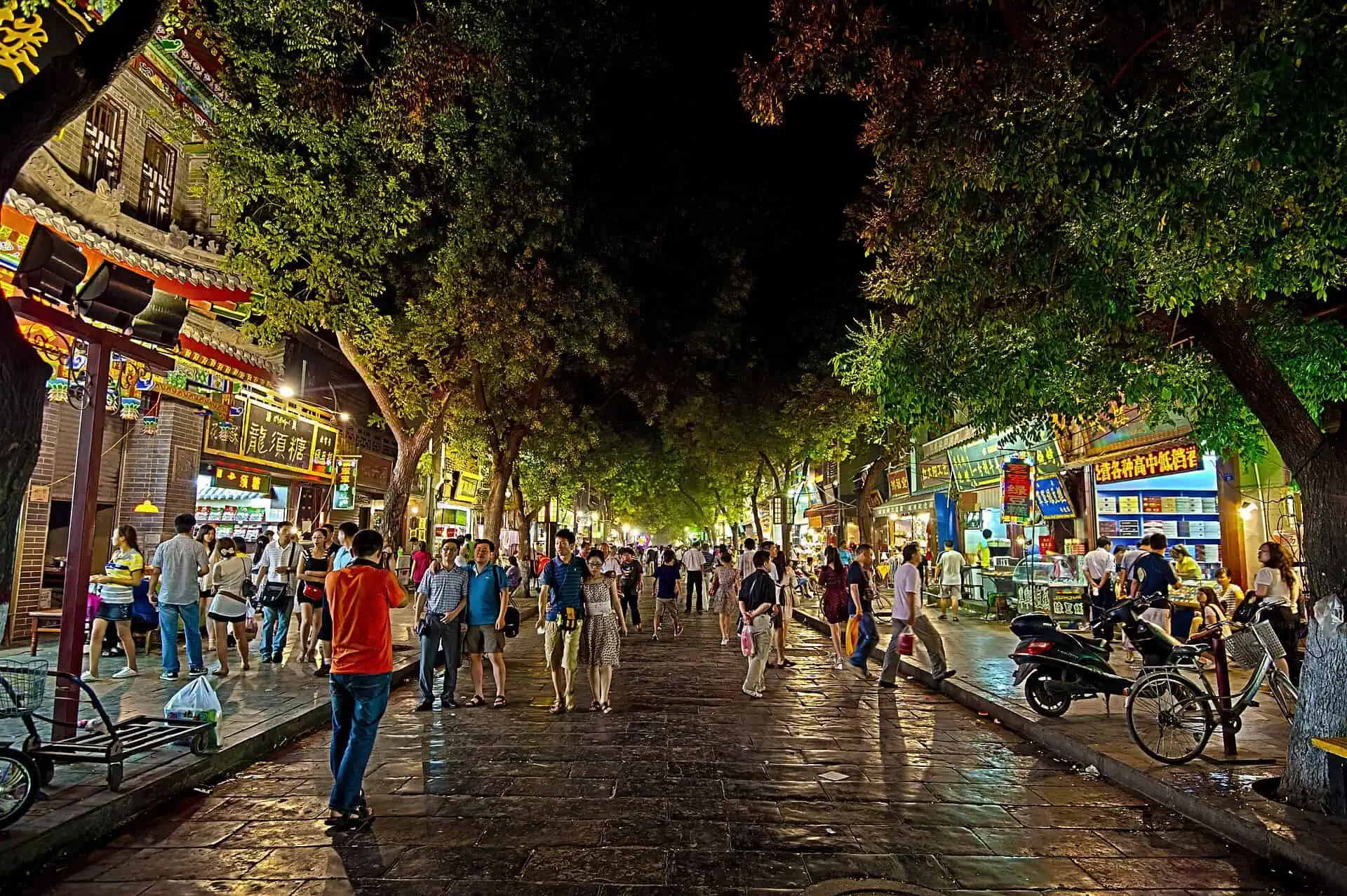
The Muslim Quarter after dark is the best street-photography set in Xi'an: charcoal smoke and steamer clouds backlit by neon, mallets pounding sesame candy, pomegranate presses, faces lit by grill fire. The main strip, Beiyuanmen (北院门, Běiyuànmén), gives you the dense neon canyon; the side lanes of Xiyangshi (西羊市) and Dapiyuan (大皮院) give you the working neighborhood — quieter, more human, better pictures.
Field notes:
- Shoot the light, not the noon. Come after 18:00 when the grills are going; winter steam shows up best against the cold air.
- Backlight the steam. Position yourself so stall lights shine through the smoke and steamer clouds toward your lens.
- Ask before faces. This is a living religious neighborhood, not a theme park. Vendors at tourist-heavy stalls are used to cameras; residents in the side lanes deserve a gesture and a smile first, and a no is a no. Buying something first changes every interaction for the better — see our food crawl for what to order.
- Leave the tripod. Lanes are shoulder-to-shoulder; a fast lens at ISO 3200–6400 is the tool. Watch your bag in the crush.
Terracotta Army: the rules
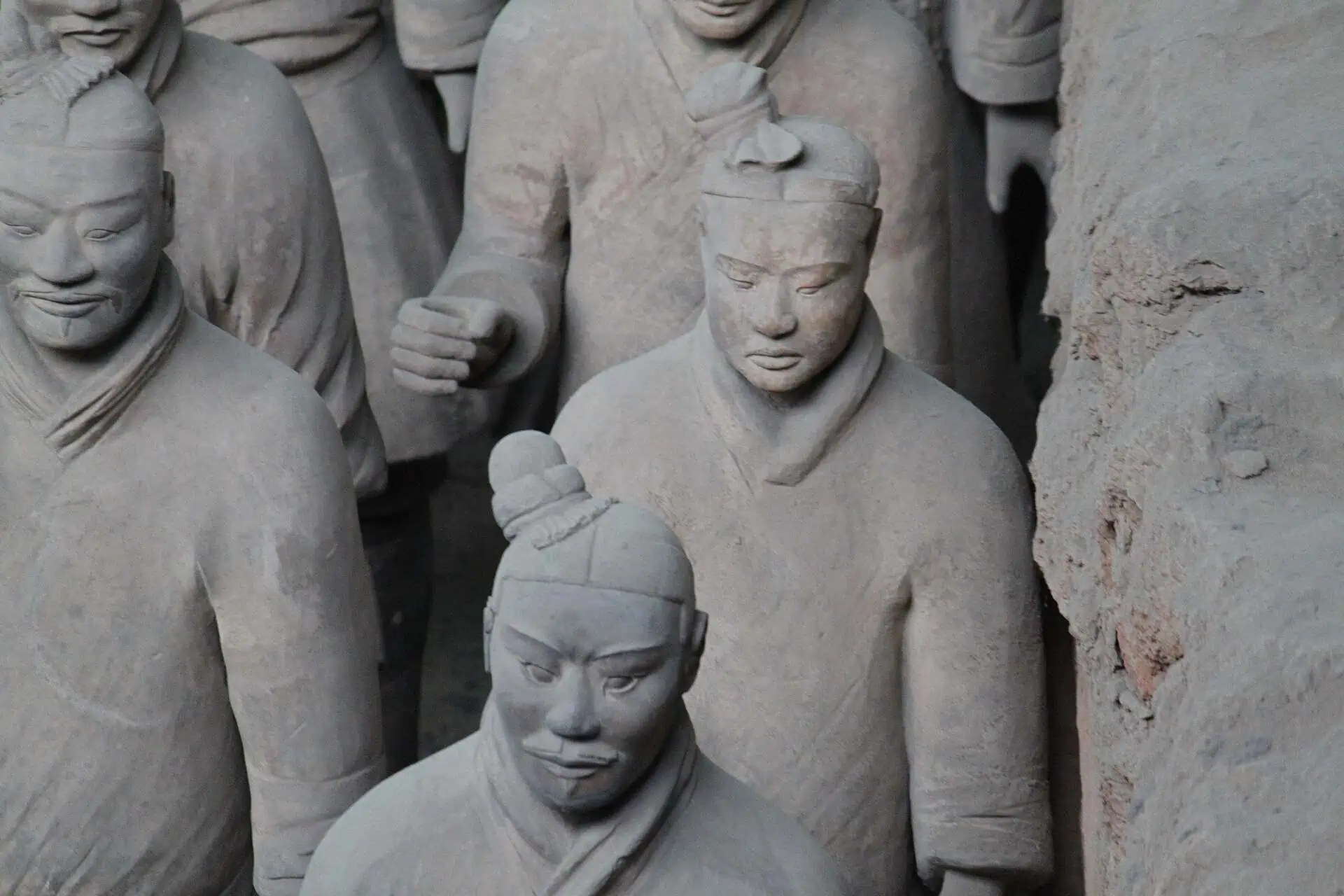
Photography is allowed in the Terracotta Army pits — but on strict terms, and the conditions are harder than most people expect:
- No flash. Anywhere, ever. Flash damages pigment and will get you shouted at by staff within seconds.
- No tripods (and treat monopods and selfie sticks as equally unwelcome in the galleries).
- No drones anywhere at the site — full stop.
- The light is dim and the distance is long. You shoot from elevated galleries, and Pit 1's far ranks are a hundred meters away in museum lighting. Bring your fastest lens and plan on ISO 1600–6400; a 70–200mm reach earns its bag space for faces and details.
- The best frame comes early. At 8:30 opening, you can shoot the length of Pit 1 over an empty railing; by 10:30 you're composing around selfie sticks. The glass-case figures in Pit 2 (the kneeling archer especially) are your close-up portraits — no flash, high ISO, wide aperture, and wait for a gap in the crowd.
Booking and transport are the bigger battle — read the Terracotta Army guide before you go.
Drones: read this before you pack one
China regulates drones seriously, and enforcement has tightened since the national rules took effect on January 1, 2024. The conservative summary for a visiting photographer — this is orientation, not legal advice, and you should confirm current rules on the CAAC's UOM platform before flying anything:
- Real-name registration is required. Drones must be registered on the CAAC's UOM platform (uom.caac.gov.cn), and the registration mark displayed on the aircraft. DJI drones also prompt real-name verification in the app on Chinese servers.
- There's a hard ceiling. In airspace open to hobbyists, flight is capped at 120 meters above ground; anything higher or in controlled airspace needs approval you are not going to get as a tourist.
- Assume Xi'an's sights are off-limits. The Terracotta Army bans drones outright. Airports (Xi'an Xianyang is northwest of the city) sit inside large no-fly zones, and DJI's geofencing will physically stop you around sensitive areas — government, military, and infrastructure sites you may not recognize as sensitive. City-center flying over crowds is a bad idea under any reading of the rules.
- Enforcement is real. Fines, confiscation and police attention all happen, and counter-drone systems operate around sensitive sites. "I didn't know" is not a defense that works.
The pragmatic verdict: unless you have a specific, researched location and confirmed registration, leave the drone at home. Xi'an's best frames — the wall, the towers, the pagodas — are all shootable from public terraces and ramparts, which is most of what this page is about.
Questions, answered
What is the best photo spot in Xi'an?
The City Wall at the South Gate at blue hour — ramparts leading toward the illuminated Bell Tower, with the floodlit gate complex behind you. Go up about 90 minutes before sunset. The best free spot is the Kaiyuan Shopping Mall's 5th-floor terrace, level with the Bell Tower across the roundabout.
Is there a free viewpoint of the Bell Tower?
Yes — the open-air viewing platform on the 5th floor of the Kaiyuan Shopping Mall (开元商城) on the roundabout's southeast corner. It's free, open roughly during mall hours (about 10:00–22:00), and three minutes from Zhonglou metro station exit C. Go 30 minutes after sunset for the floodlit tower against a blue sky.
Can I use a tripod at the Terracotta Army?
No — tripods are prohibited inside the museum, flash is banned, and drones are not allowed anywhere at the site. Photography itself is fine: bring a fast lens, shoot from the elevated galleries at high ISO, and arrive at opening (8:30) for crowd-free frames of Pit 1.
Can I fly a drone in Xi'an as a tourist?
Only with real-name registration on the CAAC's UOM platform, below 120 m, and outside controlled airspace — and in practice you should assume Xi'an's major sights (Terracotta Army, and anywhere near the airport or sensitive sites) are off-limits. Enforcement has tightened since 2024, with fines and confiscation. For a short tourist trip, leaving the drone at home is the sensible call.
What time does Xi'an light up at night?
Major monuments — the Bell Tower, Drum Tower, City Wall gates and Big Wild Goose Pagoda — are floodlit from around sunset until roughly 23:00. The best shooting window is the 30–40 minutes after sunset, when the sky still holds deep blue color. In Xi'an that lands around 18:00 in midwinter and around 20:00 in midsummer.
Places in this story
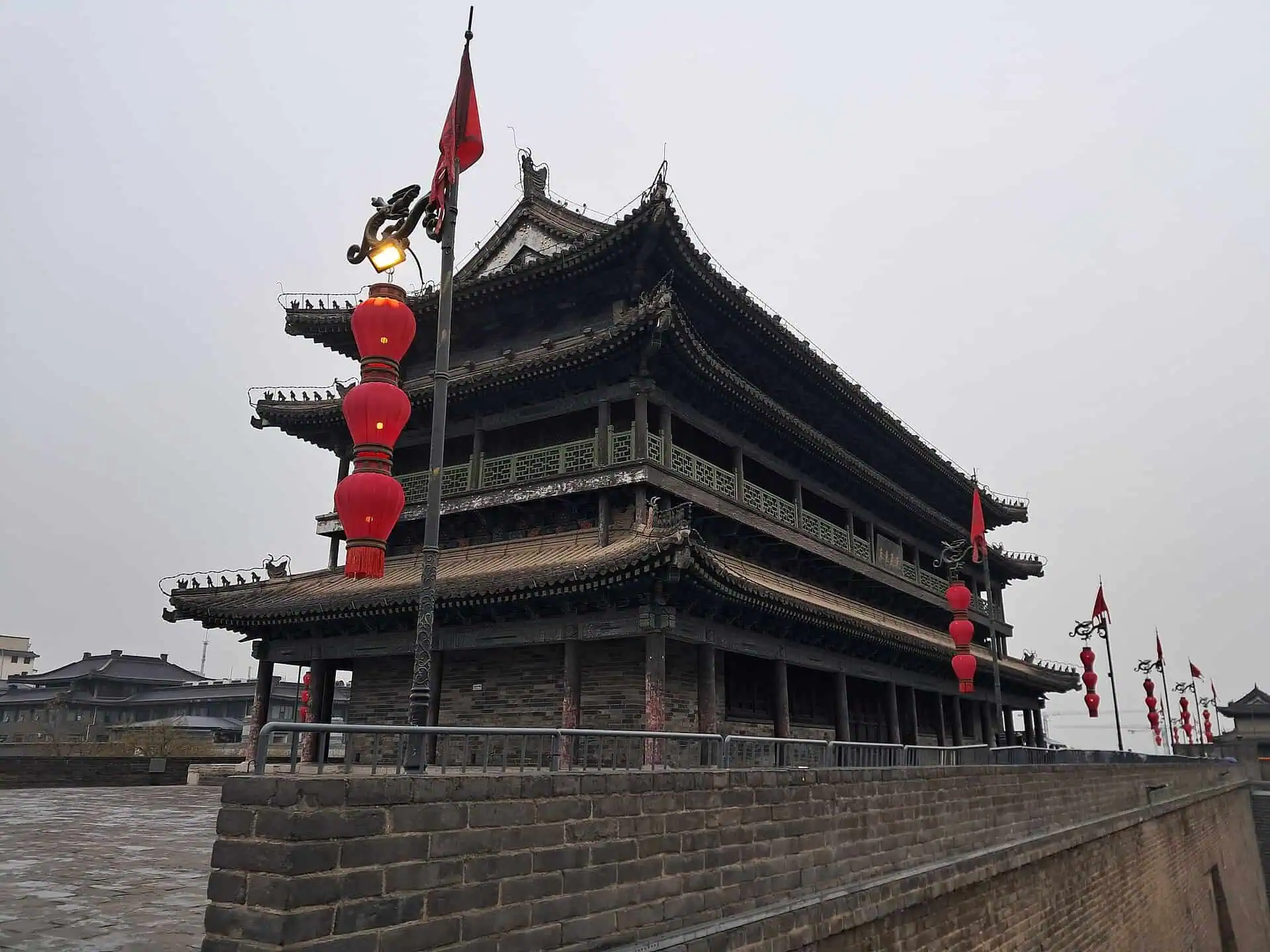
Xi'an City Wall
A 14-kilometer Ming dynasty rectangle you can cycle on top of — 650 years old and still the city's favorite commute.
Learn more →
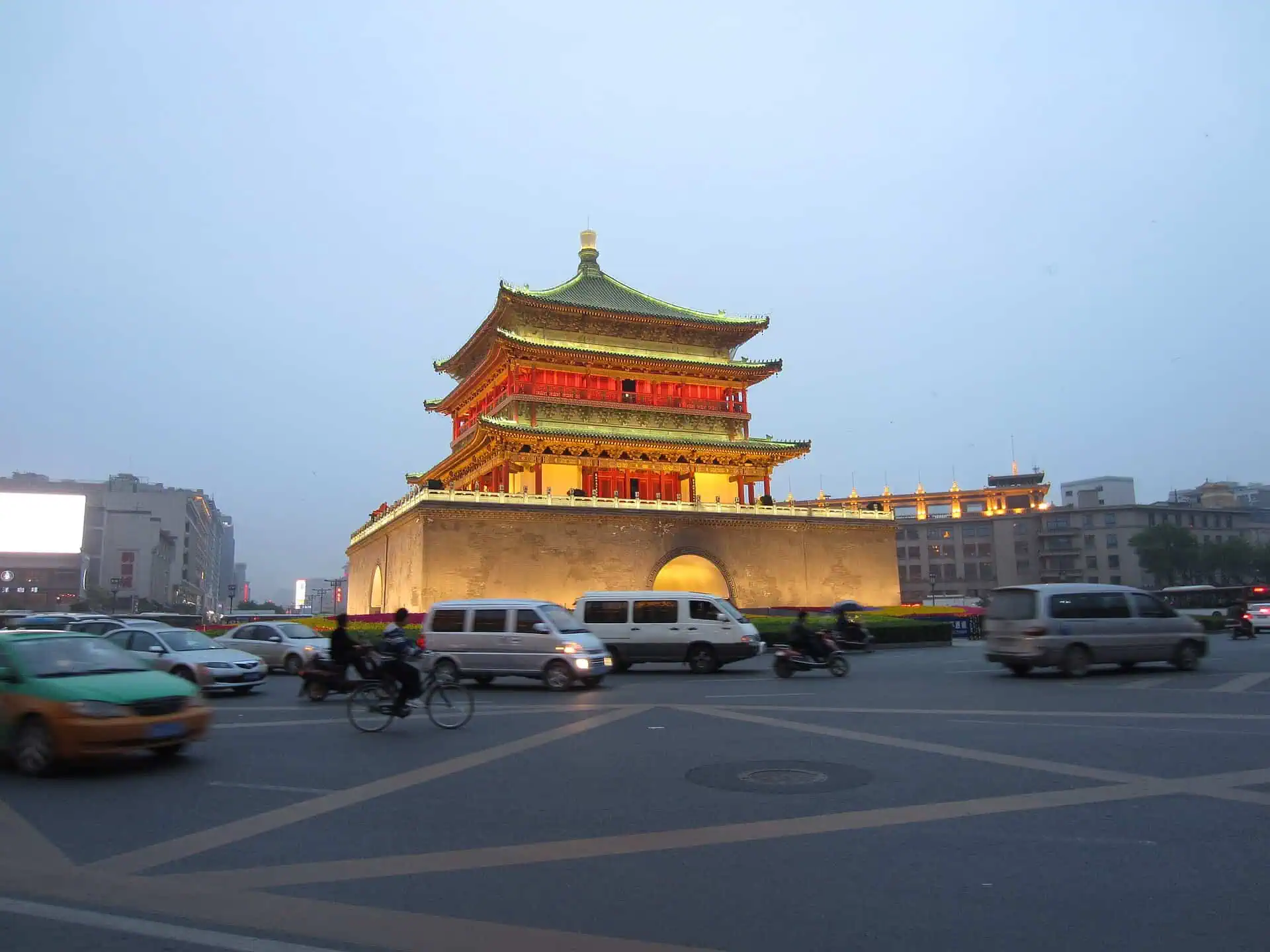
Xi'an Bell Tower
A Ming tower from 1384 at the dead center of the walled city — best admired at dusk, floodlit above the roundabout.
Learn more →
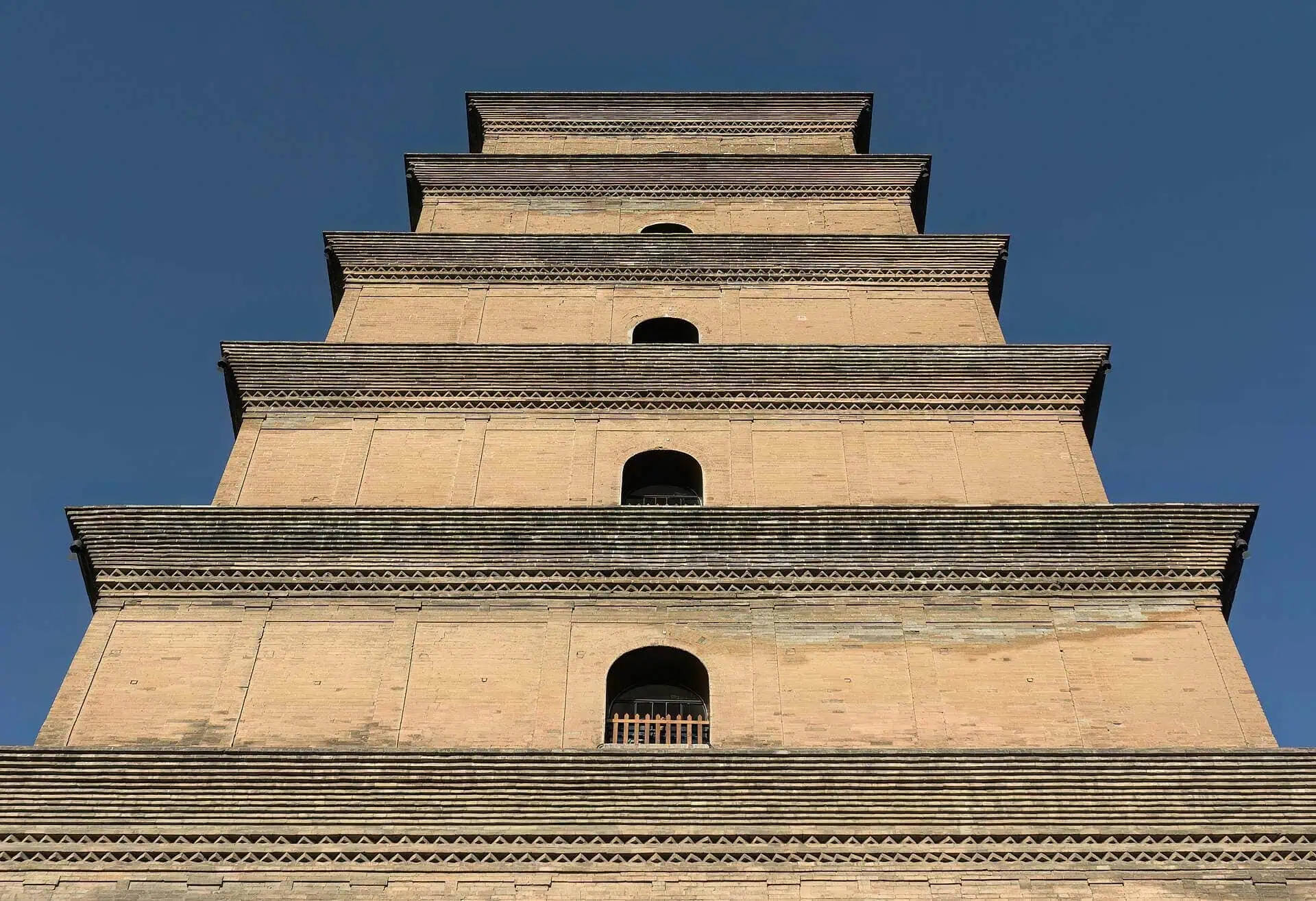
Big Wild Goose Pagoda
A Tang brick pagoda raised in 652 AD for a monk's 17-year journey to India — still Xi'an's defining landmark.
Learn more →
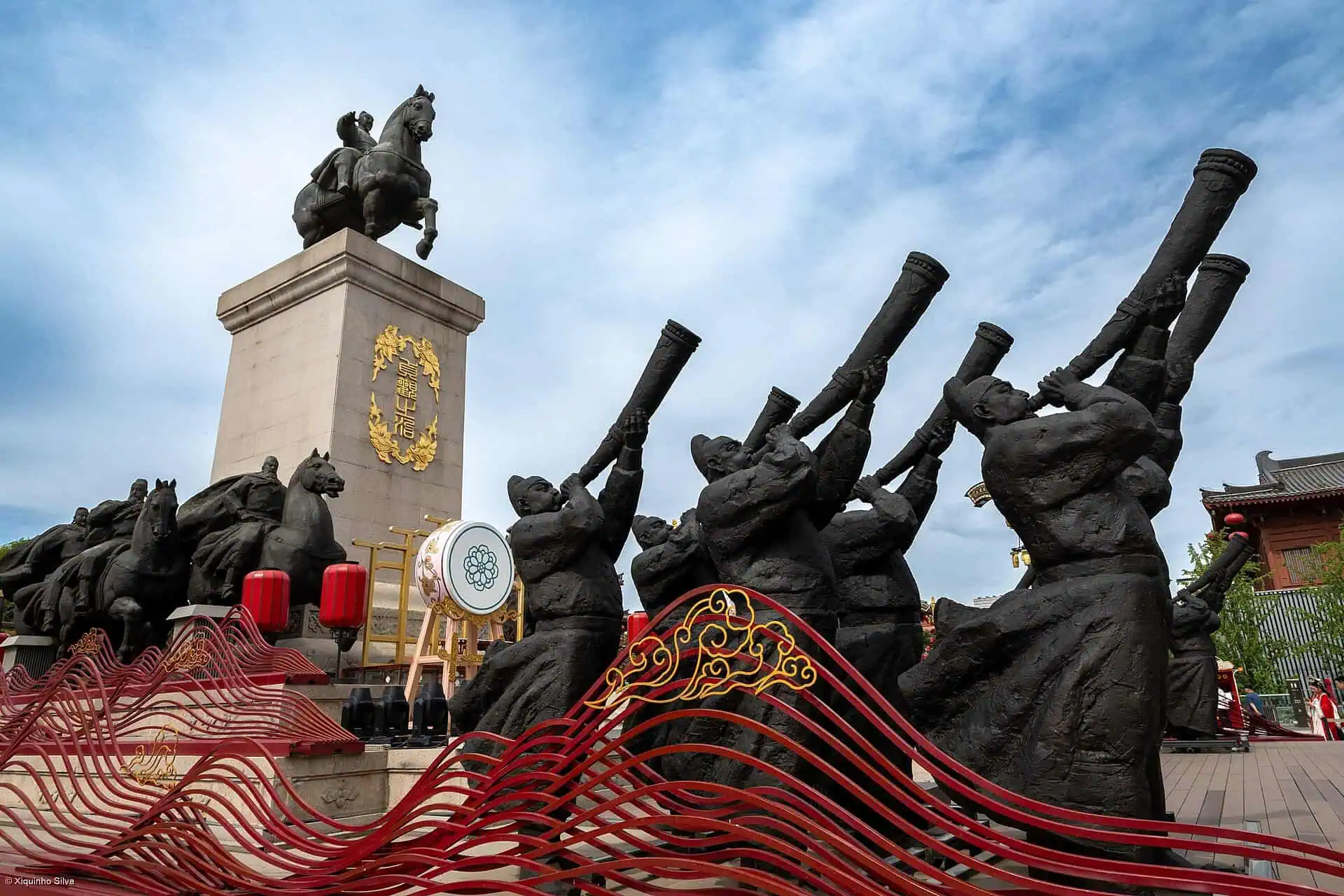
Grand Tang Ever-Bright City
Two kilometers of free, floodlit Tang dynasty spectacle — the golden age, rebooted nightly.
Learn more →
Muslim Quarter
Feeding Xi'an since the 700s — the loudest, smokiest, best-smelling streets of its Hui community.
Learn more →
Terracotta Army
8,000 life-sized soldiers buried for China's First Emperor — and still on guard 2,200 years later.
Learn more →
Keep exploring
Hanfu costume rental & photoshoot guide
Renting a Tang-style costume and having your photo taken against 1,300-year-old backdrops is Xi'an's signature tourist experience — and unlike most signature tourist experiences, it's actually good value. A full outfit with hair and makeup runs ¥100–300, the streets are so used to costumed visitors that nobody bats an eye, and the night scenery does the heavy lifting. Here's how to do it without getting upsold.
Tang Dynasty show & dumpling banquet — worth it?
The Tang Dynasty Palace dinner show is Xi'an's longest-running tourist evening: a dumpling banquet followed by an hour of Tang court music and dance in a plush theater. It's polished, comfortable and unashamedly aimed at visitors — and whether it's ¥400 well spent depends entirely on who you are. Families and first-time visitors to China tend to love it; travelers chasing the raw and local should spend the evening at Ever-Bright City for free instead.
Xi'an at night: lights, shows & evening walks
Xi'an is a different city after dark — Tang-style streetscapes floodlit gold, a pagoda floating over fountain shows, gate towers glowing above the moat. The best of it is free: the Grand Tang Ever-Bright City pedestrian street alone is worth an evening, and the pagoda fountain show costs nothing. Add a late dinner in the Muslim Quarter and, in season, the open-air Song of Everlasting Sorrow, and your nights may outshine your days.