The Hui community and Islam in Xi'an
Islam reached Chang'an with Silk Road merchants in the Tang dynasty, and their descendants — the Hui, China's Chinese-speaking Muslims — have kept a quarter around the Great Mosque ever since. The story, the temple-style mosque, the food, and how to visit respectfully.
Islam comes to Chang'an
Islam was barely thirty years old when it reached China. By Muslim and Chinese tradition alike, the first embassy from the caliphate arrived at the Tang court in Chang'an (长安, Cháng'ān) in 651, in the reign of the third caliph, Uthman — and Persian (波斯, Bōsī) and Arab merchants followed the embassies along the Silk Road and the sea routes. Tang Chang'an, the most international city of its age, took them in: by the eighth century the capital had a settled community of Muslim traders, and the Great Mosque claims a founding date of 742. The tradition runs ahead of the documentation — the oldest surviving mosque buildings are far younger — but the core fact isn't in doubt: Muslims have been part of this city for about as long as there have been Muslims.
From foreign merchants to the Hui
For centuries these communities were foreigners — fanke (蕃客, Fānkè), "guest merchants" — living in their own lanes under their own headmen. The transformation came under the Mongol Yuan dynasty (1271–1368), which moved large numbers of Central Asian Muslims across the empire as soldiers, craftsmen and administrators, settling them throughout China. Intermarriage with Han Chinese, adoption of the Chinese language and a shared religion slowly produced something new: a people the records call Huihui (回回, Huíhuí) — the ancestors of today's Hui (回族, Huízú), recognized in modern China as an ethnic group of about eleven million, the country's largest Muslim community. The Hui formula is unusual anywhere in Islam: orthodox practice carried in the Chinese language, in Chinese-looking buildings, by people who eat with chopsticks. Xi'an's quarter is its most famous surviving neighborhood — and the deeper backstory is in Xi'an and the Silk Road.
A thousand years around the mosque
The quarter beside the Drum Tower has been continuously Muslim for roughly a millennium — through dynasties, rebellions and city planners. Its anchor is the Great Mosque (大清真寺, Dà Qīngzhēnsì) on Huajue Lane (化觉巷, Huàjuéxiàng), founded by tradition in 742 and rebuilt across the Ming and Qing; a scatter of smaller neighborhood mosques once served the surrounding lanes, and several still do. The hardest test came in the 1860s, when Hui revolts swept Shaanxi and the Qing suppression that followed destroyed or expelled most of the province's Muslim communities — some refugees ended up as far away as Kyrgyzstan, where their descendants are still called Dungan. The community inside Xi'an's wall survived, which is why the quarter today is so compact: it is what remains of a much larger world.
A mosque that looks like a temple
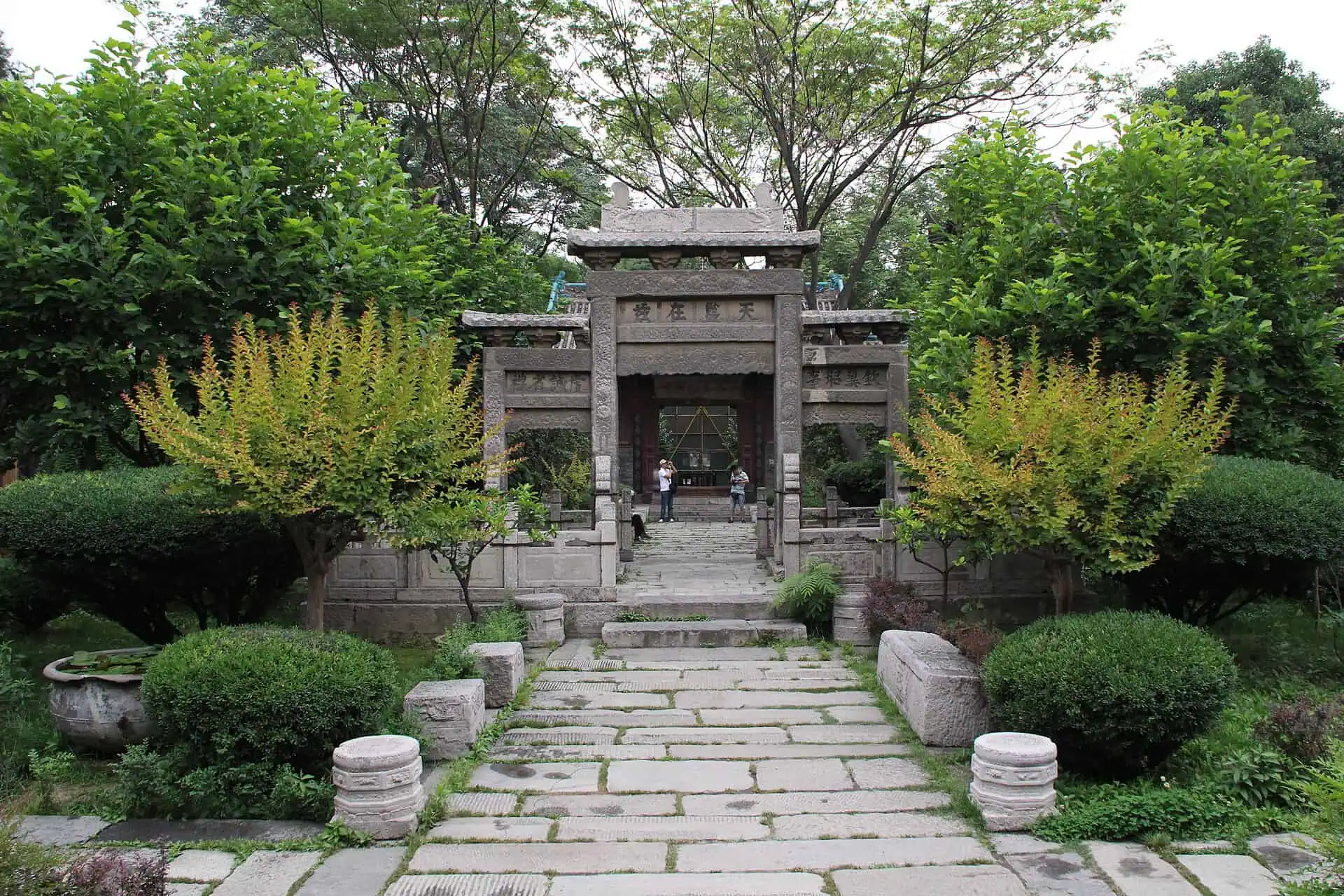
First-time visitors walk through five courtyards of tiled roofs, wooden pavilions, stone gateways and carved screen walls, and ask the obvious question: where are the dome and the minaret? The answer is the point. Chinese Islam built in the local vocabulary — the mosque is laid out like a Chinese temple or palace, along a walled central axis — and then bent that vocabulary to Islamic use. The complex runs east–west so the prayer hall at its far end faces Mecca; the "minaret" is a wooden pagoda-like pavilion used for the call to prayer; roof-ridge dragons share space with Arabic verses brushed in Chinese calligraphy; and there are no images of people or animals anywhere — decoration is geometric, floral and calligraphic. It is the most complete surviving example of a style that once covered China, and it explains the Hui better than any book: fully Muslim, fully Chinese, no contradiction.
The food the quarter built
A millennium of Muslim butchers, bakers and sesame-roasters produced Xi'an's most famous food neighborhood. The signature dish is yangrou paomo (羊肉泡馍, yángròu pàomó) — flatbread you tear yourself, soaked in lamb broth — joined by the Hui breakfast staple hulatang (胡辣汤, húlàtāng), a peppery beef soup with meatballs; guantang baozi (灌汤包, guàntāngbāo), soup-filled lamb dumplings; and zenggao (甑糕, zènggāo), a steamed cake of glutinous rice and dates sold from carts. Everything here is halal by default, which makes the quarter one of the easiest places in China for Muslim travelers to eat well. Start with our halal food guide, then work through the Muslim Quarter eats guide for specific stalls.
Visiting respectfully
The Muslim Quarter is a living religious neighborhood, not a food park with a mosque attached. A few courtesies go a long way:
- Dress modestly if you plan to enter the Great Mosque — covered shoulders and knees. Headscarves are not required of visitors.
- The prayer hall is closed to non-Muslims. The courtyards are open; admire the hall from the doorway.
- Time your visit around prayers. Five daily prayers structure the day, and Friday midday is the week's main gathering — pick another hour if you want the courtyards quiet, and never walk in front of someone praying.
- Ask before photographing people, especially worshippers and older residents; skip flash indoors.
- Don't bring pork or alcohol into the quarter. Many restaurants don't serve alcohol at all — order tea and don't make a thing of it.
- Ramadan flips the rhythm: subdued days, then some of the liveliest evenings of the year after iftar. The dates move each year — check before you go.
Where to see this today
- The Great Mosque: five courtyards on Huajue Lane, founded by tradition in 742 — allow an hour, dress modestly, avoid prayer times.
- The Muslim Quarter: the lanes north of the Drum Tower — eat the main street, then detour into the side alleys where the neighborhood actually lives.
- Bell Tower and Drum Tower: the quarter's Ming neighbors — the drum once marked curfew for everyone, Muslim and Han alike.
- The food: the halal guide for eating across the city, and Muslim Quarter eats for the stalls.
- Base yourself nearby: inside the city wall puts the quarter a short walk away — best visited hungry, after dark.
Questions, answered
Who are the Hui people?
China's Chinese-speaking Muslims — descendants of Persian, Arab and Central Asian Muslim merchants, soldiers and officials who settled in China from the Tang dynasty onward and intermarried with Han Chinese. Numbering about eleven million, they are the country's largest Muslim community, and Xi'an's quarter around the Great Mosque is their most famous neighborhood.
When did Islam arrive in Xi'an?
By tradition, an embassy from the caliphate reached the Tang court in Chang'an in 651, and Muslim merchants settled in the city soon after. The Great Mosque claims a founding date of 742; its surviving buildings are mostly Ming and Qing. Either way, Islam has been present in the city for well over a thousand years.
Can non-Muslims visit the Great Mosque of Xi'an?
Yes — the five courtyards are open to visitors for a small admission fee. Dress modestly, avoid prayer times (especially Friday midday), and note that the prayer hall itself is reserved for worshippers; you can look in from the doorway.
Is the food in Xi'an's Muslim Quarter really halal?
Yes. The quarter is a Hui neighborhood and its stalls and restaurants are halal as a matter of course — lamb, beef and chicken, no pork anywhere, and little or no alcohol. It's the easiest place in Xi'an for Muslim travelers to eat, and the best food neighborhood in the city for everyone else too.
What is the best time of day to visit the Muslim Quarter?
Late afternoon into evening, when the food streets are in full swing — but steer clear of Friday midday prayers at the Great Mosque. During Ramadan, expect quiet days and festive nights after the fast breaks.
Places in this story
Great Mosque of Xi'an
A mosque founded under the Tang in 742 AD, dressed as a Chinese garden temple.
Learn more →
Xi'an Drum Tower
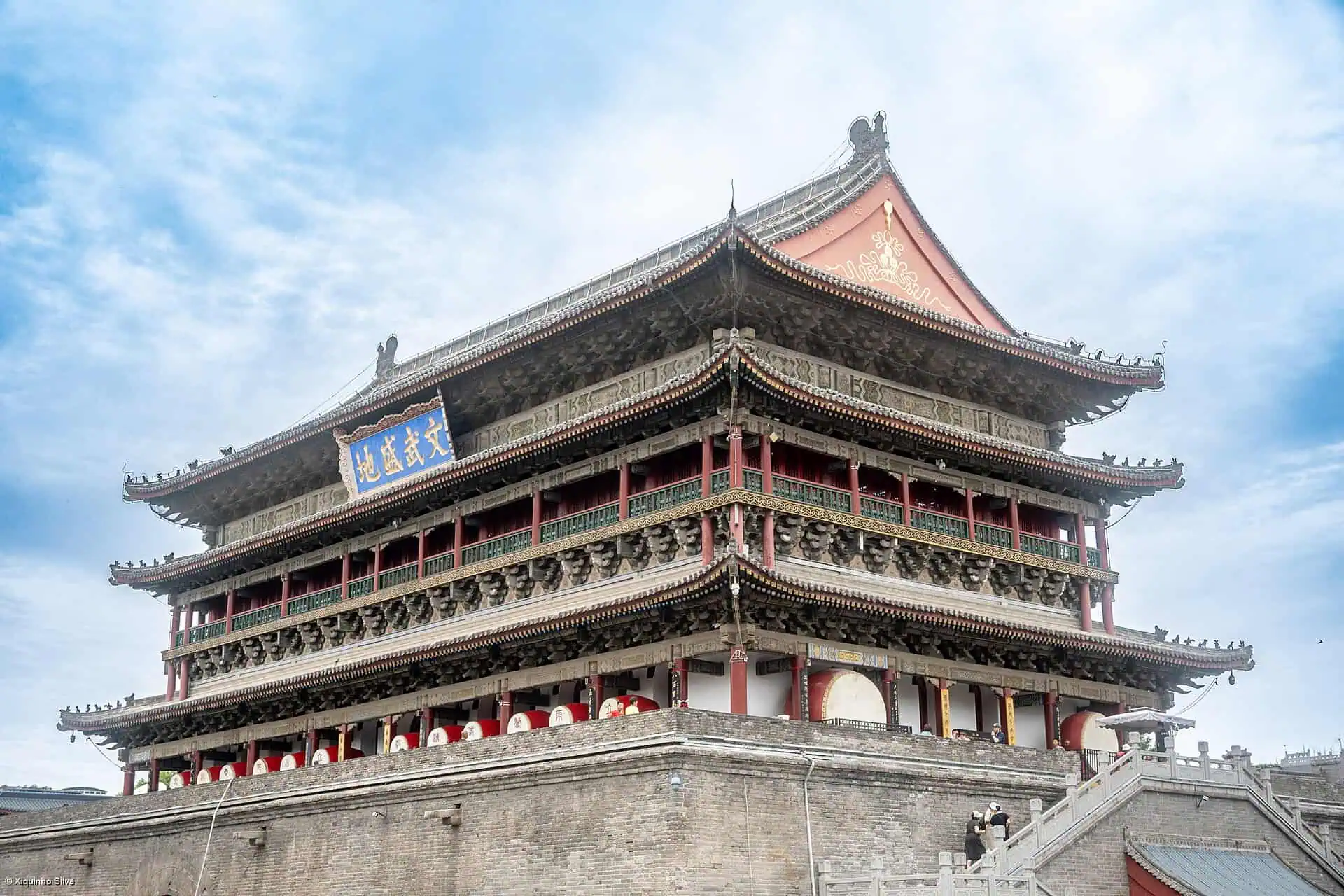
Built in 1380, four years before its famous sister — the tower whose drums closed every Xi'an day, and the gateway to the Muslim Quarter.
Learn more →
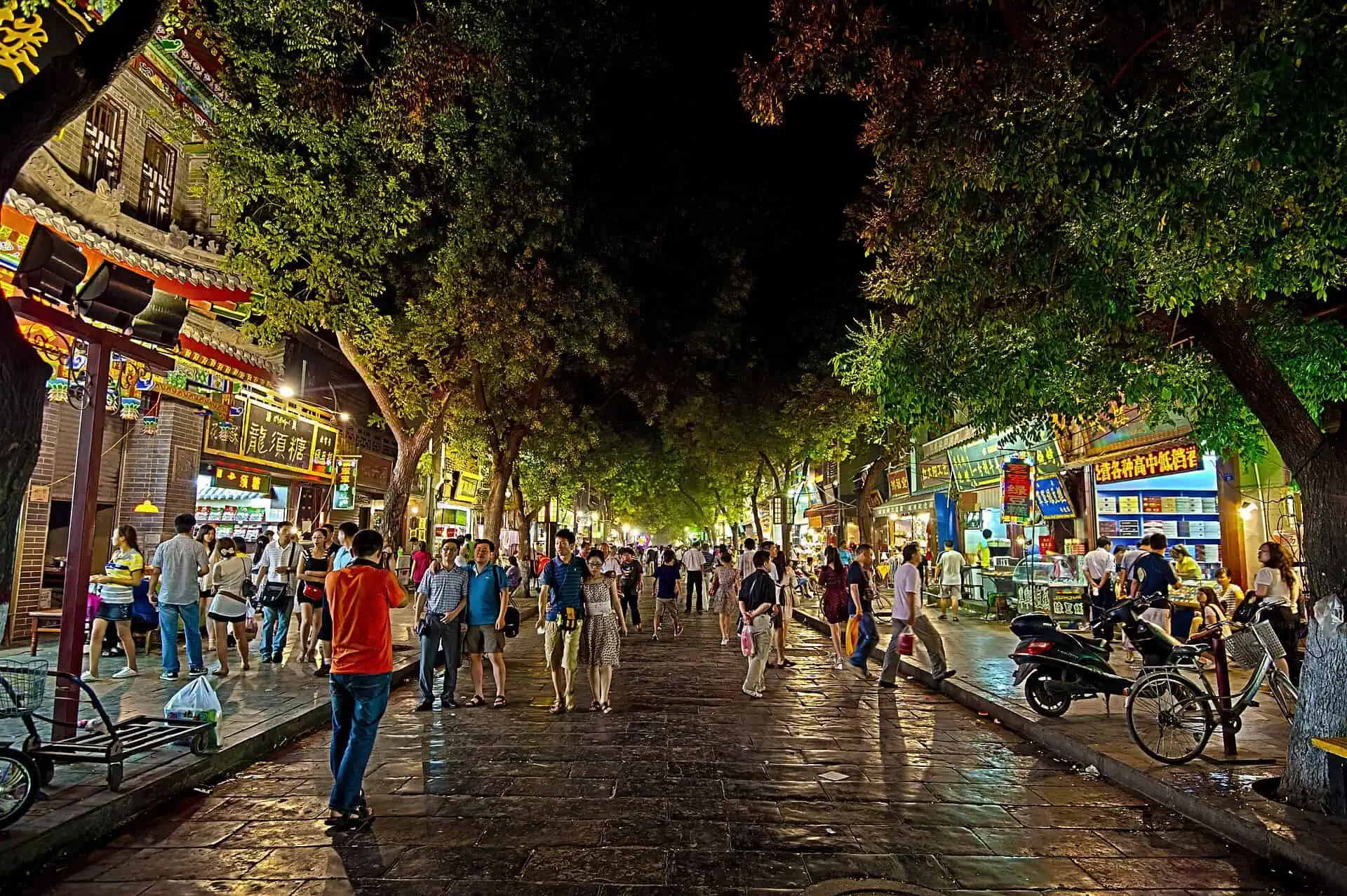
Muslim Quarter
Feeding Xi'an since the 700s — the loudest, smokiest, best-smelling streets of its Hui community.
Learn more →
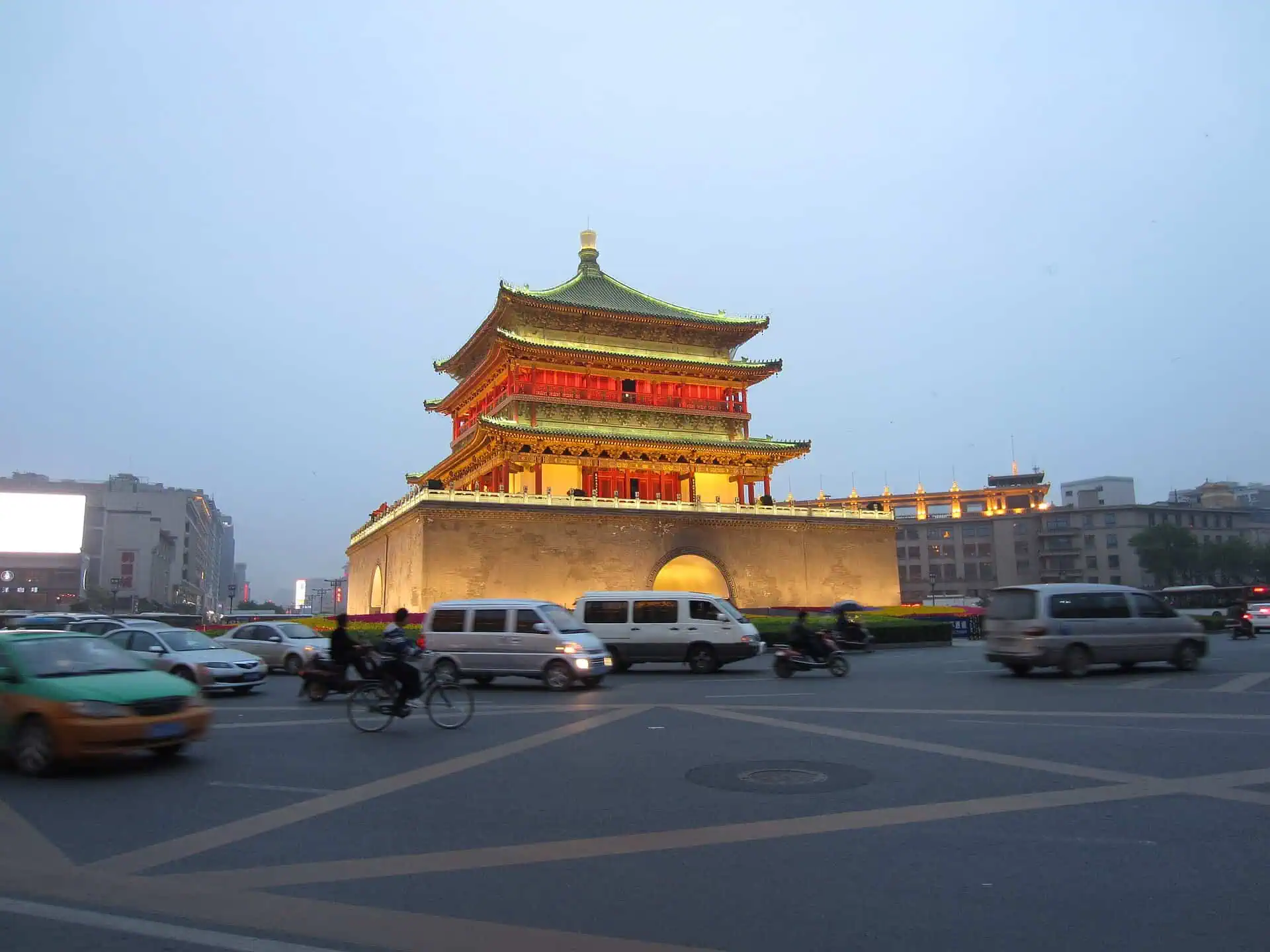
Xi'an Bell Tower
A Ming tower from 1384 at the dead center of the walled city — best admired at dusk, floodlit above the roundabout.
Learn more →