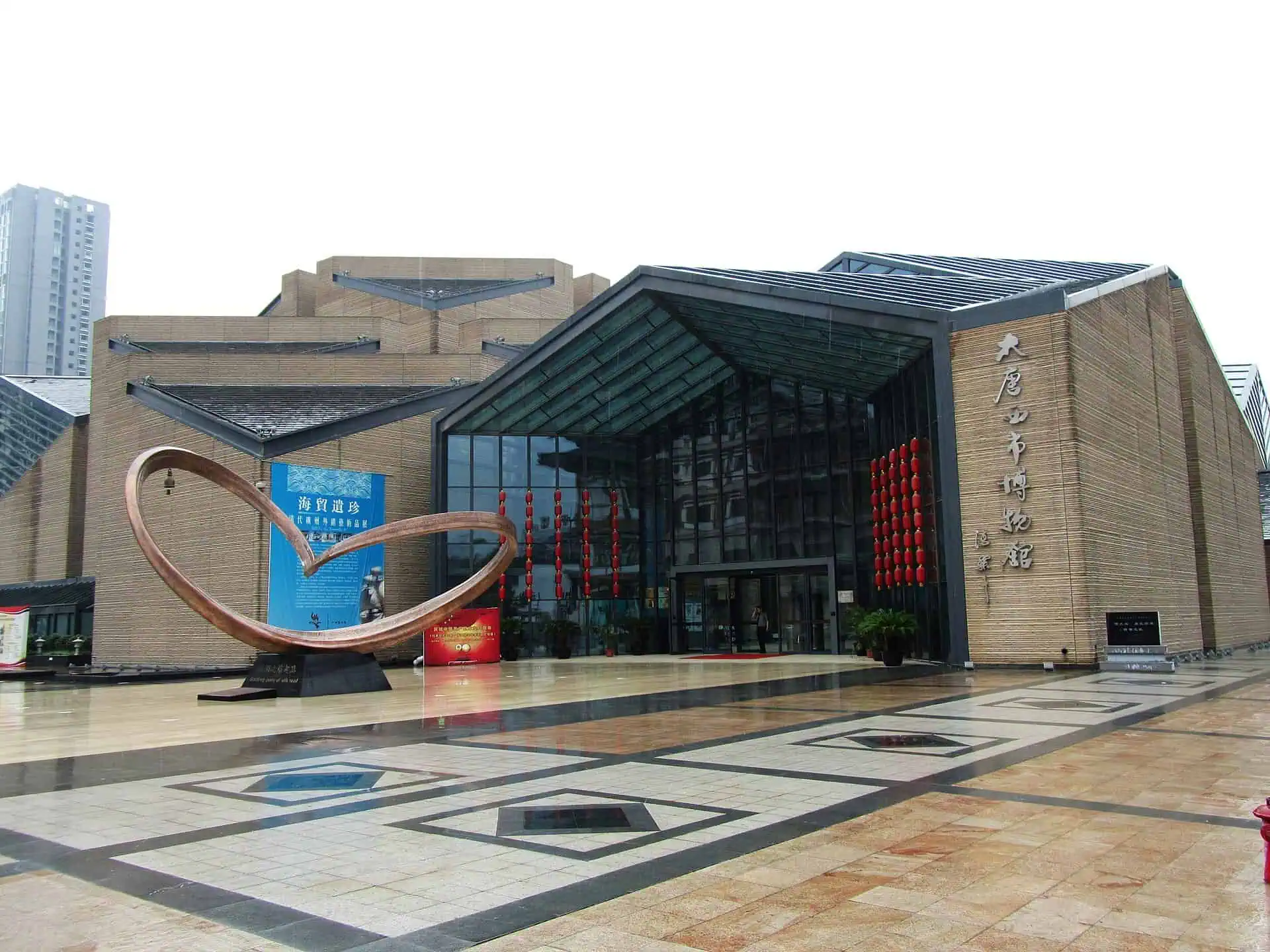
Tang West Market & Museum
Dàtáng Xīshì
On the buried ruins of Tang Chang'an's international Silk Road market — where the caravans, in theory, began.
Entry
From ¥60
Hours
Apr 1 – Oct 31 · 9:00
Time needed
1–1½ hours
Booking
Required
Metro
Line 6 · Tang West Market (大唐西市) · B1
The Tang West Market (大唐西市, Dàtáng Xīshì) sits on the buried remains of the West Market of Sui–Tang Chang'an — the trading quarter where Sogdian, Persian and Central Asian merchants did business and, by the museum's own claim, the eastern starting point of the Silk Road. The on-site museum over it (opened 2010, China's first private on-site museum and the first non-state museum rated national first-grade) glass-covers the excavated crossroads, road and drainage, then adds Tang ceramics, Silk Road coins and a Sogdian trader's epitaph. It's a niche complement for travelers already deep in Xi'an's Tang layer — skip it on a first visit in favour of the Shaanxi History Museum, and come if you have a free half-day and want the Silk Road told where it actually happened.
What you're looking at
Tang Chang'an ran on two markets. The East Market (东市) served the city's own households and workshops; the West Market (西市), a couple of kilometres southwest inside the city wall, was where the foreigners were — Sogdian and Persian traders bringing horses, jade, spices and glass in along the Silk Road and carrying silk and tea west. The West Market was the louder, international, after-dark one; Tang poets wrote about its crowds. When the Tang fell and the capital moved east in the 10th century, Chang'an's markets died and the West Market was buried under farmland.
In the 2000s a private developer began the modern Datang West Market complex on the site, and archaeology turned up the market itself: road surfaces, drainage runs, cart-rutted paving, shop foundations and the northeast crossroads. Rather than rebury it, the developer funded a museum over the top — the Tang West Market Museum (大唐西市博物馆), opened in 2010 and recognised as China's first private on-site museum. In 2017 it became the first non-state museum in the country to be rated national first-grade.
The permanent collection (floors 1–3, free with ID) is built around what came out of the ground: Tang ceramics, bronze mirrors, the camel figurines every Silk Road exhibition reaches for — and, the headline, the excavated crossroads and road themselves, under glass, at walking level. Look for the Sogdian merchant An Bei (安备): his tomb epitaph is held here, a direct document of the Iranian-speaking traders who ran the caravan trade. Up on floor 4 (a ¥60 add-on), rotating exhibitions stretch to a Silk Road ancient-coins gallery — more than 2,000 coins from some 48 ancient states strung along the route.
Visiting strategy
Honest verdict: this is a rewarding niche stop, not a first-visit must. If your Xi'an days still hold the Terracotta Army, the City Wall, the Muslim Quarter and the Shaanxi History Museum, the West Market can wait. Come back on a third visit, or on a half-day when you've ticked the headline Tang sites and want the Silk Road story told on the actual soil.
What earns the detour is the on-site ruin. Most museums show you objects; this one shows you the street the objects were sold on. The Shaanxi History Museum has the bigger, glossier Tang collection; the West Market has the crossroads. The two pair well if you're deep in the Tang layer, alongside Daming Palace and Xingqing Palace Park.
Timing. Allow 60–90 minutes. Go on a weekday morning when the ruins gallery is quiet. Mondays it shuts (except public holidays). The free floors need a timed slot and your passport; the ¥60 floor-4 show is optional.
The complex around it. The museum sits inside the modern Datang West Market (大唐西市) development — a Tang-themed cultural and commercial quarter with an antique market (大唐西市古玩城), teahouses, restaurants and Silk Road craft shops. It's a calmer, more curated counterpart to the spectacle of the Grand Tang Ever-Bright City; come for a slower Tang evening, not a performance.
Getting there
The museum sits southwest of the City Wall, in Lianhu District, a short walk from its own metro station.
- Metro: Line 6 to Tang West Market station (大唐西市), Exit B1, about 600 m on foot. Lines 5 and 6 to Northwestern Polytechnical University (西北工业大学) is roughly 800 m.
- Bus: routes 24, 43, 106, 107, 201, 322 and 503 all stop at the Datang West Market stop.
- Taxi/DiDi: ask for 大唐西市博物馆. See getting around Xi'an for metro-card basics.
Practical notes
- Reservation: the free permanent galleries need a timed slot with passport/ID — book on the museum's official WeChat account or at dtxsmuseum.com, or walk up with your passport on a quiet day. Floor 4 needs a ¥60 ticket.
- English: signage is thinner than at the big state museums; the Shaanxi History Museum is the better first stop if you read only English. Bring a translation app for object labels.
- Payment: WeChat Pay / Alipay at the desk is standard — see our money and payments guide.
- Photography: allowed in the permanent galleries, no flash; the in-situ ruins gallery photographs well.
- Crowds: a fraction of the Terracotta Army's — weekday mornings are near-empty, though school groups can roll through mid-morning.
- Pairing: a natural companion to the Great Mosque and the Muslim Quarter — together they trace the Silk Road's Central Asian and Muslim footprint across Tang and Ming Xi'an. The longer backstory is in our Hui community piece.
Questions, answered
Is the Tang West Market Museum worth visiting?
Only if you've already done the big Tang sights or you're specifically keen on the Silk Road. For most first-time visitors the Shaanxi History Museum covers more ground; the West Market wins on the in-situ ruin — the excavated crossroads and road under glass — and on the 'this is where it happened' factor.
How much does it cost to enter the Tang West Market Museum?
The permanent galleries on floors 1–3 are free with passport or Chinese ID and a timed reservation. The floor-4 special exhibition is around ¥60 as an optional add-on. Pricing policy has changed before, so confirm on dtxsmuseum.com before a dedicated trip.
What are the opening hours?
Roughly 9:00–17:30 from April to October and 9:00–17:00 from November to March, with last entry about an hour before close. Closed Mondays except public holidays, and closed on Chinese New Year's Eve.
How do I get to the Tang West Market Museum by metro?
Take Line 6 to Tang West Market station (大唐西市), Exit B1 — about a 600 m walk. Lines 5 and 6 to Northwestern Polytechnical University (西北工业大学) station is a similar distance, around 800 m.
What is special about the Tang West Market site?
It's the buried remains of the West Market of Sui–Tang Chang'an, the international trading quarter where Sogdian and Persian Silk Road merchants worked. The museum is built directly over the excavated northeast crossroads, road surface and drainage, so you look at the actual paving and cart ruts, not just objects in cases.
How long should I spend at the Tang West Market Museum?
Allow 60–90 minutes for the permanent galleries and the in-situ ruins. Add roughly 30 minutes if you pay for the floor-4 special exhibition.
Keep exploring
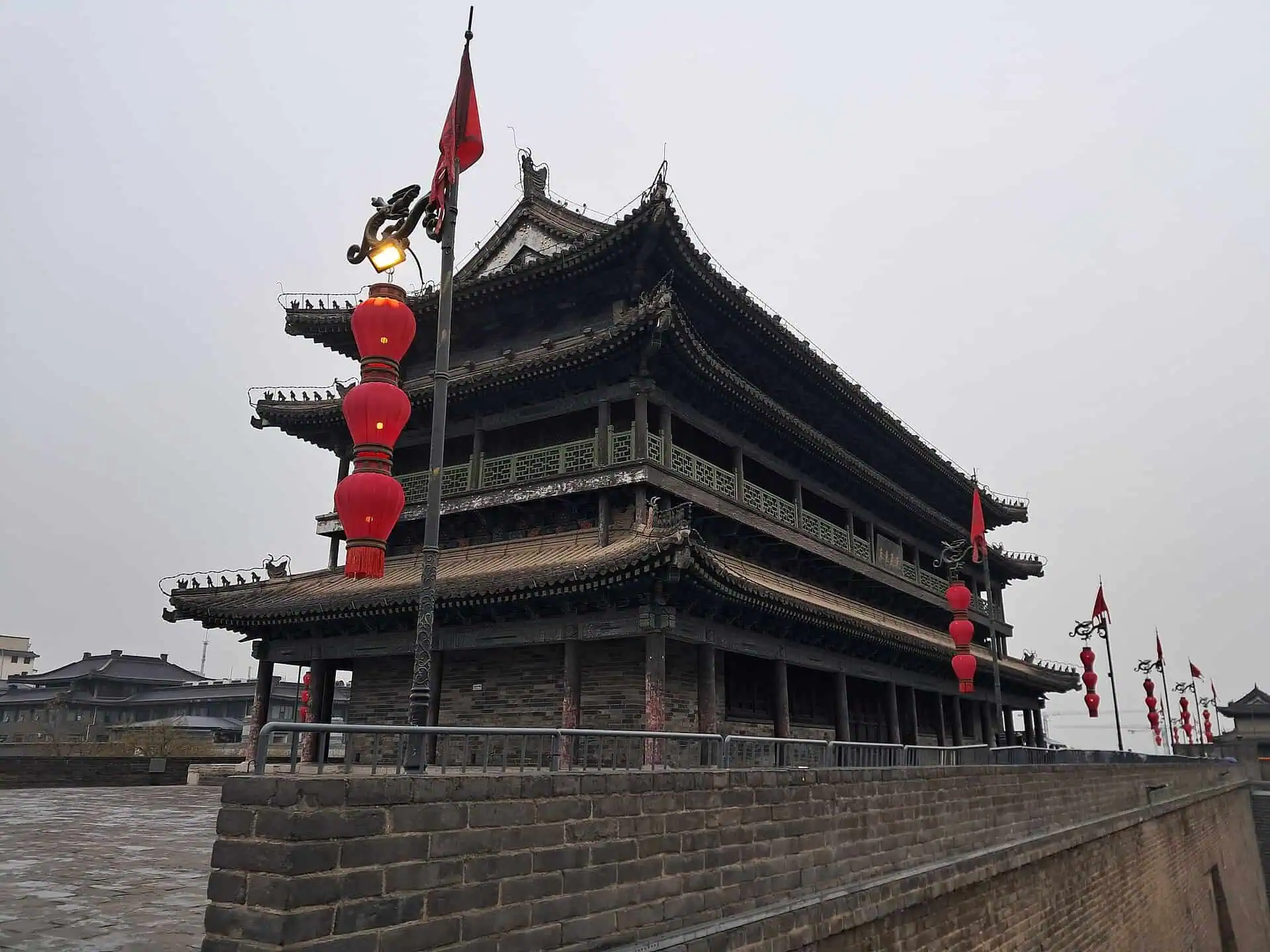
Xi'an City Wall
A 14-kilometer Ming dynasty rectangle you can cycle on top of — 650 years old and still the city's favorite commute.
Learn more →
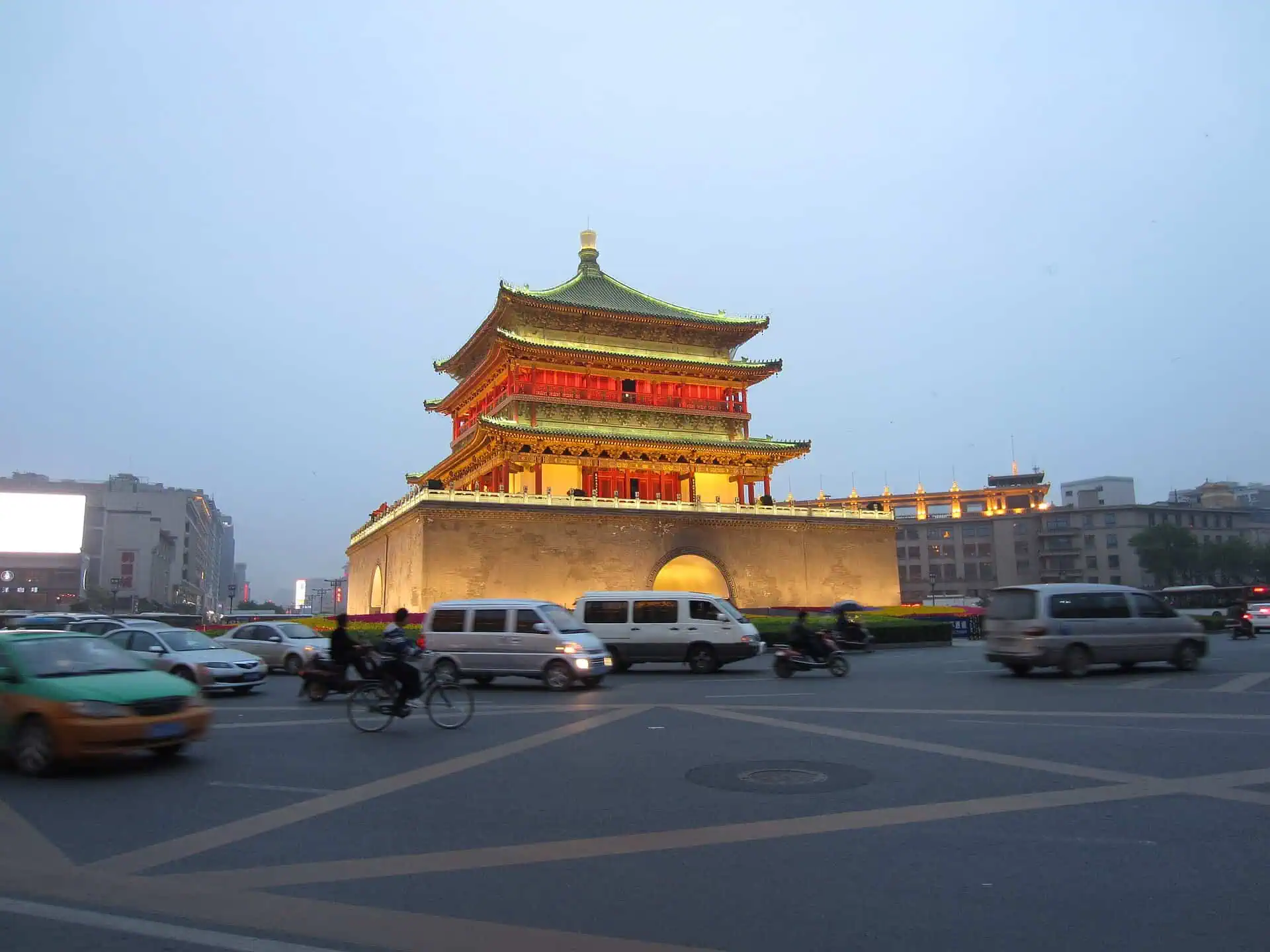
Xi'an Bell Tower
A Ming tower from 1384 at the dead center of the walled city — best admired at dusk, floodlit above the roundabout.
Learn more →
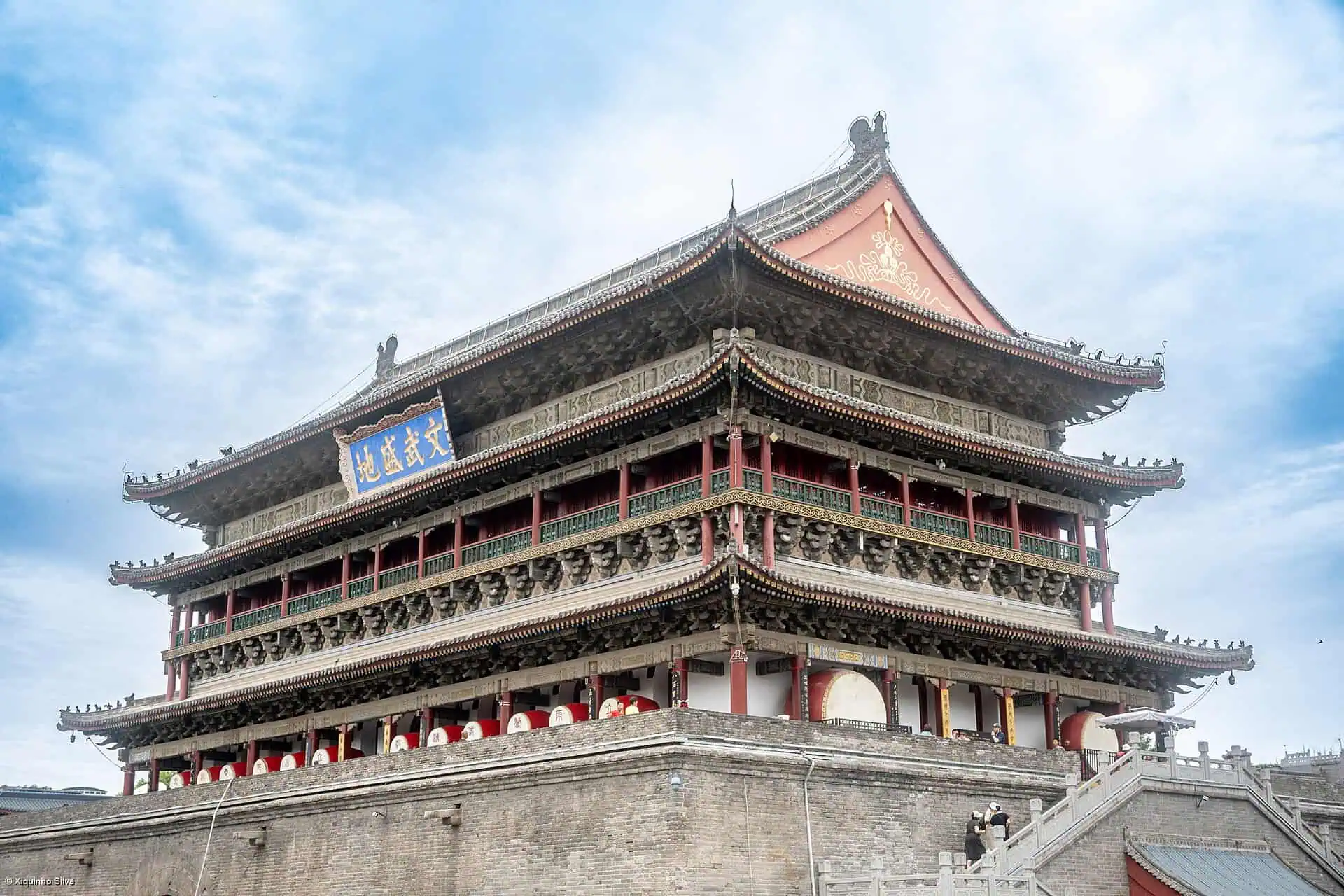
Xi'an Drum Tower
Built in 1380, four years before its famous sister — the tower whose drums closed every Xi'an day, and the gateway to the Muslim Quarter.
Learn more →
On video
Xi'an on video
What this place looks like on video.